
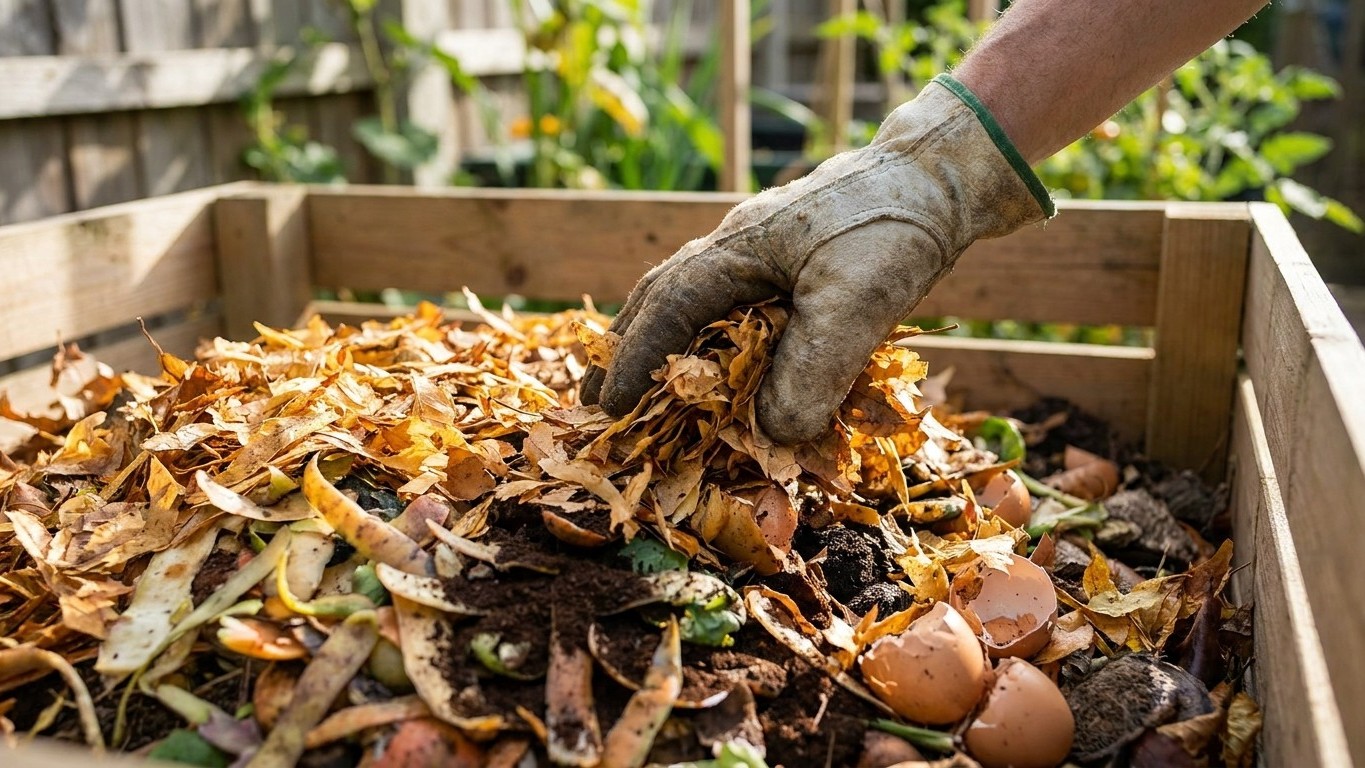
One bucket of shredded leaves changed everything about that compost pile. No more clouds of fruit flies hovering over the garden table at dinner. No more that sour, ammonia-tinged smell that made everyone wrinkle their nose walking past the bin. Just a simple brown layer tossed on top of the scraps, and the whole ecosystem around that pile shifted almost overnight.
This isn’t a fluke or a lucky coincidence. It’s basic compost chemistry, and it explains why so many backyard composters fight the same battle every summer without knowing the fix was sitting in their yard the whole time.
Key takeaways
- Fresh food scraps alone create a fly-magnet buffet—but one simple layer changes everything
- The real science: it’s not about luck, it’s about a ratio most gardeners get wrong
- Your autumn leaf pile isn’t waste to haul away—it’s next season’s odor control sitting on the lawn
Why food scraps alone practically invite flies
Kitchen scraps are what composters call “greens”: nitrogen-rich, wet, and, left uncovered, irresistible to insects. Carrying a bowl of scraps out and tipping it onto an open pile leaves that material sitting in open air, ripening in the sun and turning into a visible, smellable buffet for flies during the day. The odor isn’t just unpleasant for whoever walks by. The smell of decomposing food is a homing beacon, and flies lay eggs in wet, fermenting material while the odor advertises the location to every nose in the neighborhood.
The science behind this comes down to a ratio most gardeners have heard of but rarely apply correctly. Too many nitrogen-rich greens without enough carbon-rich browns is the root cause behind most wet, stinky, fly-ridden piles, since composting microbes work best around a carbon-to-nitrogen ratio of roughly 25 to 30 to 1. Dried leaves, it turns out, sit at roughly 60:1 on their own, which is exactly why they’re such an effective counterweight to something like vegetable peelings, sitting closer to 25:1 in nitrogen content.
When that balance tips too far toward the green side, the pile doesn’t just smell bad, it actively fails. When you dump in too many greens without enough browns to balance them, the excess nitrogen gets released as ammonia gas, the sharp, acrid smell that makes neighbors complain. Add moisture to that mix and you’ve built the perfect breeding chamber. Too many greens turn a pile into a wet, smelly mess with an overwhelming amount of larvae.
What actually happens when leaves go on top
The fix works on two levels at once, which is why the results feel almost immediate. First, there’s the physical barrier. One of the simplest ways to discourage fruit flies is by covering fresh food scraps with a layer of brown materials such as dry leaves, shredded paper, straw, or cardboard. A fly can’t lay eggs on food it can’t reach, and a few inches of dry leaf litter does exactly that job.
Second, and more importantly for the long game, dried leaves pull moisture out of the equation. Layering dry brown materials like shredded cardboard, dry leaves, straw, and paper against wet food waste means these carbon sources absorb moisture, reduce odors, and create a drier surface that discourages fly larvae. Maggots and fly larvae need a damp, oxygen-poor environment to thrive. Dry carbon material breaks that environment apart from the inside.
There’s also a chemistry shift happening that most people never see. Mixing scraps with carbon-rich browns and enough air lets bacteria and fungi work fast and turn waste into compost instead of sludge, which reduces smell, keeps flies down, and creates a soil amendment that improves drainage, water retention, and root growth. Without that carbon boost, the same organic matter just sits there fermenting instead of actually composting, which is the difference between a pile that smells like a farm and one that smells like nothing at all.
Getting the ratio right without a science degree
Nobody needs a lab scale to pull this off. The rule of thumb that most experienced composters lean on translates the technical carbon-to-nitrogen math into something you can eyeball with a bucket. The optimal mix falls somewhere between 20:1 and 30:1 in the lab, which in backyard terms usually means about three to four times more browns than greens by volume.
In practice, that means keeping a stash of shredded leaves within arm’s reach of wherever scraps get dumped, and using it every single time, not just when the smell gets bad. Covering every scrap layer with browns, topping each addition of kitchen waste with at least twice as much brown material by volume, works out to roughly one bucket of scraps covered by two to three buckets of shredded cardboard or dry leaves. That’s a lot of leaves, and it’s exactly why fall cleanup season, when yards are drowning in them anyway, is the best time to stockpile a season’s worth in a dry bag or bin.
Texture matters just as much as ratio. Grabbing a handful of the pile and squeezing it should feel moist and spring back, without any water dripping out. If it feels bone dry, it needs a splash of water. If it feels swampy, that’s the leaves’ cue to come out again. Turning the pile to get oxygen in and mixing in dry brown material until the texture resembles a wrung-out sponge is enough, since a healthy aerobic pile produces almost no odor at all.
Beyond just leaves: building a fly-free habit
Shredded leaves are the easiest fix precisely because they’re free, already sitting in most yards every autumn, and require zero shopping trip. But they work best as part of a small routine rather than a one-time save. Burying fresh scraps rather than just topping them, mixing occasionally instead of letting layers sit undisturbed, and keeping meat, dairy, and oily leftovers out of the mix entirely all reinforce what the leaves are already doing.
What’s genuinely surprising is how forgiving compost becomes once that carbon buffer is in place. A pile that used to demand vinegar traps and constant lid-checking can go weeks without a single fly, purely because the smell that summoned them in the first place never gets the chance to build. Worth remembering next time the rake comes out this fall: those leaf piles aren’t yard waste to bag and haul away. They’re next year’s odor control, sitting right there on the lawn.
Sources : davidwilliamrosales.com | touchwoodeditions.com