
Late summer Strawberry beds across the country are getting the same treatment: gardeners grabbing shears or firing up the mower, ready to strip every leaf down to a stubble. It feels productive. It looks tidy. And for June-bearing varieties done fruiting, it’s often the right instinct at the wrong moment or with the wrong technique. The difference between a strawberry patch that explodes with fruit next spring and one that limps back weak (or doesn’t return at all) comes down to a single glance most people skip entirely.
Key takeaways
- There’s a hidden growth point on every strawberry plant that regenerates entire leaf canopies—but it cannot regrow itself
- The difference between thriving plants and dead ones is measured in inches, and timing matters as much as height
- Most gardeners are cutting at exactly the wrong time, destroying flower buds they can’t even see yet
The check that takes one second and saves the plant
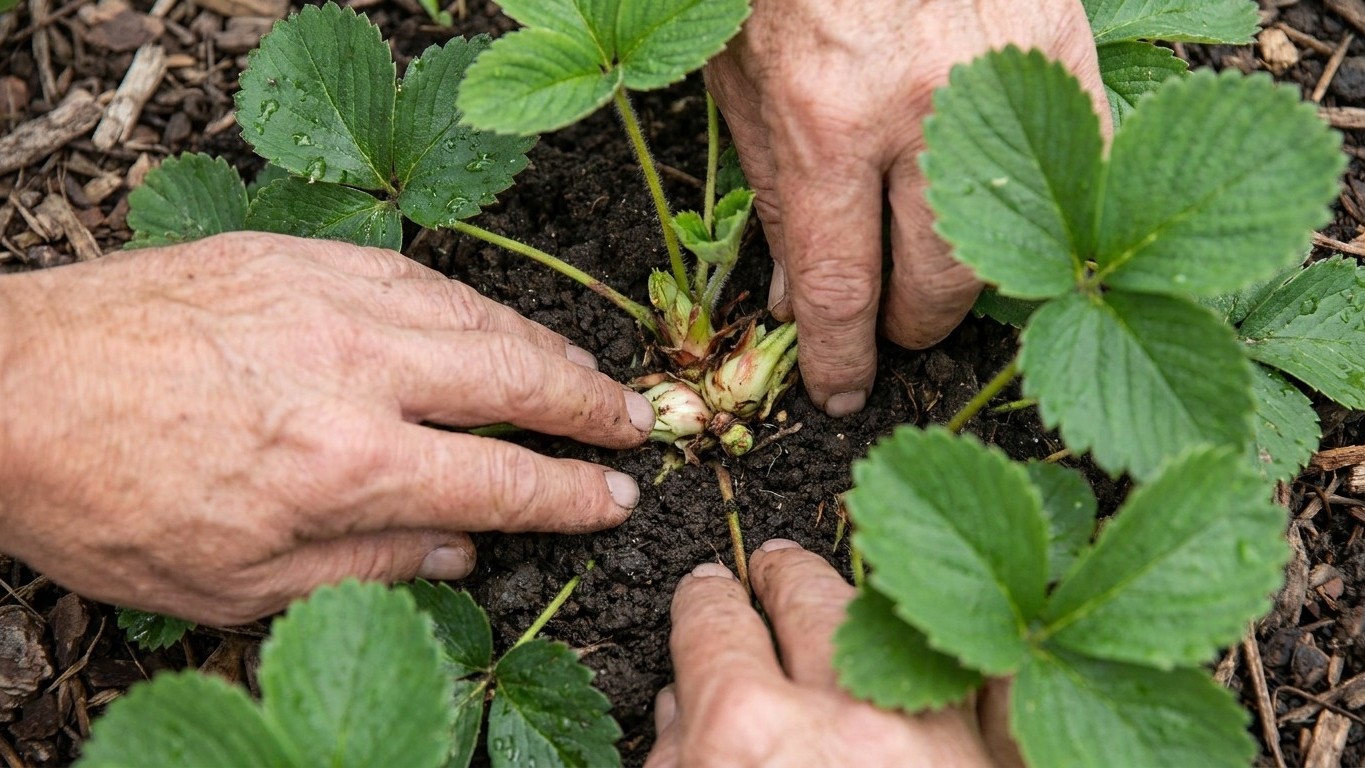
Before any blade touches a strawberry plant, find the crown. That’s the thick, compressed stem sitting right at soil level where every leaf, runner, and future flower stalk originates. The first step in renovation is to mow or cut the foliage down, leaving the plant crowns, the compressed stem where leaves and flowers emerge, undamaged. Miss that check, cut too low, and you’re not pruning anymore. You’re amputating the plant’s only growth point.
The margin for error is smaller than most people assume. If you accidentally cut into the crown, you’ve potentially killed that plant. That’s not an exaggeration for effect, it’s the literal mechanism of failure. A strawberry plant can regrow an entire canopy of leaves from a healthy crown in a matter of weeks. It cannot regrow a crown. So the rule That Matters More Than any calendar date is height: this cut should be made about one to three inches above the crown to remove the majority of the old leaves without harming the growth point. Extension researchers at the University of Minnesota land closer to the conservative end of that range, recommending growers mow off the old strawberry leaves, about two inches above the crowns, a height recommended in order to prevent damage to the strawberry crown.
Why timing is the second half of the equation
Height alone doesn’t tell the whole story. When you cut matters almost as much as how close you cut. This renovation technique only applies to June-bearing strawberries, the type that produces one big harvest and then goes dormant for the rest of the summer. Everbearing and day-neutral varieties operate on a completely different clock, and treating them the same way is one of the more expensive mistakes a home gardener can make. Mowing everbearing or day-neutral strawberries will cut off fruiting buds and get almost no berries next year. If your plants have been producing smaller batches of berries all summer rather than one concentrated flush in June, put the mower away and just snip off damaged or diseased leaves as you spot them.
For the June-bearing plants that do call for renovation, the clock started ticking the moment the last berry came off the vine. It is best to mow strawberry plants within one week after they produce their last harvest, since mowing later than this week will likely result in damage to new foliar growth. By early August in most of the country, that window has already closed. No strawberry plants should be mowed after the first day of August, because flower buds begin forming around the middle of August across most of the United States, and overhead strawberry leaves are needed. Cut a plant back hard in mid-August instead of July, and you’re not renovating it. You’re stripping away the exact foliage it needs to build the flower buds that become next year’s fruit.
Peer-reviewed research backs up why the early end of that window produces the best results. A 2025 study published in the European Journal of Horticultural Science found that the earliest mowing at the end of July reduced crown branching and increased the number of flowers in the inflorescence. The same researchers noted a genuine trade-off worth knowing about: mowing may also decrease the number of flowers and fruit per plant and thereby increase fruit size. In plain terms, cutting early tends to trade a higher count of small berries for fewer, bigger ones. Neither outcome is wrong, but it’s worth knowing which one you’re steering toward.
What comes right after the cut
The mowing or shearing is only step one. Leaving clippings scattered across the bed undoes most of the disease-prevention benefit you just earned. That debris is full of fungal spores and pest eggs, and composting it would re-infect the bed. Rake it out completely and bag it or discard it away from the growing area rather than tossing it on the compost pile.
With the bed cleared, thin the row while you can still see what you’re working with. Overcrowded crowns compete for light, water, and nutrients, which is exactly the opposite of what you want heading into fall bud formation. Take a garden fork and narrow the rows to 12 to 18 inches wide, giving remaining plants a fist’s width of space between crowns. Anything with a dark, woody crown or spotted leaves should go straight into the trash, not the compost bin, since diseased material can reinfect healthy soil later.
Feed and water immediately after. Apply a balanced granular fertilizer, such as a 10-10-10 blend, at around five pounds per 100 feet of row, to encourage rapid regrowth of leaves and support the initiation of flower buds for the following year. Skip the water and the fertilizer just sits on top of dry soil doing nothing. Thorough watering is necessary immediately after any significant trimming, since deep irrigation supports the recovery process and helps the newly applied fertilizer move into the root zone. Most extension guides land on roughly one inch of water per week during the regrowth phase that follows, whether that comes from rainfall or a hose.
None of this is glamorous work. There’s no dramatic before-and-after photo moment while you’re kneeling in dirt checking crown height with your fingers. But that quiet, unphotogenic five minutes spent looking before cutting is the entire difference between a strawberry bed that rewards you again next June and one you’ll be replanting from scratch.
Sources : positivebloom.com | doaj.org