
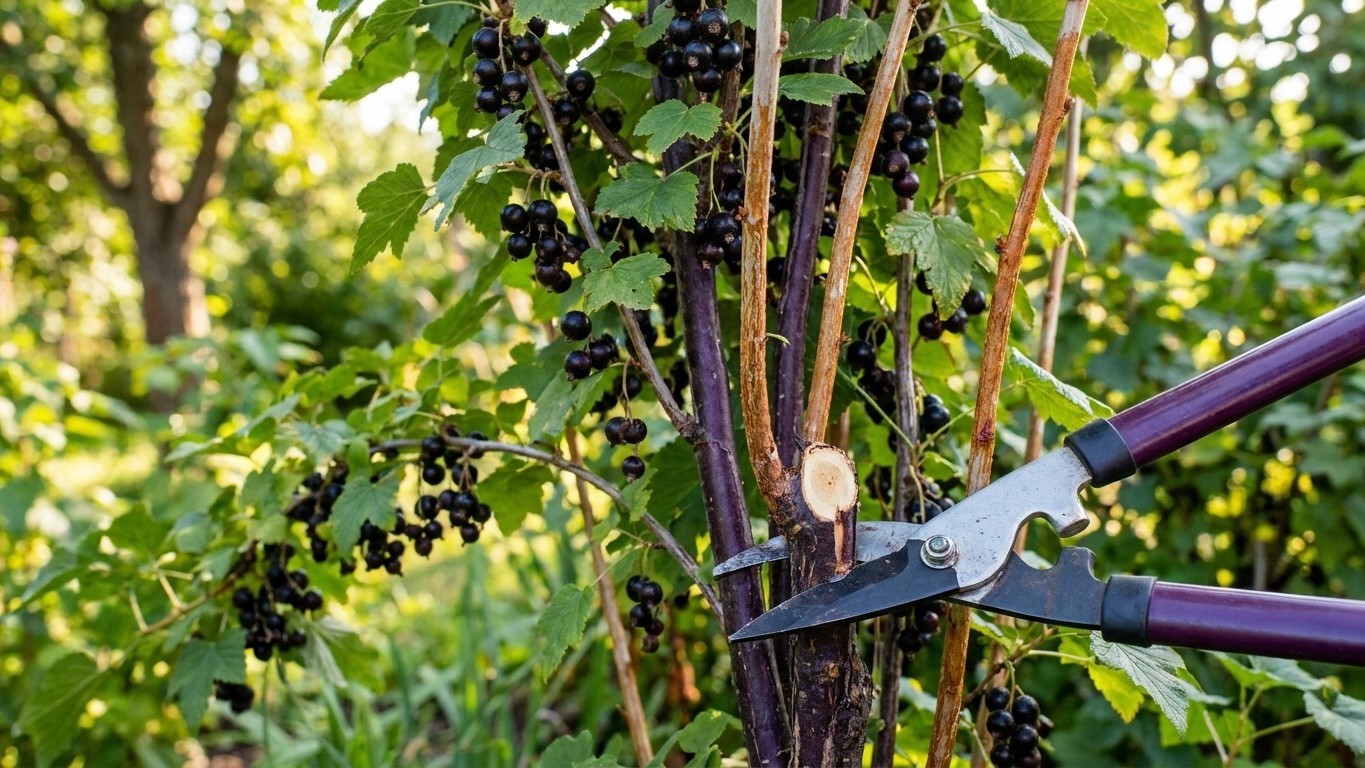
He waits until the last currant is in the bucket, then walks the row with loppers and takes out exactly three of the oldest branches, cuts them flush at the base, and stacks them like firewood. No trimming, no shaping, no tidying up loose ends. What he’s actually doing is running a fruit factory reset button, and the timing is the whole trick.
Blackcurrants don’t behave like most fruiting shrubs. Pruning currants makes a wickedest difference to the amount and quality of fruit because the fruits come on young wood, and left unpruned, the harvests become increasingly pathetic with too much old unproductive wood. That’s the part most backyard growers never quite absorb: a blackcurrant bush isn’t like an apple tree that gets better with age. It’s more like a factory floor where the machinery on the far end has already stopped producing anything worth collecting.
Key takeaways
- A gardener removes three old branches immediately after harvesting—but the reason has nothing to do with tidying up
- Blackcurrants fruit on young wood, not old growth, which means the pruning strategy most gardeners use is backwards
- Pruning right after picking—not in winter—lets you see which branches are exhausted before they disguise themselves
Why the oldest wood has to go, not the messy wood
The instinct when you look at a currant bush is to remove whatever looks scraggly or crossed or in the way. That’s not what’s happening here. Blackcurrants fruit best on strong, young growth made in the previous few years, so the aim of pruning is to remove some of the oldest, least productive stems each year and encourage new ones to sprout from the base. The Royal Horticultural Society is specific about the scale of that removal too: established bushes, aged four years or older, are best pruned every winter to keep them fruiting strongly, and the process is simple, cutting out up to a third of the oldest stems down to the base.
Identifying which branches qualify isn’t guesswork either. Blackcurrants crop best on vigorous two and three year old stems, and two-year-old wood tends to be grey in color, whereas the new shoots are rusty brown. The oldest offenders stand out even more clearly once you know what you’re looking for. These can be recognised from their darker bark which is a deep purple in colour, almost to the point of being black. Three branches, cut right at the point where they meet the soil, is a modest, controlled dose for a mature bush rather than a random hack job.
Right after picking beats waiting for winter
Most pruning guides tell you to wait for dormancy, sometime between November and February. That’s not wrong, exactly, but it misses a shortcut that experienced growers rely on. To avoid confusion between new and fruited canes, remove old growth straight after harvesting and tie the new growth to supportive wires or canes. In winter, once the leaves have dropped, every stem looks the same shade of brown and you’re left squinting at bark texture to guess a branch’s age. Right after picking, the fruited wood is still obvious, sagging, stripped bare, often with the papery remains of old fruit stalks clinging to it.
One gardening resource put it plainly: until you get used to how the old wood looks, it may be easier to prune branches out immediately after harvest in summer, removing the branches with the heavy crops and leaving the branches with light crops. That’s the logic behind the neighbor’s ritual. He’s not being lazy about winter pruning, he’s using the harvest itself as a map, marking the exhausted wood while it’s still holding evidence of what it just gave up.
What actually happens inside the bush after the cut
Removing that old wood isn’t cosmetic. It changes where the plant sends its energy for the following year. If a black currant grows without pruning, it puts too much of its energy into growing old wood, which means the fruit-bearing two-year-old wood ends up comprising only a very small part of the plant. Cut the tired branches now, and the roots redirect that stored energy into fresh shoots pushing up from the base over the following spring, shoots that will carry the heaviest crop two summers from now.
There’s a structural payoff too. Fewer old, thick stems means more light and air moving through the middle of the bush, which matters more than people assume for a plant prone to mildew in a damp season. Blackcurrants are usually grown as multi-stemmed bushes, with an open structure of 6–10 upright stems growing from the base, and every gnarly old branch left in place is one less gap for sunlight to reach the ripening fruit underneath.
Don’t overdo it, and don’t touch the young stuff
The temptation once you start cutting is to keep going. Resist it. The one-third pruning rule caps things at removing up to 30 percent of any wood from an established bush in a single season. Go further than that and you’re not rejuvenating the plant, you’re stressing it for no gain. Three branches on a modest, mature bush usually lands comfortably inside that limit without needing a tape measure.
Younger plants get a pass entirely. Newly bought blackcurrants, if planted while dormant, should be pruned straight after planting by cutting all the stems down to one or two buds above ground level, and after that initial hard cut, they need almost nothing for the next couple of seasons while they build their framework. The three-branch ritual is strictly a mature-bush habit, something you earn after the plant has had three or four years to establish a real root system worth protecting.
One detail that trips people up: never shorten the remaining branches to tidy the silhouette. Don’t head back or shorten anything on a blackcurrant unless one branch is racing ahead of the others, in which case head it back to a similar length to create a balanced shrub. Everything else stays exactly as it grew. The neighbor’s whole system depends on that restraint, three cuts at the base, nothing more, and letting the plant do the rest of the work on its own schedule.
Sources : idealhome.co.uk | gardeningetc.com