
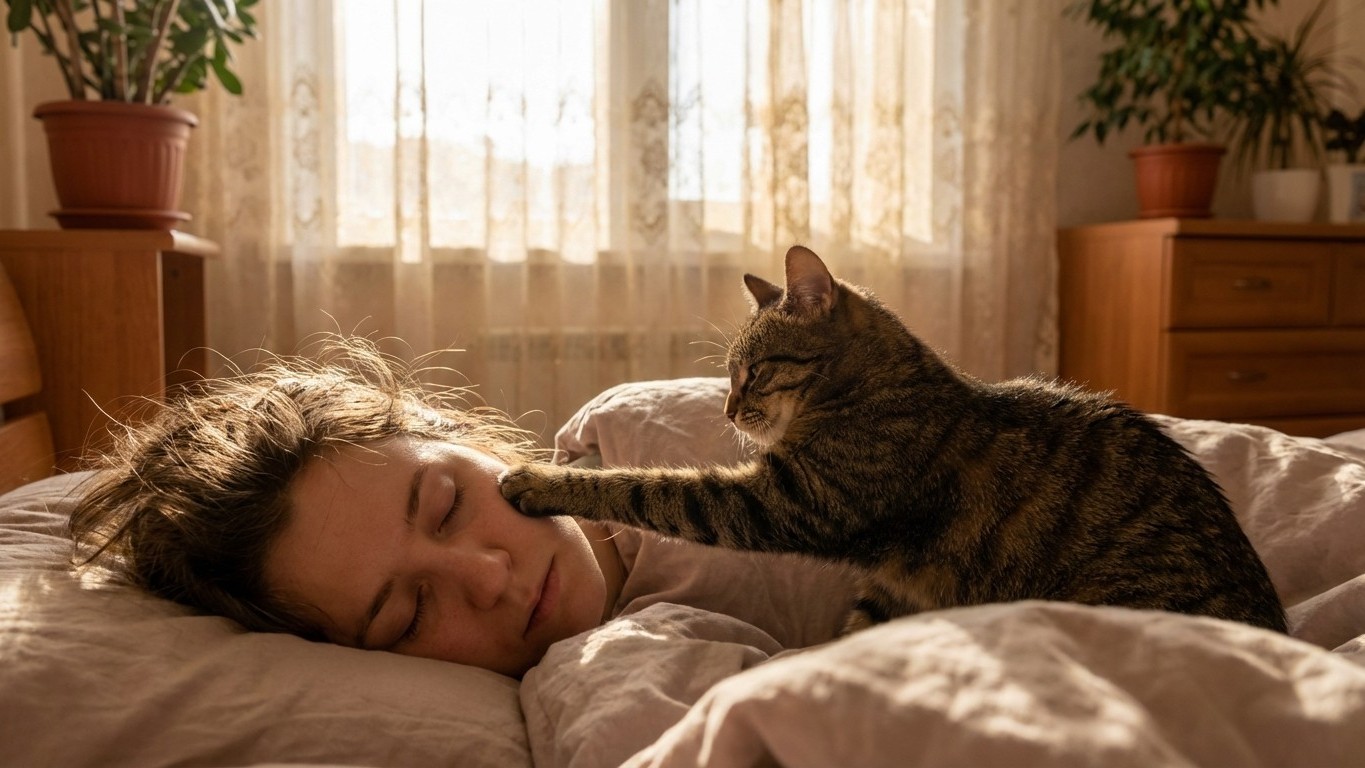
That insistent paw tapping your face, the persistent meowing, or the sudden weight landing on your chest – if your feline companion has turned into a furry alarm clock with impeccable timing, you’re not alone. Millions of cat parents worldwide share this bewildering experience of being awakened at almost identical times each morning, often wondering if their cats have somehow synchronized their internal clocks to torment sleepy humans.
The truth behind these morning wake-up calls reveals a fascinating glimpse into feline psychology, biology, and their deep connection to both natural rhythms and human routines. Far from being random acts of mischief, your cat’s precise timing stems from a complex interplay of evolutionary instincts, learned behaviors, and their remarkable ability to read environmental cues that we often overlook.
The Ancient Hunter’s Clock Still Ticks
Your domesticated companion carries within them the same biological programming that guided their wild ancestors through thousands of years of survival. Cats are naturally crepuscular creatures, meaning they’re most active during dawn and dusk – the optimal hunting times when prey animals are most vulnerable. This evolutionary inheritance explains why Your Cat seems to come alive just as you’re settling into your deepest sleep phases.
The consistency of your cat’s wake-up time reflects their internal circadian rhythm, which operates on roughly a 24-hour cycle but can be influenced by external factors. Unlike humans, who have largely adapted to artificial lighting and modern schedules, cats remain closely attuned to natural light patterns. As dawn approaches, even the subtle increase in ambient light triggers hormonal changes that activate their hunting instincts, translating into the urgent need to patrol their territory – which happens to include your bedroom.
This biological imperative becomes particularly pronounced because your cat recognizes you as part of their social group. In multi-cat households or feral colonies, cats often coordinate their activities, with dominant members initiating group movements. Your cat may be attempting to rally their ‘pride’ – consisting of you and other household members – for the day’s activities, viewing themselves as the responsible party leader ensuring everyone is alert and ready.
Reading the Invisible Schedule
Cats possess an extraordinary ability to detect patterns and environmental cues that escape human attention. Your feline friend has likely mapped your household’s rhythm with scientific precision, noting when Heating systems activate, when the first neighbor leaves for work, or when garbage trucks begin their routes. These consistent external markers become anchors for their internal timing system, explaining why they wake you at such specific times.
The remarkable consistency – like that precise 5:47 AM wake-up call – often correlates with household routines you may not even consciously recognize. Perhaps this is when your coffee maker’s automatic timer activates, creating subtle sounds and vibrations. Maybe it’s when the house’s heating system cycles on, or when early commuters begin passing by your home. Your cat processes these environmental changes as signals that the household should transition from rest to activity mode.
Additionally, cats can detect physiological changes in their sleeping humans. As you naturally transition through sleep cycles, your breathing patterns, body temperature, and even scent change slightly. Cats, with their heightened senses, recognize when you’re entering lighter sleep phases and seize these moments as optimal times for interaction, knowing you’re more likely to respond to their requests.
The Language of Morning Demands
Your cat’s morning behavior serves multiple communicative purposes beyond simple attention-seeking. Each action – whether it’s the gentle head bonk, the insistent paw tap, or the strategic positioning on your chest – carries specific meaning within feline communication protocols. These behaviors represent your cat’s attempt to engage you in essential daily rituals that strengthen your bond and address their immediate needs.
The persistence of these wake-up calls often intensifies because cats quickly learn which techniques successfully rouse their humans. If Gentle purring doesn’t work, they escalate to more assertive methods, developing a repertoire of increasingly effective strategies. This learned behavior becomes self-reinforcing as your eventual response – whether it’s feeding them, opening doors, or simply acknowledging their presence – validates their approach and encourages repetition.
For many cats, these morning interactions represent quality bonding time when their human is most accessible. During busy days, you might be preoccupied with work, chores, or other activities. But in those quiet morning moments, your cat has your undivided attention, making this timing particularly rewarding from their perspective. They’re not just demanding food or access – they’re seeking connection and reassurance that you’re present and responsive to their needs.
Transforming Morning Conflicts into Harmony
Understanding the underlying motivations behind your cat’s morning routine opens pathways to more harmonious coexistence. Rather than viewing these wake-up calls as disruptive behavior, recognizing them as natural expressions of feline biology and social bonding can help you develop strategies that satisfy both your cat’s needs and your own sleep requirements.
The key lies in working with your cat’s natural rhythms rather than against them. Consider adjusting feeding schedules to provide a satisfying late-evening meal that sustains them through early morning hours, or creating enriching evening activities that help expend their energy before bedtime. Environmental modifications, such as providing engaging early morning entertainment options or comfortable alternative sleeping areas, can redirect their attention away from your bedroom.
Most importantly, consistency in your responses helps establish clear boundaries and expectations. Whether you choose to accommodate their morning routine or gradually shift it to better align with your schedule, maintaining predictable patterns helps your cat adjust their internal clock accordingly. Remember that behind every persistent paw tap and insistent meow lies a cat simply trying to communicate their needs and maintain the social bonds that make your relationship so special.