
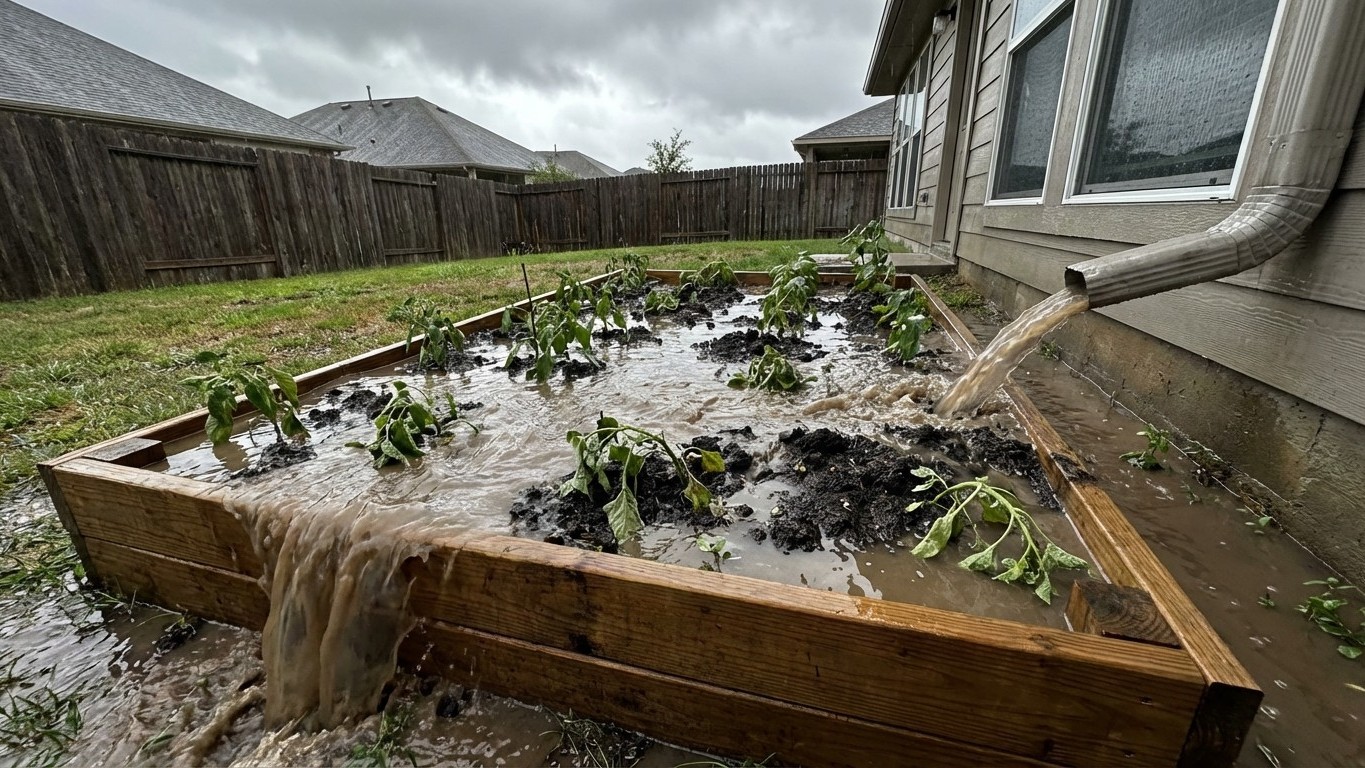
One morning last spring, a neighbor walked out to his backyard after a heavy rain to find his raised bed looking less like a vegetable garden and more like a rice paddy. Floating on top: two newly transplanted tomato seedlings, a handful of pepper starts, and about six weeks of hopeful planning. The culprit wasn’t a broken hose or a faulty irrigation system. It was a single downspout, a short length of flexible tubing, and a slope calculation he’d never actually made.
Connecting a gutter downspout directly to a raised bed sounds, on paper, like brilliant water conservation. You capture rainwater exactly where it falls, redirect it straight to your plants, and skip the watering can entirely. The logic is clean. The execution, unfortunately, is where things go sideways, sometimes literally.
Key takeaways
- A moderate rainfall can send 935 gallons of roof runoff toward a single downspout—far more than any raised bed can absorb
- The slope between your gutter and garden matters completely differently than you’d think, and getting it wrong creates erosion channels through your soil
- Two simple additions—a rain barrel buffer and proper drainage infrastructure—transform a flood risk into a reliable irrigation system
The slope problem nobody talks about
Here’s what most DIY guides leave out: gutters and raised beds operate on completely different hydraulic principles. A gutter is designed to move water fast, carrying runoff from your entire roof surface during a storm. A raised bed, even a large 4×8 foot one, has a finite capacity to absorb water, and that capacity depends heavily on soil composition, current saturation, and yes, drainage slope.
When you connect a downspout directly to a raised bed without any flow regulation or diversion system, you’re funneling potentially hundreds of gallons per hour into a box that holds maybe 20 cubic feet of soil. During a moderate one-inch rainfall event on a 1,500 square foot roof, you’re looking at roughly 935 gallons of runoff. Even if you’re only capturing a fraction of that from one downspout, the volume arriving in a short burst overwhelms any raised bed’s ability to drain. Soil becomes saturated, then compacted, then anaerobic. Roots suffocate. Seedlings float. The whole bed can take weeks to recover properly.
The slope mistake compounds this. Many gardeners run their connecting tube slightly downhill from gutter to bed, thinking gravity is their ally. And it is, until it isn’t. A steeper slope increases flow velocity, which means water hits the bed harder and faster, with less chance to percolate evenly. Without a diffuser or a splash guard at the entry point, that pressurized stream creates a channel directly through your growing medium, washing away soil amendments and exposing root zones.
What proper water redirection actually looks like
The fix isn’t to abandon the idea of connecting gutters to garden beds, it’s genuinely useful when done thoughtfully. The difference lies in adding at least two elements between your downspout and your soil: a rain barrel or surge tank, and a slow-release distribution method.
A rain barrel acts as a buffer, absorbing the sudden high-volume surge during a storm and releasing water gradually afterward. Even a basic 50-gallon barrel with a bottom spigot connected to a soaker hose running through your raised bed transforms a flood event into a slow, even irrigation cycle. The barrel fills during rain; the bed drinks at its own pace for the next 12 to 24 hours. That’s the rhythm healthy root systems actually want.
If a barrel feels like too much infrastructure, a dry creek bed or gravel-filled infiltration trench between the downspout and the bed achieves something similar. Water slows down as it moves through aggregate, loses its destructive velocity, and arrives at your bed’s edge in a trickle rather than a torrent. Some gardeners add a perforated pipe along the bottom of their raised beds specifically for this purpose, creating a drainage layer that Prevents waterlogging even when input is high.
Slope still matters here, but the target angle changes completely. For a soaker hose or drip system fed by a barrel, you want the barrel elevated 12 to 18 inches above the bed surface, enough pressure to push water through without creating a surge. The connecting line between barrel and bed should run nearly level, with just a 1% grade (about one inch per 8 feet) to keep water moving without acceleration.
Soil structure: the variable everyone underestimates
Even with perfect infrastructure, a raised bed filled with heavy, clay-dominant soil will flood under aggressive irrigation. The standard raised bed mix, roughly one-third compost, one-third peat or coconut coir, one-third perlite or coarse sand — achieves a drainage rate of approximately one inch per hour under normal conditions. That sounds fast until you realize a connected downspout during heavy rain can deliver water three to four times faster than the soil can move it downward.
Adding an extra portion of perlite (pushing toward 40% of total volume) significantly improves drainage without sacrificing water retention for dry spells. Some experienced growers place a one-inch layer of pea gravel or crushed stone at the very bottom of their raised beds before adding soil mix, creating a French drain effect that accelerates percolation during high-input events. It’s a small structural decision made once at build time that pays dividends every rainy season.
One thing worth testing before any connection is made: fill your raised bed with a full watering can and watch how quickly the surface water disappears. Less than 30 seconds means excellent drainage. More than two minutes means your soil mix needs amendment before you introduce any additional water source, especially one tied to roof runoff.
The question worth sitting with
Water management in a home garden sits at the intersection of physics, biology, and patience. The gardeners who get it right aren’t the ones with the most sophisticated systems, they’re the ones who watched what their soil actually did under pressure before designing around it. Your downspout isn’t the enemy. Your assumption that the connection would be self-regulating probably was. What would your garden tell you if you watched it through a full storm cycle before intervening?