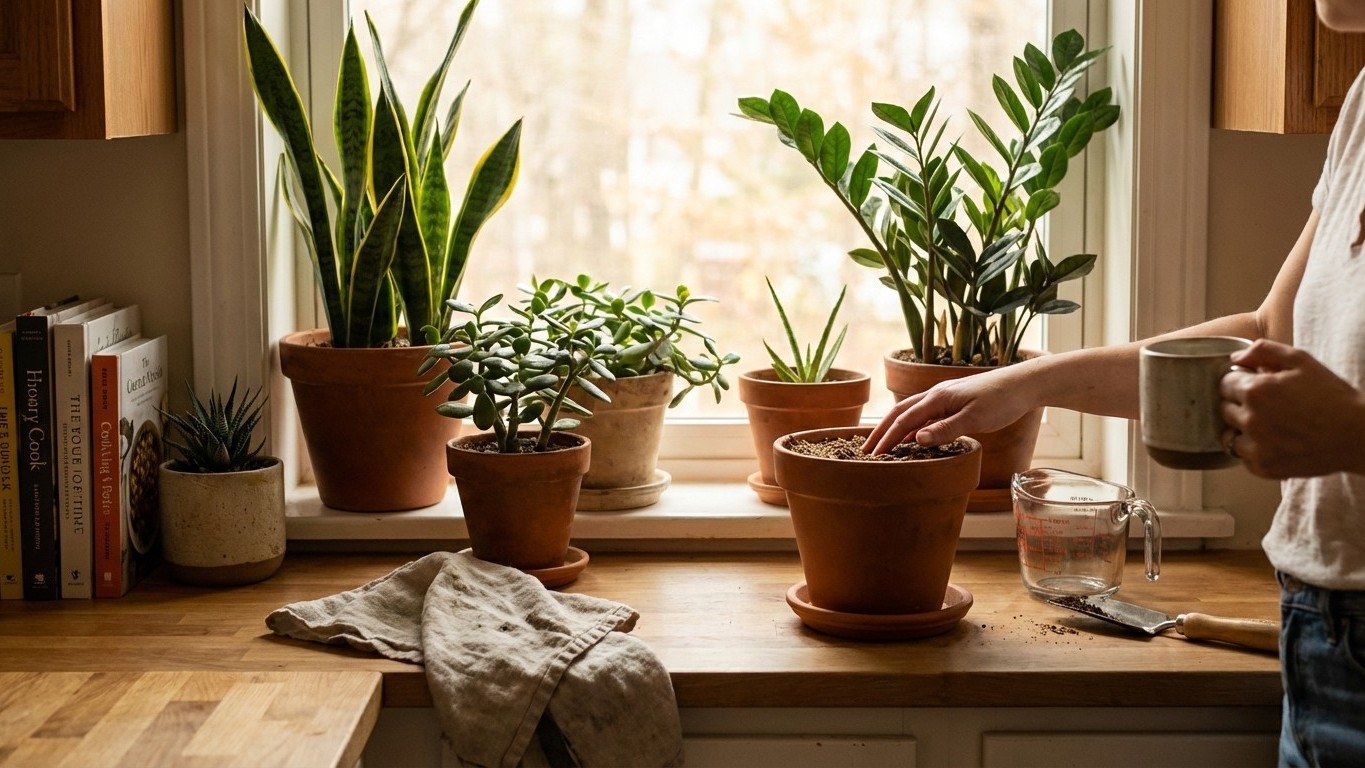
Five. That’s how many snake plants I’ve said goodbye to — and it sounds absurd, given their reputation for being “unkillable.” But I managed to kill them all, one by one, with what I thought was love. Picture a kitchen windowsill scattered with yellowing leaves and soft, limp stems. My thumb looked more black than green.
Blame it on optimism. Or maybe on Instagram, where lush pothos vines and glossy ZZ plants seem to flourish in every backlit corner. The message is clear: Plants Brighten up a home, even in the dreariest spaces. So why did my own “easy” plants look so defeated within weeks of arriving?
Key takeaways
The Wrong Kind of Attention
Everyone assumes you need neglect to kill a snake plant. My problem was the opposite — I drowned them in attention. Watering day was a ritual, complete with a glass measuring cup and soothing words. The result? Soggy roots, moldy soil, and leaves collapsing like party balloons two days after the party.
Turns out, low-light plants play by different rules. Their adaptation is their superpower — they keep up photosynthesis even when the sun barely glances their direction. But it’s a double-edged sword: less light means less water used up. More water just means slow decay, invisible until it’s too late.
Plant care guides often list “watering” as a chore — something to check off. But in shaded spaces, it’s more like an earned privilege. You’re not running a hydroponic experiment; you’re stewarding a patient living thing. A dry surface doesn’t mean a thirsty plant. Trust me, I learned this the hard way, repeatedly.
Learning to Wait
One morning, standing over yet another pot of grief, I finally did something radical: nothing. No watering roulette, no poking the soil with a stick, no fertilizer “boost.” Just patience.
Weeks went by. I watched the surface of the soil go from moist to dust, then even more arid. Still, the snake plant looked…fine. The leaves stayed tall. They didn’t call the plant police. It was almost as if restraint was what they’d been waiting for.
I started to track. Three weeks between waterings became five. Once, it stretched to seven. My urge to “fix” things faded. The law of low-light: trust is better than intervention. Over-watering may be the most common crime against houseplants — and for every neglected spider plant, thousands more perish because someone was too eager to “help.” (There’s something a little existential in that. How often in life do we try to fix problems that would heal on their own if we’d just back off?)
The Humidity Factor
A humid bathroom. A dry living room. Two identical ZZ plants, but the one near the shower thrived while the other withered, even with identical care. The missing variable? Not light, or even water, but air itself.
Low-light doesn’t mean no-light — and it certainly doesn’t mean “no environment.” Most of these plants hail from lush forests where humidity grips every leaf. Our homes, particularly during fierce winters or air-conditioned summers, are deserts by comparison. Water evaporates from soil differently in every room. That means the golden rule of “every two weeks” fails as soon as the seasons shift or you move the couch three feet.
If I’d understood that earlier, I’d have stopped treating plant care as an obligation and started listening. The easiest (and surprisingly stylish) trick? Sticking a finger in the soil — not just glancing at the surface, but feeling for actual dampness below. Soil dry two inches down? Water. Otherwise, leave it alone. No tech required, just hands-on experience.
Pacing Yourself: Growth Beyond the Pot
Is it counterintuitive to recommend doing less? Maybe. Yet my flourishing low-light plants — which finally look good enough to post Without a filter — feel like a daily reminder. Sometimes, you need to resist the urge to “improve” by adding more. Watch. Wait. Let them catch up to your intentions.
After all, slow growth isn’t no growth. A plant doesn’t get bigger every day; its root system expands quietly, underground. It’s a process that can’t be rushed — not unlike the way relationships deepen, or how new habits settle in your life. There’s a parallel here, subtle but haunting. The most resilient things in our homes (our lives?) are the ones we stopped micromanaging.
These days, watering is less of a ceremony and more of a conversation — what do my plants actually need, right now? Not what the tags promised or the influencers displayed. Just genuine care, tailored to their pace and place.
There’s freedom in that approach, and a quiet defiance, too. Let people chase after the next must-have air purifier or the latest “self-watering innovation.” Meanwhile, the real victory goes to slow, imperfect learning — and to patience. Will it make me a plant expert? Not likely. But perhaps the better question is, in a world obsessed with growth and productivity, what else might thrive if we simply learned to trust the process?