
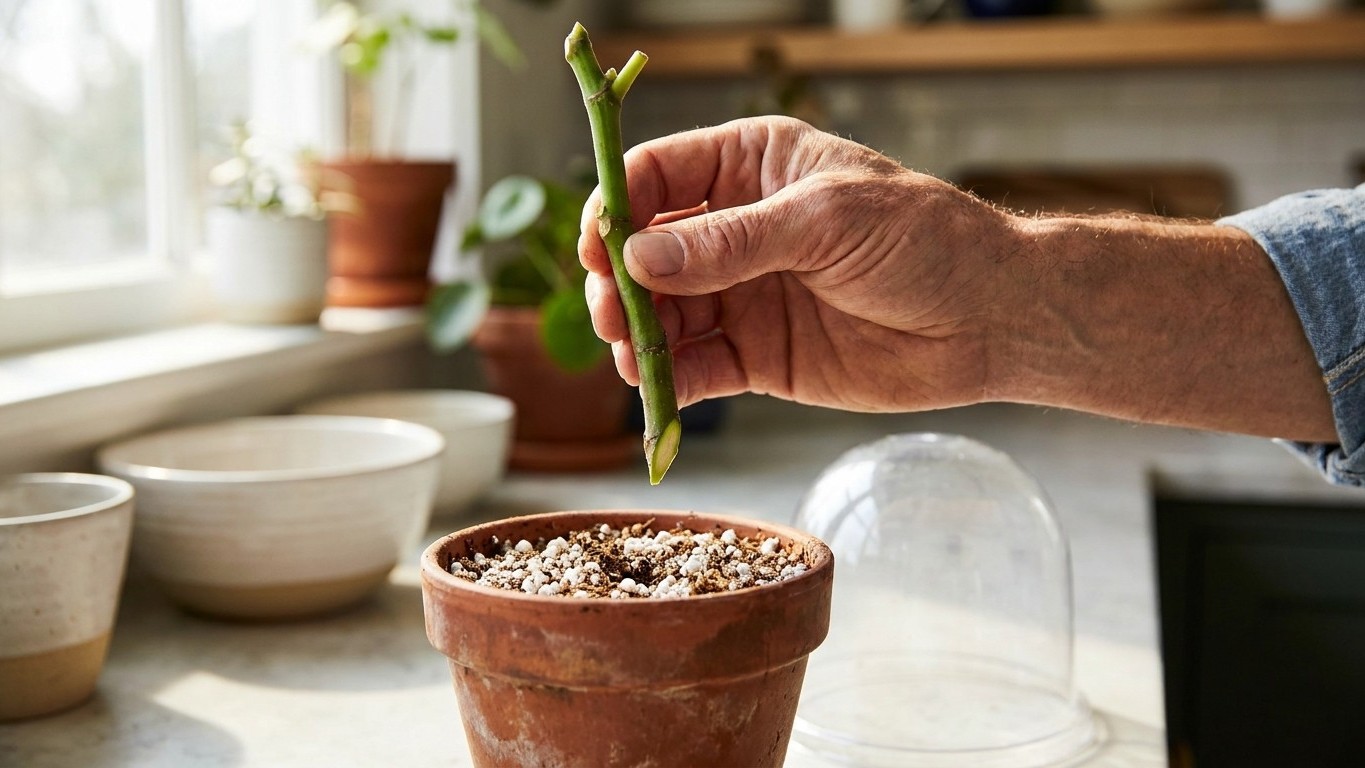
A fig tree costs anywhere from $30 to $80 at a nursery. Your retired neighbor gets his for free, from a stick, in six weeks. He’s been doing it for decades, and the method hasn’t changed, because it works.
Fig trees are among the easiest species to propagate. In fact, they’ve been traditionally multiplied in orchards worldwide by simply burying branches. No greenhouse, no special equipment, no horticultural degree. The biology is on your side here, and once you understand why, the whole process clicks into place.
Key takeaways
- Why fig trees root so easily compared to apples, pears, and other fruit trees
- The specific cut technique your neighbor uses that determines success or failure
- What happens during the critical six-week dormancy period that most beginners get wrong
Why Figs Root So Easily, and Why Other Fruit Trees Don’t
Unlike many other fruit trees, figs do not require grafting to produce fruit. That’s a big deal. Apples, pears, cherries, all of them need to be grafted onto rootstock, a technique that requires skill, timing, and usually a nursery. Fig trees are known for their ability to root easily from cuttings, and this method allows gardeners to create exact genetic copies of the parent tree, ensuring that desirable traits and fruit qualities are preserved.
The science behind it is straightforward. According to Dr. Louise Ferguson, a Pomology Specialist at the University of California, fig cuttings have a high success rate due to their “abundant latent root primordial, which are essentially pre-formed root initials waiting to develop.” This biological advantage gives fig cuttings a head start in the rooting process, making them relatively easy to propagate even for novice gardeners. The tree, already wants to root. You’re just giving it the right conditions to do so.
While most fruit trees require specialized grafting techniques, fig branches can transform into fully rooted trees in as little as three months. Experienced growers typically see 70–80% of their cuttings develop into healthy trees, though some report success rates as high as 93%. That’s a batting average most gardeners would dream of.
The Cut That Changes Everything: Timing and Branch Selection
Dormant cuttings can be taken any time between late October and February. Many growers attest that fall cuttings have more sap in them and therefore root more easily. But the real secret your neighbor knows is this: winter dormancy is your friend. This is when the tree’s energy is concentrated in the wood. The cuttings should be taken before buds begin to swell in spring. Dormant cuttings have the highest success rate because they focus energy on root development rather than supporting leaves.
Choose healthy, one-year-old wood about pencil thickness. Cut 6- to 10-inch sections, making the bottom cut just below a node at an angle, and the top cut straight across just above a node. The angled bottom cut helps you remember which end goes down and increases rooting surface. This directional detail matters more than most beginners realize. Plant a cutting upside down and nothing happens, weeks of patience, wasted.
Research on fig propagation confirms that distal and longer cuttings significantly enhance rooting efficiency and biomass production, yielding optimal shoot and root morphology for transplanting success. Translation: if you’re choosing between a short stub and a longer branch, take the longer one. It has more stored energy, more nodes, more everything.
The Six-Week Wait: What to Do (and What Not to Do)
Once cut, the branch goes into a pot. Use a pot with drainage holes, filled with a well-draining rooting medium. A mix of perlite and peat moss works well. The critical point here, and the one most beginners get wrong, is the growing medium. The most important thing is to ensure the medium has no fertilizer or nutrients. While it’s certainly possible to root cuttings in potting soil or rich compost, your success rate will go down dramatically. The young cuttings don’t yet have any roots and therefore can’t take up nutrients in a charged soil. Rich soil doesn’t help. It rots.
Warmth and humidity are the key factors to successfully rooting your fig cuttings. Because you’re taking dormant hardwood cuttings, they don’t even require light until they begin producing leaves. That’s the counterintuitive part. Keep them warm, keep them humid, and leave them alone. You’ve just stressed this little piece of branch by removing it from the tree. To help it recover and grow roots, put a clear plastic bag over it to keep humidity levels high around the cutting and help prevent it from drying out.
In about a month you should start to see buds opening, but don’t get impatient and pot them up too soon. Figs are prone to collapsing if potted up too early. Typically you wait two months before potting them up, but if they’re pushing active vigorous shoots you can be pretty sure they’re sufficiently rooted. The six-week rule your neighbor quotes is the minimum. Eight weeks is often safer, especially in a cooler house.
Temperature control matters too. Heat really helps to speed up rooting. Above 20°C (68°F) is best. A heat mat under the pot, especially if you’re rooting in a garage or basement, can cut days off the process. When used in conjunction with a thermostat, heat mats will allow you to keep the soil at a somewhat constant temperature throughout the propagation process.
Storing, Sharing, and Scaling Up
One of the underrated advantages of this method: you don’t have to root cuttings immediately after pruning. If you’re not ready to root the cuttings right away, wrap them in a damp paper towel and place them in two layers of plastic bags, leaving the bags 90% closed to allow slight air circulation. Store them in the crisper drawer of your refrigerator to keep them fresh until you’re ready to plant. This means you can prune in November and root in February, on your own schedule.
Another reason to propagate with fig tree cuttings is that the selection of fig varieties at garden centers is usually limited. Once you figure out how to grow fig tree cuttings, you have access to a lot of very delicious and early-ripening fig varieties. Cuttings make it easy and inexpensive to shop, or trade, for great varieties. There’s an entire subculture of fig enthusiasts who mail cuttings across the country, trading obscure Mediterranean varieties the way baseball fans once traded cards.
A healthy fig tree will produce high-quality fruit for about 15 years. Multiply that across several cuttings from a single branch, and you start to see what your neighbor figured out long ago: one good fig tree, properly managed, is a gift that reproduces itself indefinitely. Certain cold-tolerant varieties like the Chicago Hardy can survive temperatures as low as 10°F (-12°C), which means this isn’t just a warm-climate trick, gardeners from New England to the Pacific Northwest are pulling it off every winter, in garages and on kitchen windowsills, with nothing more than a branch, some perlite, and patience.
Sources : fignut.com | pmc.ncbi.nlm.nih.gov