
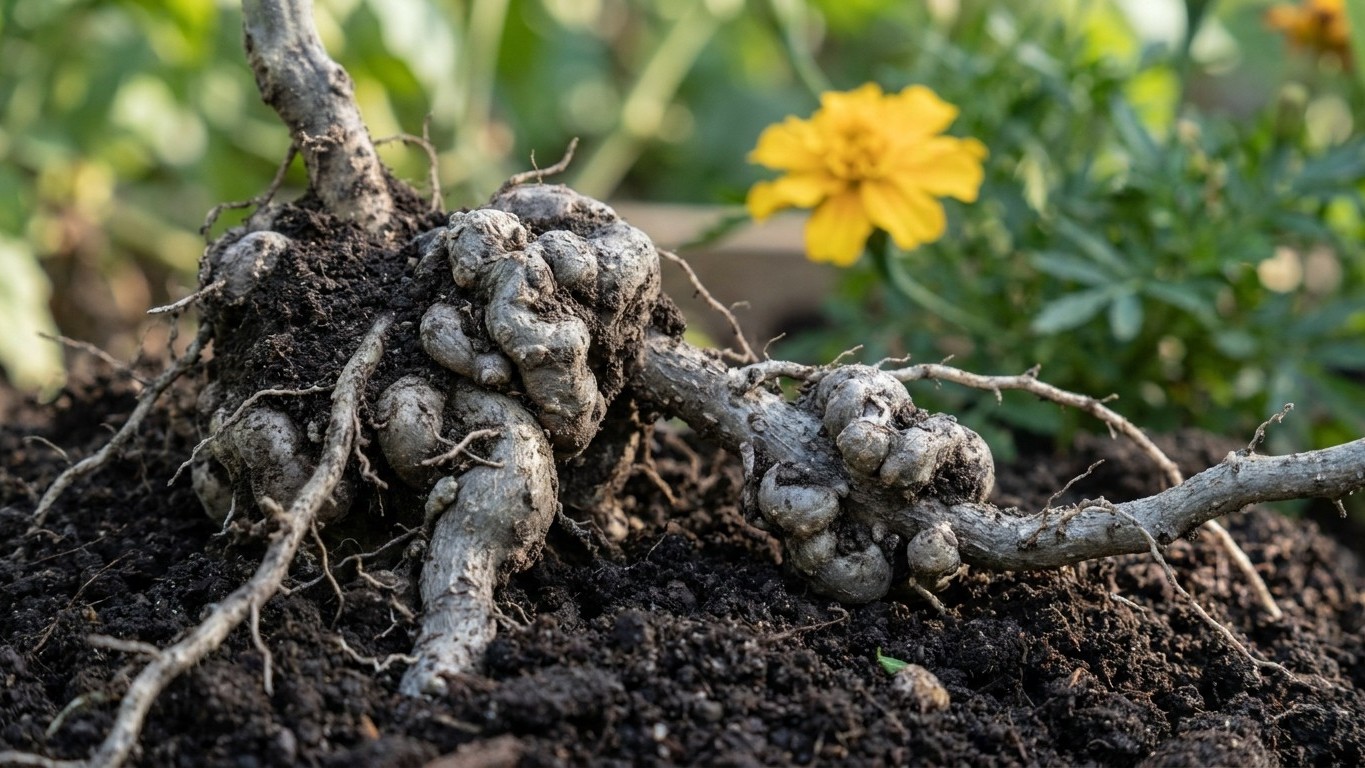
Two marigolds tucked at the end of a tomato row look tidy. They do nothing for the nematodes chewing through the roots underneath. That’s the hard lesson buried in raised beds across the country every autumn, when gardeners pull their tomato plants and find the roots swollen, knotted, and gray instead of clean and white.
Root-knot nematodes are microscopic worms living in soil, and they don’t care about a splash of orange at the border of a bed. Parasitic nematodes are microscopic worms that attack the roots of many vegetable plants, reducing both yield and quality. Tomatoes happen to be among their favorite targets, which is exactly why the marigold-as-companion-plant advice spread so widely in the first place. The problem is that most gardeners apply the advice as decoration rather than as a strategy, and decoration doesn’t disrupt a nematode’s life cycle.
Key takeaways
- The marigold myth persists, but most gardeners apply it exactly wrong
- A single compound in marigold roots requires dense planting and direct contact to suppress nematodes
- Timing matters as much as placement—too late spring planting allows nematodes to establish before protection begins
Why two flowers per row never had a chance
The active ingredient behind marigold’s reputation is a compound called alpha-terthienyl, released from the roots as the plant grows. The allelopathic effect of marigold that is responsible for nematode suppression is mainly attributed to α-terthienyl. That detail matters more than most garden blogs admit, because the compound doesn’t drift through soil like a scent. It has to make contact with the nematode near the root zone where it’s produced.
Researchers at the University of Hawai’i’s tropical agriculture program have been blunt about the density this requires. Marigold varieties like ‘Cracker Jack’ or T. patula ‘Single Gold’ may be sown at 20 plants per square meter, either broadcast or seeded in rows. Twenty plants per square meter is a thick planting, essentially a living carpet of marigold roots threading through the soil. Two flowers stationed at the far ends of a ten-foot tomato row cover almost none of that ground. The nematodes populating the middle of the row, right where the tomato roots actually spread, never encounter the compound at all.
There’s also a mechanical detail that trips people up: the protection only exists while the marigold is alive and rooted. Marigold kills plant-parasitic nematodes as a standing cover crop and is ineffective after soil incorporation, and the nematicidal activity was only detected in the root exudates rather than in homogenized extracts of roots and leaves. Chopping the marigolds down and tilling them in at season’s end, something plenty of gardeners do assuming they’re adding a soil amendment, throws away the one property that made them useful in the first place.
Timing was the second mistake
Planting marigolds alongside tomato transplants in late spring feels logical. It’s also usually too late for meaningful nematode suppression. Planting marigolds with tomatoes is one of the few companion planting strategies backed by peer-reviewed research, but that research shows it only works if you do it early, while most gardeners tuck a few marigold seedlings between tomato plants in June, when the beds already look established and both whitefly scouts and root-knot nematodes have already claimed their territory.
The Hawai’i extension guidance frames marigold less as a companion plant and more as a rotation crop, grown on its own before the vegetable goes in. A marigold cover crop can be grown for two to four months during the summer season, with the most timely period being right after termination of a spring vegetable crop. Field trials back up the payoff of doing it that way. Tomato yields after marigold were about 50% higher than after fallow ground, and marigold Single Gold consistently reduced nematode infestation and galling of tomato roots. That’s not a marginal difference. It’s the gap between a productive bed and one where every plant looks stunted by August.
Extension nematologists who get asked about this every season tend to add a dose of realism. Although there may be some slight advantages of putting marigolds and vegetable plants together, the root-knot nematode is still able to find and infest the roots of susceptible vegetable plants, though marigolds can help control some of the most damaging nematodes that attack vegetables in home gardens. Help, not eliminate. That distinction matters if you’re deciding whether to trust marigolds alone or pair them with resistant tomato varieties, which many seed catalogs now label clearly for exactly this reason.
Getting it right next season
Species selection trips people up almost as often as timing does. Not every marigold does the same job, and the confusion runs deep enough that extension services keep having to correct it. African (T. erecta) and French marigolds (T. patula) are the most commonly used species for nematode suppression. Signet marigolds, despite their charm and heavy bloom, aren’t reliable for this purpose, and calendula, often called “pot marigold,” is an entirely different plant that doesn’t carry the same root chemistry at all.
If a full cover crop rotation isn’t realistic in a small backyard bed, the fallback is density and patience rather than symbolism. Interplant marigolds through the whole row, not just at the ends, and get them into the ground weeks before the tomatoes go in, not alongside them. Leave the marigolds standing and alive through the season rather than pulling them early for a tidier-looking bed. And if a plot has a known nematode problem, treat marigold as one tool alongside resistant tomato varieties and crop rotation, not a stand-alone fix.
The nematodes that ruin a root system by autumn were already established by July, long before the first tomato ripened on the vine. By the time roots come up gnarled and gray, the growing season’s real decisions were made back in spring, quietly, underground, while the marigolds up top were just starting to bud.
Sources : apsjournals.apsnet.org | sciencedirect.com