
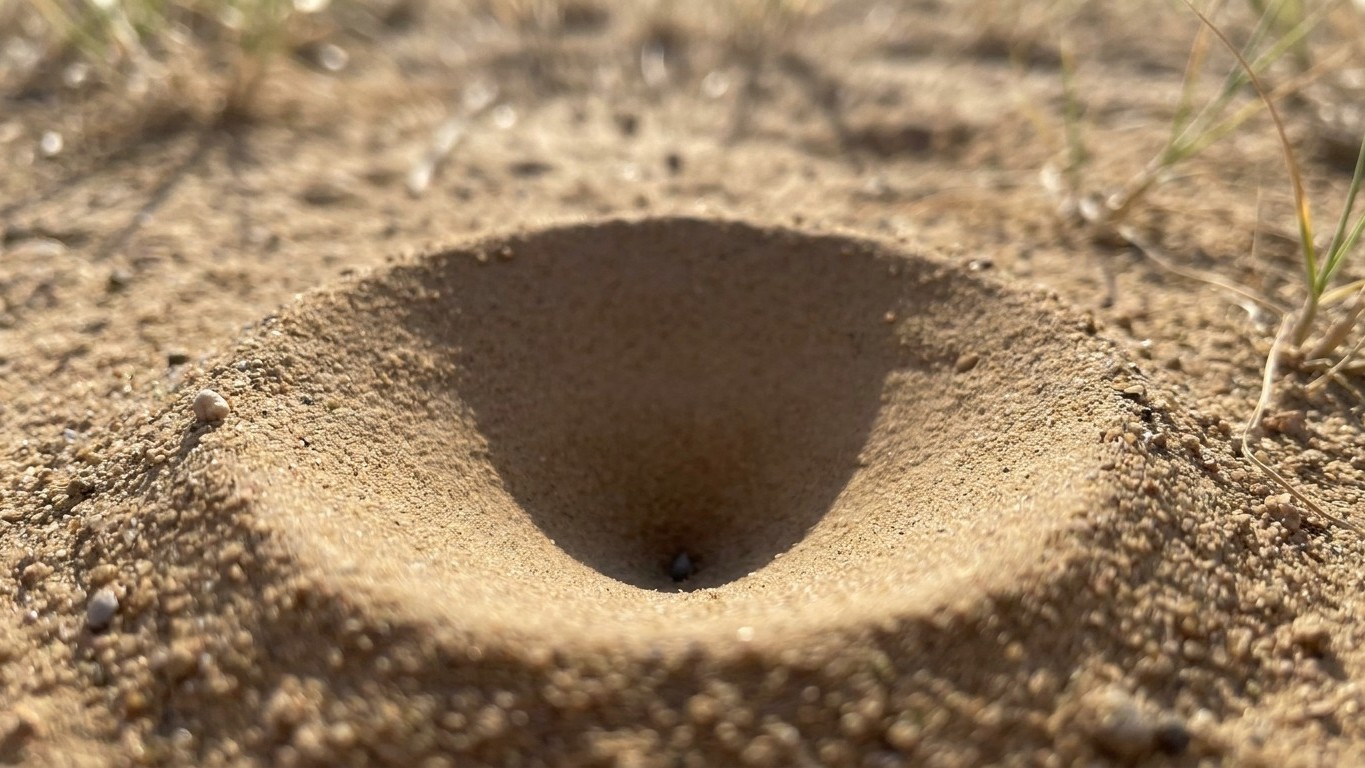
Two weeks. That’s all it took for a handful of “tidy” patches in a Georgia backyard to turn into a lesson in humility. The homeowner had noticed dozens of tiny cone-shaped depressions dotting a dry, sandy corner of the lawn near the foundation, decided they looked messy, and smoothed them over with a rake. Job done. Except two weeks later, bigger, deeper funnels showed up in the exact same spot, some of them wider than a quarter. That’s when the penny dropped: those weren’t random dirt divots. They were traps, built by one of the most efficient ambush predators in the insect world.
Key takeaways
- Tiny cone-shaped pits in sandy soil aren’t lawn damage—they’re elaborate traps built by carnivorous insects in minutes
- The homeowner unknowingly demolished a multi-year pest-control operation that targeted ants without chemicals
- Those bigger funnels that appeared later revealed a shocking truth about what was living beneath the surface
What those cones actually are
The culprit has a name straight out of a monster movie: the antlion, or “doodlebug” if you grew up in the South. If you’ve ever seen small, cone-shaped pits in fine soil or sand, you’ve likely found an antlion trap, made by pit-building larvae that hide beneath the surface waiting to ambush ants and other small insects that fall in. These aren’t ant hills. They’re kill zones, engineered with almost mathematical precision.
The construction process itself is oddly elegant. The antlion begins a pit by walking backward and pressing its wide, flattened abdomen into the soil, creating a winding spiral trail before digging deeper using its head and long, sickle-shaped mandibles to fling sand out. The whole build takes almost no time at all: the digging continues for only approximately 15 minutes while the larva spirals deeper into the ground, and the finished pit may be 1 to 2 inches across and 1 to 2 inches deep. That’s a professional-grade trap assembled faster than most people can unload a dishwasher.
Once it’s finished, the larva buries itself at the bottom with only its jaws exposed. Waiting quietly at the bottom of its conical pit, with just the tips of its pincerlike fangs protruding, the antlion larva grabs any ant or other insect unlucky enough to tumble down the sides, drags it below the pit to drink its juices, then hurls the drained skin beyond the edges and waits again. Entomologists aren’t exaggerating when they call the jaws impressive. “They have mandibles that are ridiculously massive, and they are ferocious predators,” said Wizzie Brown, a Texas A&M AgriLife Extension Service entomologist.
Why the second wave of funnels was bigger
Here’s the part that made the whole backyard mystery click. Antlion larvae don’t build one pit and call it a career. Over the course of its larval life the antlion will continue to grow and will usually go through three moults, and in this process it outgrows its original pit, so it needs to move and excavate a new one. Filling in the first round of small holes didn’t kill the colony living underneath that patch of dry soil. It just displaced them, and a couple weeks later, the survivors had grown enough to need roomier real estate.
Size, by the way, isn’t a simple measure of age or hunger satisfied. An antlion makes several pits and repeats the feeding process several times as it grows and develops over a period that may last as long as three years, and a large pit indicates a hungry antlion, one that hasn’t fed for a long time. Research on trap-building even shows a direct link between body size and pit dimensions: larger larvae built larger traps, and warmer soil led to more and larger traps. Translation: those wider funnels weren’t a coincidence of timing. They were a growth spurt made visible in the dirt.
The larval stretch of an antlion’s life is surprisingly long for something the size of a grain of rice with legs. The larval stage of antlions can last one to three years, and when they pupate, they dig further down into the soil and form a cocoon before emerging as adults, which only live about a month, just long enough to mate and for females to lay eggs in sandy locations. So a homeowner filling in pits every July could theoretically be interrupting the same generation of insects for two or three summers running before it finally takes wing.
Why filling them in was the wrong move
Smoothing over antlion pits feels like tidying up. It’s actually removing free pest control. These larvae have one obsession: ants. Antlions are beneficial to man because of their ant diet and they cause no problems. A lawn edge or a dry, sheltered strip near a foundation with a cluster of these cones is, functionally, a tiny ant-suppression station running on autopilot, no spraying required.
They also tend to colonize the exact spots homeowners overlook, which is part of why they go unnoticed until someone starts raking. Homes with roofs featuring large overhangs create a veritable desert just beneath the overhang, and each year miniature craters about the size of half dollars pockmark that dusty ground. Bare, sandy, rain-sheltered strips along foundations, under eaves, or in thin patches of lawn are prime antlion real estate, not lawn flaws to be corrected.
Distinguishing an antlion pit from an actual ant mound is easier than it sounds. Ant hills are small piles of loose excavated dirt pushed up and out. Antlion pits are the opposite: a smooth, symmetrical crater pressed down into the soil, funnel-shaped and precise enough to look almost machined. If you see something more like an inverted cone than a mound, put the rake down.
What to do instead of filling them in
The simplest response is often no response at all. These larvae are harmless to people, pets, and turfgrass, and they’ll relocate on their own if conditions change (drier soil elsewhere, more shade, a shift in the ant traffic they’re ambushing). If a cluster is genuinely bothersome, say, in a play area, watering the patch more consistently to keep the soil from staying loose and dry tends to make it less appealing without any chemical intervention.
For anyone curious enough to look closer, a small trowel and a tea strainer can reveal the larva itself, though patience helps. Few people are ever fortunate enough to see the antlion, since they spend so much time motionless at the bottom of the pit and are dirt-colored, usually camouflaged with a thin layer of dust or sand, and the best view is achieved by sifting them out with a tea strainer. It’s a five-minute detour that turns a “lawn flaw” into one of the more entertaining fifteen minutes a backyard can offer, and a good reminder that not every irregularity in the grass needs fixing.
Sources : berkshireeagle.com | phys.org