
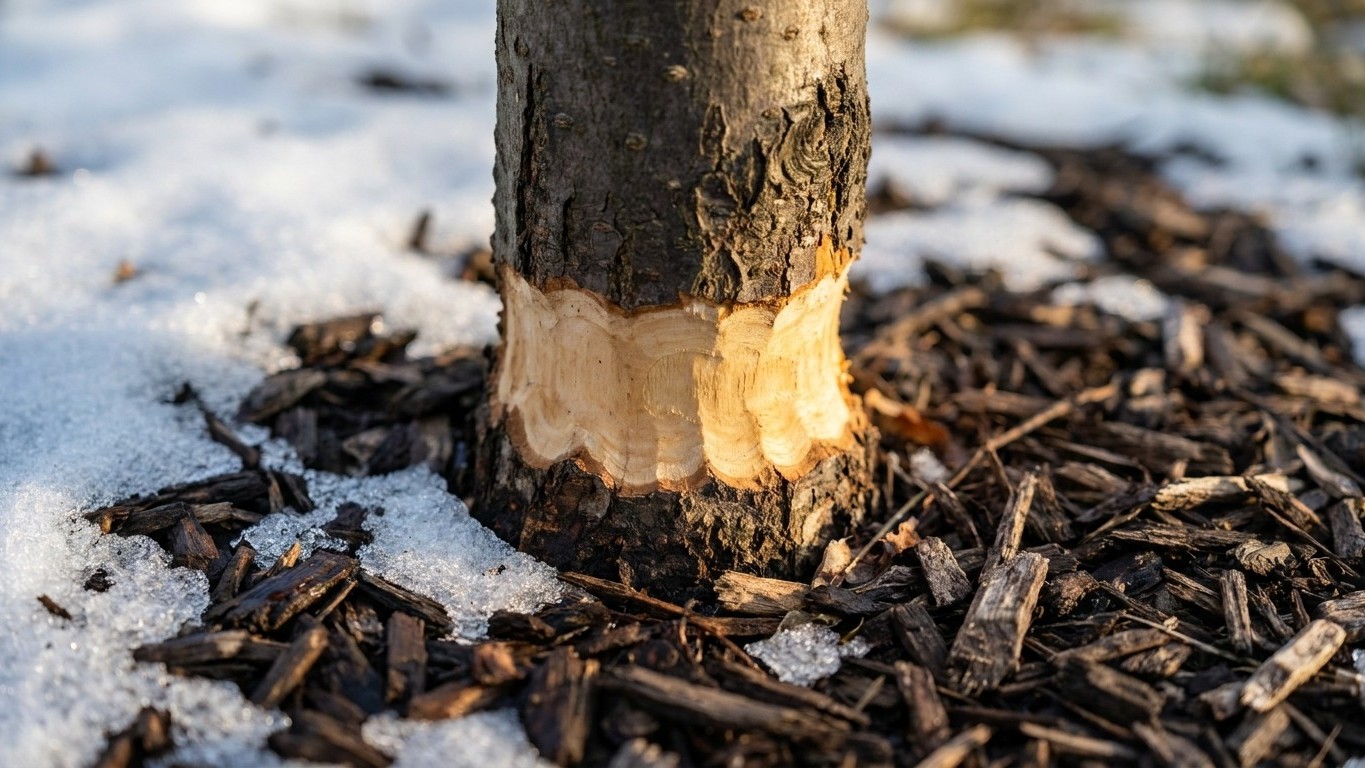
The mulch was still there in March. Piled two feet high against the trunks, just as it had been since October. What had vanished was a ring of bark at the base of each tree, chewed clean down to bare white wood in some spots, all the way around the trunk in others. The mulch hadn’t failed. It had done exactly what it always does when heaped against a trunk instead of spread around it: it built a five-star winter hotel for voles.
This is one of the most common and least understood disasters in home orchards, and it happens every single winter to gardeners who did Everything else right. They planted good stock, watered properly, staked the trees against wind. Then they mulched for weeds and moisture, piled it thick against the bark “to be safe,” and unknowingly built a shelter that let rodents work undisturbed for four or five months straight.
Key takeaways
- Voles tunnel through mulch piled against tree trunks, invisibly girdling the bark all winter long
- A completely girdled tree dies; a partially girdled one may leaf out beautifully in spring, then collapse by summer
- The fix isn’t abandoning mulch—it’s the simple geometry of keeping it a few inches away from the bark
Why the Mulch Itself Wasn’t the Problem
Bark is a living tree’s skin, dead on the outside but doing real protective work. Tree bark is meant to protect the trunk and works best in the air and light. Piling mulch onto the bark exposes it to dark and moisture. That alone can cause rot. But rot is slow. What actually stripped those trunks bare over a single winter was something faster and hungrier.
Voles take advantage of mulch piled on tree trunks, burrowing into it and chewing bark without anyone aware that the tree is being girdled. The mulch pile isn’t just cover from hawks and owls. It’s insulation, a buffet, and a construction site rolled into one. With snow on the ground and less abundant natural vegetation, voles begin feeding on the bark near the soil surface and roots of trees and shrubs. Snow makes it worse, not better. Since voles burrow in the snow, they may damage tree trunks as high as snow accumulates. That explains why the damage often isn’t confined to a tidy band at ground level. It can run a foot or more up the trunk, following the snowpack line like a tide mark.
What Was Actually Missing at the Base
What disappears in these cases is the phloem and cambium, the thin living layer just under the bark that moves sugars from leaves down to roots. Voles gnaw on the bark and the cambium layer just beneath it, effectively cutting off the tree’s circulatory system, a process called girdling. If the gnawing wraps all the way around the trunk, the tree is effectively cut off from itself. If a tree is completely girdled, it cannot be saved. Partial girdling is survivable but leaves a permanent scar and a weak point for years.
The frustrating part is how invisible the whole process is until the reveal. Much of the feeding damage occurs during the winter months when voles girdle trunks of woody plants, and it often goes unnoticed until drought stress occurs during the following growing season and the injured trees become weak or die. A tree can look completely normal in April, leaf out in May, and then collapse in the July heat because it no longer has a functioning connection between roots and canopy. Young apple trees are particularly exposed here. Voles cause serious damage to young apple trees, especially those on dwarfing rootstocks. Dwarf and semi-dwarf trees, which is most of what backyard orchardists plant now for space reasons, have thinner bark and smaller trunks. A vole doesn’t need much time to work its way around one.
The Fix Isn’t Less Mulch, It’s Mulch That Doesn’t Touch Wood
None of this means mulch is the enemy. When done correctly, mulch protects the tree from a lawnmower or string trimmer, aids in keeping the soil moist, keeps the ground cooler in summer and warmer in winter, and improves soil structure, aeration, and prevents erosion. The problem is entirely about geometry. Extension horticulturists have a simple visual test: you should be able to see the trunk and the flare at the base of the tree, the portion that widens as it goes into the soil. If the flare is buried, the mulch is too close.
The standard recommendation is a donut, not a volcano. The mulch ring should be 2 to 3 feet wide around the tree trunk radius, with a maximum depth of 2 to 3 inches, and mulch shouldn’t touch the bark of the tree. That gap, usually a few inches of bare soil between mulch and trunk, does more to protect a young tree than any amount of extra mulch depth ever could.
For rodents specifically, mulch management is only half the answer. Physical barriers do the rest. Hardware cloth barriers can be used to keep voles from girdling small trees, wrapped in a strip of quarter-inch mesh around the base. That mesh needs to go a few inches into the soil, since voles will tunnel under a guard that only sits on the surface. Keeping grass mowed short around the trunks matters too, because keeping grass and weeds short by mowing, raking leaves as they accumulate, and eliminating brush removes the cover voles rely on to move around undetected in the first place.
Timing Matters as Much as Materials
Fall is when this problem gets set in motion, long before the first snow. Before winter, push back any mulch that is against the trunks of trees. If a trunk wrap is used instead of or alongside hardware cloth, it needs to come off again in spring. In mid- to late March, the wrap should be removed so water does not seep in and begin to rot the bark. Leaving protection on year-round just trades one problem for another, since damp material against bark all summer invites the same rot that mulch volcanoes cause.
Vole populations also swing wildly from year to year rather than staying constant, which is why some winters pass without a scratch and others leave every trunk in a row stripped. Populations of some species of voles tend to have cyclic fluctuations in abundance in northern latitudes with a peak every three to five years. A quiet winter isn’t proof that the mulch-against-the-trunk habit is safe. It just means the vole population happened to be low that particular year. The hardware cloth collar costs a few dollars and ten minutes per tree in the fall. Compare that to replacing a three-year-old apple tree that finally leafs out one more time in spring, only to wilt by midsummer because the damage was already done under the snow.
Sources : articles.extension.org | sciencedirect.com