
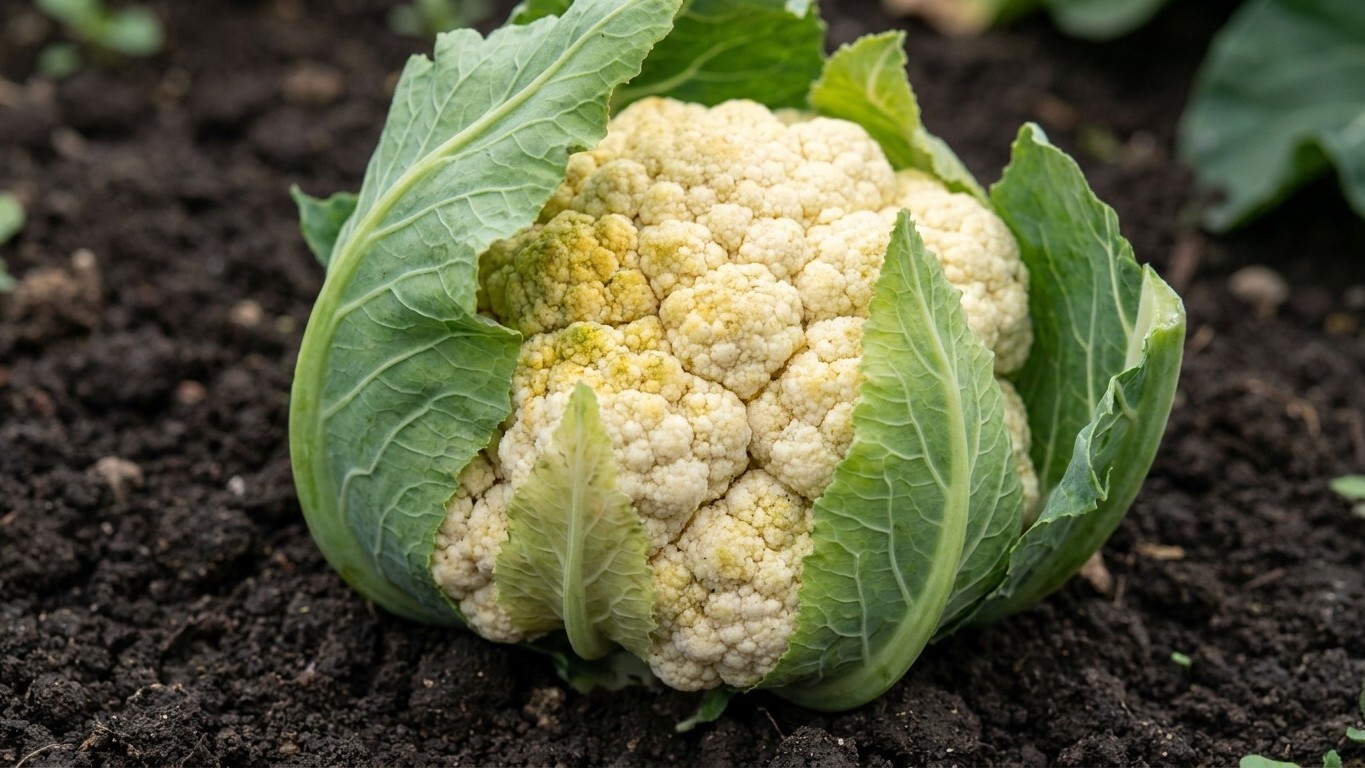
Sunday morning, the reveal. Leaves peeled back, expecting cream-white curds after a week of pushing 28°C. Instead: a dull yellow crust spreading across the surface, texture gone grainy in places. The instinct to give the plants “more light” during a heat spell turned out to be exactly backward, and the timing could not have been worse.
Cauliflower is one of the few garden vegetables that actively punishes sun exposure at the wrong moment. Cauliflower heads need protection to stay white, and when the developing curd is exposed to direct sunlight, it begins to produce chlorophyll, the same pigment that makes lawns and leaves green, which in cauliflower leads to a yellowish or even greenish tint. That’s not a defect of a particular variety or a sign of disease. It’s basic plant chemistry, and it happens fast once conditions line up against you.
Key takeaways
- What happens when cauliflower gets too much sun at exactly the wrong temperature
- Why 28°C is the danger zone that flips the plant into reproductive mode
- The one 30-second technique that prevents this disaster entirely
Why 28°C was the tipping point
The number matters more than it seems. Yellowing is more likely to occur when temperatures are above 80°F, which lands at roughly 26.7°C. A week of 28°C days sat right in that danger zone, and every uncovered hour let the curd soak up UV and warmth simultaneously. Heat doesn’t just discolor the head either. Both riciness and fuzziness of cauliflower heads can occur when temperatures are warm above 80°F during head formation, with riciness giving the curd an open and uneven appearance as floral parts elongate and small flower buds form. That grainy patch noticed on Sunday wasn’t just sun damage. It was the plant’s internal clock speeding toward flowering, triggered by the heat itself.
Push the temperature a bit further and the damage compounds. When daytime temperatures linger above 30°C for several consecutive days, the plant’s growth shifts from vegetative development to reproductive mode, producing small, discolored heads and often bolting prematurely. Twenty-eight degrees sits just under that harder threshold, but it’s close enough that a full week at that level puts real stress on the curd’s structure, not just its color. And there’s a secondary effect worth knowing: curd bracts, or small green leaves between the segments of the curd, are caused by too high of temperature or drought, with high temperatures causing a reversion to vegetative growth with bract production on the head. That’s a second, separate way heat sabotages the harvest, independent of sunlight.
The leaf-tying step that got skipped
Here’s the mistake in plain terms: leaves left open on purpose, thinking the plant needed the light to keep growing. But once a cauliflower head starts forming, it doesn’t need direct sun on the curd itself, it needs the opposite. Blanching cauliflower is a key technique to protect those classic white heads from turning yellow or developing a bitter taste due to sunlight exposure. Once the curd reaches about 2 to 3 inches across, gently gather the outer leaves over the head and secure them with a rubber band or soft twine, which shields the curd from direct sun while allowing air to circulate. The plant’s own foliage is the shade cloth. Skipping that step during a heat wave is like leaving a sunroof open during a hailstorm because you wanted the fresh air.
Timing is everything here, and a single missed week can be the entire difference. Start blanching a little earlier if temperatures are particularly hot or sunny, since unblanched cauliflower often becomes discolored and tough. The standard advice is to begin tying leaves the moment the curd is roughly golf-ball to tennis-ball sized, not after a heat spike has already started cooking it. Waiting until Sunday, after seven straight days of exposure, meant the cover came far too late to undo what daylight had already triggered.
Is the yellow cauliflower still worth eating
The good news, and it is genuinely good news: this is almost entirely cosmetic. In nearly all cases, a yellow cauliflower head is perfectly safe and nutritious to eat, and the color change from sun exposure is purely cosmetic, though the flavor may be slightly stronger or more bitter. If the ricey texture is only patchy, it doesn’t need to go straight in the compost either. If the yellowing is due to over-maturity, the texture might be grainier or less tender, and it’s best used in soups, stews, or mashed cauliflower where texture is less critical. A roasted floret dish might show the color more than a purée would, so bury the imperfection in something creamy rather than serving it whole and white-expectant on a plate.
Before writing off the whole head, though, check it properly. Always check for signs of actual spoilage like soft, slimy spots, mold, or a foul odor, but if it’s just yellow and firm, it’s good to go. Sun scorch is a different story from simple yellowing, and it’s worth knowing the distinction. If the sun has scorched portions of the curds to a charred brown, the damaged portions can be cut off and the unblemished florets consumed. So the Sunday reveal wasn’t a total loss. It was a lesson in reading the thermometer, not the calendar, when deciding whether the leaves stay open or come down.
Next season, the fix is cheap and takes thirty seconds per plant: picking varieties known for good self-blanching, like Snow Crown and Skywalker, is a smart move for anyone gardening in a sunny area. Pair that with a rubber band and a five-day weather forecast, and the next heat wave won’t get the chance to write the ending before the leaves are even pulled back.
Sources : ncbi.nlm.nih.gov | cultivatedearth.com