
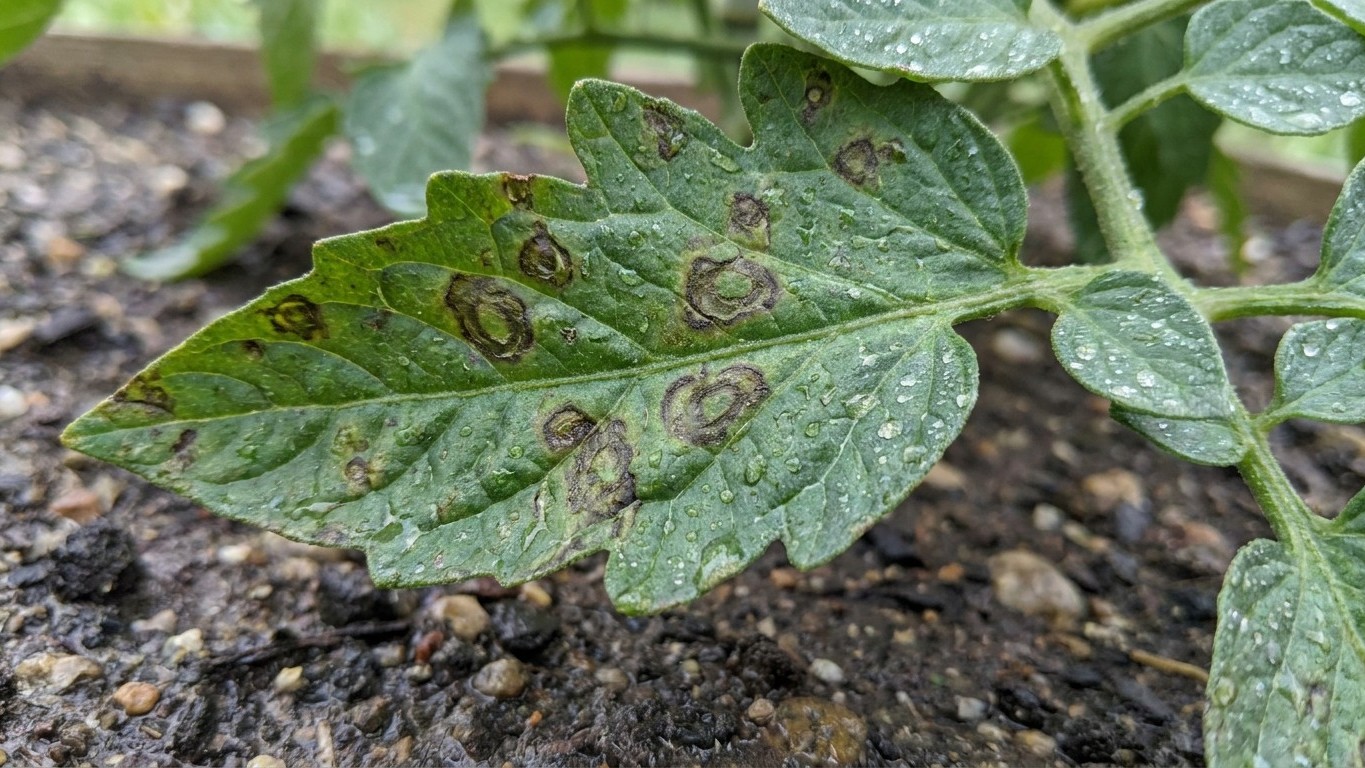
Three weeks after that first watering, the lowest leaves on the tomato plants had gone dark, spotted, almost fuzzy at the edges. The stakes looked fine last fall, dried out over winter, seemingly harmless. But wood is porous, and porous wood holds onto more than sunlight and rain.
Reusing garden stakes to save money sounds like common sense. Wash off the dirt, let them dry, stick them back in the ground come spring. The problem is that disease doesn’t always wash off that easily. Bacterial and fungal diseases have been shown to survive on wooden stakes and can be a source of new infections, since plant diseases survive on plant debris and soil on the surface of stakes and can also survive on the interior of stakes due to the porous nature of the wood.
Key takeaways
- Three weeks after watering, mysterious dark spots appeared on the lowest leaves—but the real culprit was hiding in plain sight
- Wooden stakes aren’t just inert supports; they’re a second source of disease that overwinters alongside contaminated soil
- The solution costs pennies and takes one hour, but timing and soaking duration matter more than most gardeners realize
What Actually Showed Up on the Lower Leaves
The pattern matters here. Spots concentrated on the lowest leaves, the ones closest to the soil, point almost directly at early blight or Septoria leaf spot rather than something that traveled in on the wind. Lower leaves become infected when they come into contact with contaminated soil, either through direct contact or when raindrops splash soil onto the leaves. That first watering did exactly that: it turned dormant spores clinging to old wood and residual soil into an active infection route, splashing them straight onto young, vulnerable foliage.
Early blight is caused by the fungus Alternaria solani, and it doesn’t need much encouragement. During wet or humid conditions, like warm days with significant rainfall or morning dew, the fungus that causes early blight can replicate rapidly, and spores can be produced as quickly as 3 to 5 days after spots first appear. Three weeks is plenty of time for a full cycle. The telltale sign is a lesion with concentric rings, almost like a tiny target painted on the leaf, sometimes bordered by a yellow halo. The early blight pathogens both overwinter in infected plant debris and soil, and the pathogen also survives on tomato seed or may be introduced on tomato transplants.
Septoria leaf spot behaves the same way and gets grouped with early blight for a reason: early blight and septoria leaf spot spores survive the winter in the ground, causing the disease to return next year. Reused stakes essentially act as a second reservoir alongside the soil, doubling down on the source of contamination instead of eliminating it.
Why Old Stakes Are Riskier Than They Look
Here’s what surprised me most in the research: it isn’t only fungal disease that hitches a ride on old wood. Wooden stakes are a place where the bacterial pathogens that plague tomatoes can survive between crops, and stakes from a tomato planting where research was conducted on bacterial diseases have been used as a source of the pathogen for subsequent experiments. Bacterial speck, bacterial spot, and bacterial canker all fall into that category, and canker in particular is nasty enough that experts recommend tossing the stakes entirely rather than trying to save them. There are three bacterial diseases of concern on tomato: speck, spot and canker, and bacterial canker is sufficiently destructive that discarding stakes is recommended after an outbreak.
The good news, if there is any, involves late blight, the disease that caused the infamous outbreaks that wiped out backyard tomato crops across entire regions in past seasons. Late blight will not survive on tomato stakes and cages, since it needs living tissue to persist through winter. But that’s really the exception. Even so, other tomato plant diseases such as Septoria leaf spot can overwinter on dead tissue or stakes, which means one clean bill of health doesn’t cover the rest of the garden.
The Cheap Fix That Actually Works
None of this means stakes have to be thrown out every fall. Extension services that deal with commercial growers, where reusing equipment across acres of crops is standard practice, have worked out a routine that costs almost nothing and takes less than an hour. Start by removing every trace of dirt and old plant material, because dirt and debris can protect pathogens and de-activate disinfectants. Scrub with soapy water first, then move to disinfection.
A bleach solution at a rate of 0.5%, meaning one part bleach to nine parts water, is the standard household approach used by home gardeners and extension offices alike. The stakes need real contact time, not a quick splash. Stakes should be soaked in the disinfectant solution for a minimum of 20 minutes, preferably 30, completely submerged so the solution surrounds each one, using weights to hold them under water if needed. Skip the soak and the treatment barely touches surface contamination, let alone whatever has worked its way into the grain.
Timing the bleach matters too. It doesn’t stay effective indefinitely once mixed. Bleach is highly effective but short-lived after mixing in water, with a half-life of only 2 hours, and it is especially prone to being inactivated by organic matter, which is exactly why pre-cleaning is critical. Mix a fresh batch right before soaking rather than relying on a solution made the night before. For metal cages, an even simpler option exists for anyone with a sunny driveway: wrap the cages completely with clear plastic sheet and leave them in the sun for a week, and the resulting heat inside will be sufficient to kill anything else living in there.
Reusing stakes still makes sense financially, and disinfecting a batch costs less than a bottle of fungicide. The three weeks it took for those spots to appear is roughly the same window it would have taken to soak, scrub, and dry the stakes properly before the season even started. Next year, the stakes go in the bleach bucket before they go back in the ground, not the other way around.
Sources : extension.umaine.edu | backtothegoodlife.com