
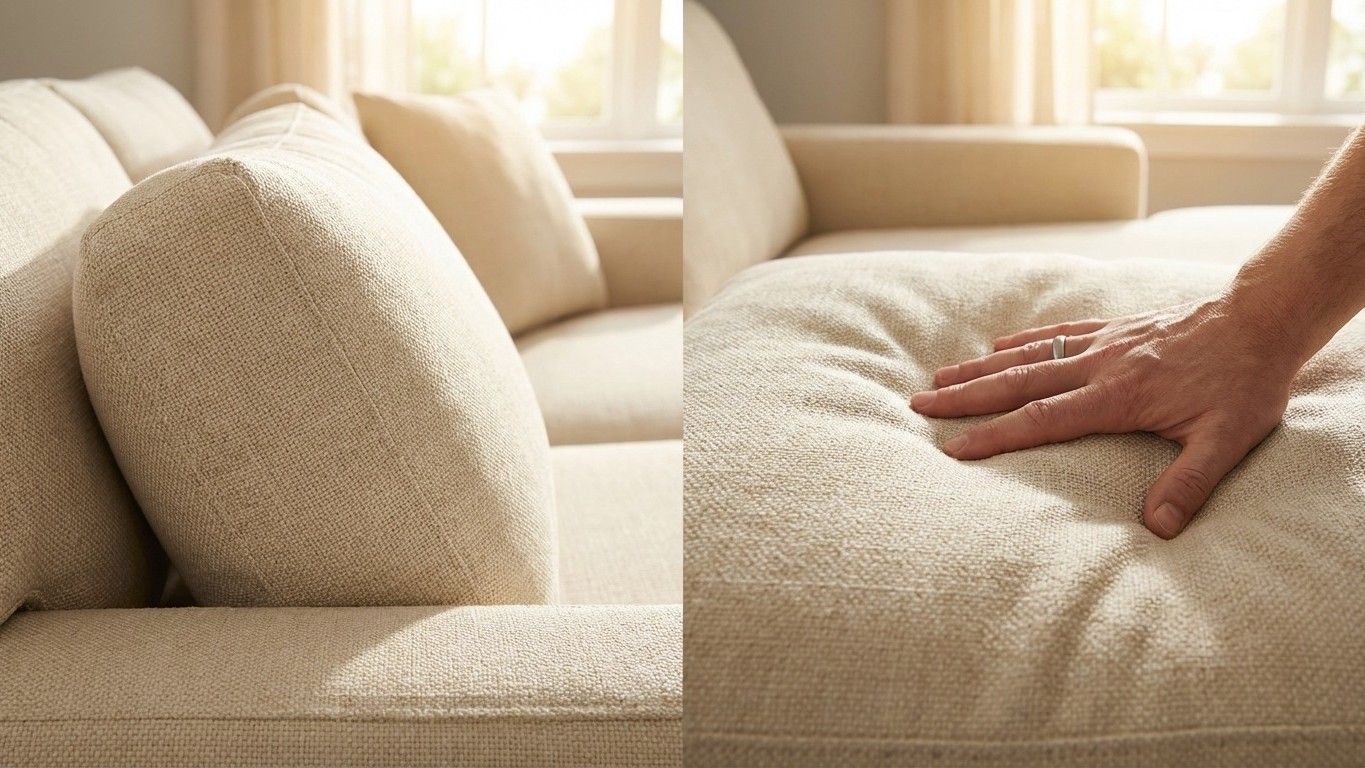
Your living room’s centerpiece sits there innocently enough — plush, inviting, the perfect spot for Sunday afternoon naps. But beneath that soft exterior, something sinister might be happening. A gradual deterioration that starts small, almost imperceptible, yet signals the slow death of your sofa’s soul.
The telltale sign? Those subtle depressions that no longer bounce back.
Run your hand across the cushions after everyone’s gone to bed. Feel that slight unevenness where your favorite corner used to be perfectly rounded? That’s not just wear and tear — it’s foam degradation in action. The polyurethane foam inside your sofa is literally breaking down at the molecular level, losing its ability to spring back to life.
Key takeaways
- A subtle sign on your cushions reveals what’s happening inside your sofa’s structure right now
- The process starts innocently but accelerates dramatically under specific conditions most people ignore
- There’s a critical window to act before costs spiral and comfort completely disappears
The Silent Killer of Comfort
Foam degradation doesn’t announce itself with fanfare. No dramatic collapses or sudden failures — just a gradual surrender to gravity and time. The process typically begins around the three-year mark for lower-quality foam, though premium materials might hold out for seven to ten years.
Picture foam as millions of tiny balloons clustered together. Fresh foam bounces because those cellular structures remain intact, pushing back against pressure. But exposure to air, moisture, body oils, and simple mechanical stress causes these cells to rupture one by one.
Temperature fluctuations accelerate the process dramatically. That sunny spot by the window where your sofa looks so photogenic? Those UV rays and heat cycles are cooking your cushions from the inside out. Each expansion and contraction cycle weakens the foam’s cellular matrix further.
The result manifests as Permanent indentations — areas where the foam has lost its memory of its original shape. Press down on a healthy cushion and watch it spring back within seconds. Press on degraded foam and witness a sluggish return that never quite reaches the starting point.
Beyond the Surface: What’s Really Happening
Foam deterioration creates a domino effect throughout your sofa’s structure. As cushions lose their supportive properties, surrounding materials begin compensating — and failing.
The fabric stretches more than intended, creating those telltale wrinkles and sags that no amount of fluffing can eliminate. Springs work harder to provide support, leading to premature metal fatigue. Even the frame bears additional stress as weight distribution becomes uneven.
Moisture plays a particularly destructive role. Every spilled drink that soaks through, every humid summer day, every pet accident adds to the foam’s degradation timeline. Polyurethane foam acts like a sponge, absorbing and retaining moisture that feeds bacterial growth and accelerates chemical breakdown.
Some manufacturers try to combat this with foam treatments — antimicrobial coatings, moisture barriers, density variations. But these solutions often add cost without delivering proportional longevity benefits.
The Economics of Denial
Here’s where psychology meets furniture economics. Most people notice the early warning signs but rationalize them away. “It’s just getting broken in.” “The kids jumped on it too much last week.” “Maybe if I rotate the cushions…”
This denial phase typically lasts six months to two years, during which the degradation accelerates exponentially. What started as a small depression becomes a crater. What felt slightly less supportive becomes genuinely uncomfortable.
Professional reupholstering can breathe new life into a quality frame, but the cost often approaches that of a new mid-range sofa. Replacement foam alone runs $200-500 depending on size and quality — assuming your local upholsterer stocks the right density and firmness specifications.
DIY foam replacement sounds appealing until you realize the complexity involved. Removing old foam often requires dismantling significant portions of the sofa’s structure. Getting the new foam to fit properly demands precision cutting and compression techniques that most weekend warriors underestimate.
Prevention Versus Replacement
Quality foam costs more upfront but delivers exponentially longer service life. High-density foam rated at 2.0 pounds per cubic foot or higher will typically outlast standard foam by three to four times. Some premium manufacturers now offer foam with twenty-five year warranties — unheard of just a decade ago.
Positioning matters tremendously. Keep your sofa away from direct sunlight and heat sources. Use arm covers and throw blankets to minimize direct contact with body oils. Rotate and flip cushions monthly if the design allows.
Regular professional Everything”>Cleaning extends foam life by removing the accumulated oils and moisture that accelerate breakdown. The investment — typically $150-300 for a full sofa deep clean — pays dividends in extended usability.
But perhaps the most important factor is usage patterns. That family room sofa that hosts movie nights, afternoon naps, and teenage sprawling sessions faces dramatically different stress than a formal living room piece used primarily for conversation.
Your sofa’s subtle surrender signals more than just furniture aging — it reflects the inevitable entropy that touches everything we value. The question becomes whether we recognize these quiet warnings early enough to respond meaningfully, or whether we’ll continue settling into increasingly uncomfortable compromises until replacement becomes unavoidable.