
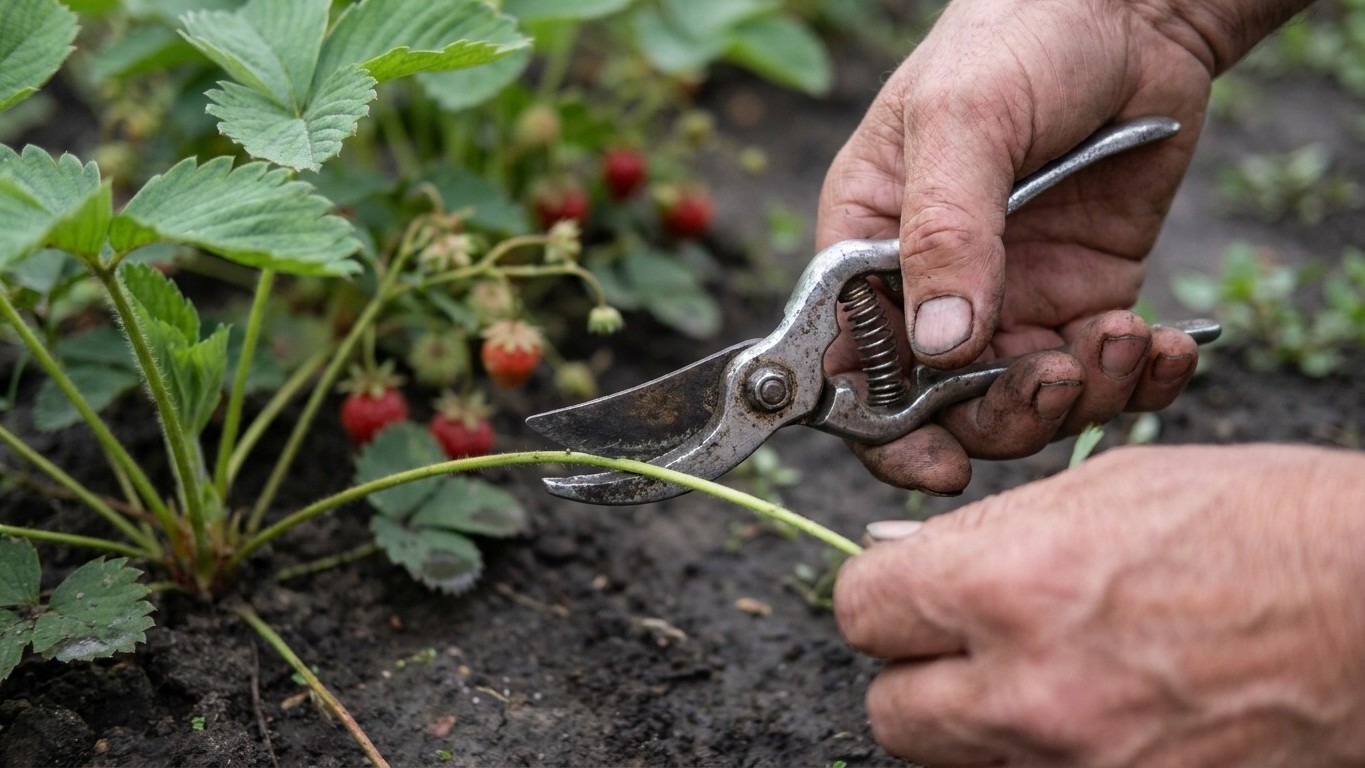
July is the make-or-break month for strawberry plants. By then, the main harvest is winding down, and every June-bearing variety in the yard has started throwing out long, wiry stems reaching for empty soil. My understanding-why-he-was-right/”>understanding-why-he-was-right/”>understanding-why-his-plant-produced-all-summer-long/”>grandfather-always-walked-his-potato-rows-with-a-bucket-in-july-i-laughed-for-years-before-understanding-why-he-never-lost-a-single-plant/”>grandfather-always-picked-his-green-beans-every-two-days-even-when-the-pods-looked-tiny-i-thought-it-was-impatience-for-years-before-understanding-why-he-was-right/”>grandfather would walk the rows with his pruning shears, snip every single one, and toss them in a bucket without a second thought. I used to think it was wasteful. Weren’t those runners just… more strawberry plants, free of charge? Why cut off something that multiplies itself?
For years I let mine sprawl. The patch looked lush, generous, almost jungle-like by August. And the following summer, the berries were smaller, fewer, and honestly kind of disappointing. It took me longer than I’d like to admit to connect the dots: my grandfather wasn’t being stingy with his strawberry plants. He was protecting them.
Key takeaways
- A single strawberry plant has a limited daily energy budget—every calorie spent growing runners is stolen directly from berry production
- Unpruned patches look lush but produce smaller fruit and invite fungal diseases through overcrowding and poor air circulation
- There’s one exception: letting 1-2 runners root strategically can renew aging plants without sacrificing this year’s harvest
What a Runner Actually Costs the Plant
A strawberry runner, technically called a stolon, is the plant’s way of cloning itself. A mother plant sends out lots of stolons throughout the season in an attempt to clone itself, and each stolon establishes roots while sucking off the energy of the mother plant. That’s not a metaphor. Strawberry plants have a certain amount of leaves, each with a certain capacity to photosynthesize every day, and as the plant uses sunlight, water, and carbon dioxide to produce energy, it naturally allocates certain amounts of energy to different plant functions. There’s no bonus reserve tank. Every joule the plant spends building a new daughter plant is a joule it isn’t spending plumping up the fruit already on the vine.
Flowering and fruiting require a lot of energy, so you don’t want the plant to use its valuable glucose stores growing runners when it could be growing fruit, and removing them ensures maximum energy channels toward berries. That’s the whole logic behind my grandfather’s July ritual. He wasn’t fighting nature, he was redirecting it. And the timing Matters More Than most gardeners realize: strawberries have finite energy reserves, and every calorie directed toward runner growth is a calorie stolen from berry development, which is why June-bearing varieties should have runners allowed only after the final harvest in July, with all runners removed during spring flowering and fruiting.
The Crowding Problem Nobody Warns You About
Left unchecked, a strawberry patch doesn’t just lose vigor, it turns into a competition for survival. When runners are allowed to root freely and mother plants are set at wide spacing with runners permitted to colonize the open space, the system trades off fruit quality, and the resulting high density leads to overcrowding and competition for light, water, and nutrients, often resulting in smaller fruit size and reduced yield per plant. That’s exactly what happened to my patch during those ignorant years. It looked abundant. It wasn’t.
There’s also a disease angle most people never think about until it bites them. Not cutting runners leads to smaller, fewer berries as the plants compete for resources, increases the risk of fungal diseases due to poor air circulation, and the mother plants may become exhausted more quickly, shortening their productive lifespan. A dense, tangled mat of leaves holds moisture longer after rain or watering, and moisture sitting on foliage for hours is basically an invitation for fungal spores. My grandfather’s rows always had breathing room between plants, which in hindsight wasn’t just tidiness. It was disease prevention disguised as pruning.
Nitrogen Makes This Worse, Not Better
Here’s the twist I didn’t expect: feeding your strawberries generously can actually backfire if you’re not also managing runners. Too much nitrogen can lead to excessive leaf area that’s out of balance with the rest of the plant, and also produces too many runners and insufficient flowers, since strawberries are quite sensitive to excessive rates of nitrogen. a heavily fertilized, unpruned strawberry bed is a double whammy: more runners competing for the same finite energy, and fewer flowers to turn into fruit in the first place. My grandfather never used much fertilizer on his strawberries, and now I understand that restraint was doing half the work his shears were doing.
Variety matters here too. June-bearing varieties produce one large crop of berries in early summer and are also prolific runner producers, so if you have June-bearing plants and want a big harvest, runner removal is especially important. Everbearing and day-neutral types, which fruit continuously through the season, tend to be less aggressive runner producers, so the stakes of skipping a pruning session are slightly lower, though still real.
When Ignoring the Rule Actually Makes Sense
My grandfather wasn’t dogmatic about it, either. Some years he’d let a few runners root on purpose, usually near the edge of the bed where an older plant was clearly fading. Strawberry plants naturally lose productivity over time, with yields declining significantly after three to four years, so allowing a limited number of runners to root cultivates a continuous supply of young, vigorous replacement plants. This is essentially free plant renewal, and it’s the one legitimate reason to break the July rule. Commercial growers use a version of this called the matted row system, letting runners fill space deliberately rather than by accident.
The trick, if you want the best of both outcomes, is choosing just one or two runners per plant to keep and cutting the rest without mercy. If you want to propagate, allow only 1-2 strong runners per mother plant to root, then remove the rest. Peg the chosen one into a small pot of soil while it’s still attached to the mother plant, let it establish for four to six weeks, then sever it once it’s rooted on its own. You get a replacement plant for next year’s patch, and the mother plant still gets the vast majority of her energy budget for this year’s fruit.
What surprised me most, going back through my grandfather’s habits with actual research in hand, was how little guesswork was really involved. He never talked about nitrogen allocation or photosynthetic capacity. He just knew, from decades of watching the same patch every July, that a strawberry plant can’t do everything-to-stop-back-pain-in-the-kitchen”>everything at once. Cutting runners was never about denying the plant a future. It was about making sure it had the energy to deliver on the present.
Sources : tinygardenhabit.com | nutrientsforlife.org