Compacted soil is a quiet killer. It suffocates roots, repels water, and turns what should be a living ecosystem into something closer to concrete. If you’ve ever pushed a trowel into your garden bed in early spring and felt that stubborn resistance, that dense, airless mass that barely crumbles, you already know the frustration. The good news: there’s a centuries-old remedy that costs almost nothing, takes minutes to apply, and works quietly through the entire growing season. That remedy is agricultural lime, a natural mineral powder that, when spread in early March, can fundamentally shift the biology of compacted, sterile soil.
Key takeaways
- A $20 soil test reveals exactly how much amendment your compacted beds actually need—and most gardeners apply far too much
- Early March timing isn’t random: freeze-thaw cycles have already cracked the soil, and lime enters those micro-fissures just as spring rains begin
- By year three of consistent lime application, gardeners report their soil becomes nearly self-managing, requiring far less intervention than untreated areas
Why Early March Is the Sweet Spot
Timing here isn’t arbitrary. The freeze-thaw cycles of late winter have already done some of the mechanical work, cracking soil particles apart slightly and creating micro-fissures. When lime is applied just as this process winds down, it gets drawn into those gaps with the first rains of spring. Soil temperatures around 40 to 50 degrees Fahrenheit are cold enough to slow microbial competition but warm enough for the chemical reactions lime triggers to begin. By the time you plant in May or June, the transformation is well underway rather than just starting.
Waiting until April or May isn’t catastrophically wrong, but you’re essentially asking lime to race against your planting schedule. Gardeners who spread in early March consistently report better results than those who apply the same product a month later. The calendar entry is worth making now.
What Lime Actually Does to Compacted Soil
The chemistry is worth understanding, because once you grasp it, the results stop feeling like magic and start feeling inevitable. Most compacted soils are also acidic, with a pH below 6.0. At that acidity level, clay particles carry a strong negative charge and bind tightly together, squeezing out air pockets and repelling water. Lime (calcium carbonate, most commonly) introduces calcium ions that displace hydrogen ions, raising the pH toward neutral. As that happens, clay particles begin to flocculate, they clump into looser aggregates rather than pressing flat against each other.
The practical result is dramatic. A soil that was 10% air space might reach 25 to 30% after a full growing season with lime. Roots can push through. Earthworms, which avoid acidic soil the way most people avoid crowds, move in. And those earthworms accelerate the process further by physically tunneling channels and leaving behind castings that act as a natural binding agent, holding the new, looser structure in place rather than letting it revert when dry.
There’s also a microbial dimension that often goes unmentioned. Bacteria responsible for decomposing organic matter are largely suppressed below pH 5.5. When lime nudges that number upward, suddenly the entire decomposition cycle restarts. Dead leaves, woody mulch, even last year’s roots begin breaking down into actual humus. The soil starts feeding itself.
How to Apply It Without Overthinking
The most common mistake is applying lime without a soil test. A test (available from most county extension offices for $10 to $20, or as an inexpensive kit from any garden center) tells you two things: your current pH and how much amendment you actually need. Applying too much lime creates its own problems, locking up nutrients like iron and manganese. A pH between 6.2 and 6.8 is the target for most vegetables and ornamentals.
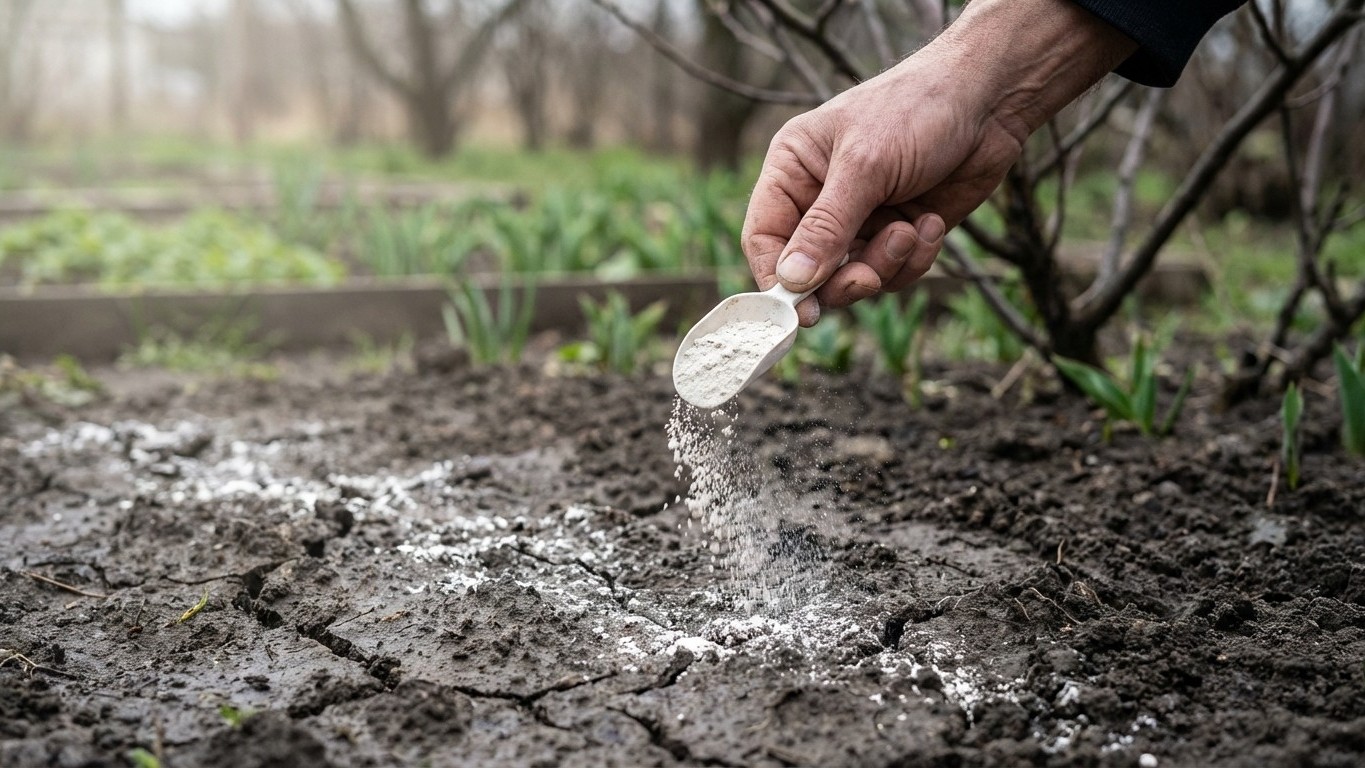
Once you have your numbers, the application itself is almost meditative in its simplicity. Use a broadcast spreader for large areas, or just scatter by hand with gloves for smaller beds. Pelletized lime is easier to handle than powdered lime, less dust, more even distribution, though both work equally well over time. A typical dose for moderately acidic soil runs around 50 pounds per 1,000 square feet, but your test results will refine that number.
Water it in after spreading, or let incoming rain do the work. No tilling required. The lime doesn’t need to be incorporated deeply; it moves downward naturally as water carries calcium ions into the soil profile.
What You’ll See (and When)
Patience is the one non-negotiable ingredient. Lime doesn’t operate on a week’s timeline. The first visible sign usually appears six to eight weeks after application: the soil surface feels slightly less crusty after rain, and you might notice a few more earthworms when you dig. By midsummer, vegetable plants in limed beds tend to show deeper green color (a sign that calcium is supporting cell wall development) and faster growth through what would have been the typical mid-June stall.
The structural improvement compounds over years. A garden bed treated with lime for three consecutive springs doesn’t just have a better pH, it has a fundamentally different architecture, one where water infiltration is faster, drought resilience is higher, and compaction returns much more slowly even under foot traffic. Some long-term gardeners describe their third-year lime beds as almost self-managing, requiring far less amendment and intervention than untreated areas.
Wood ash, another natural calcium source, gets mentioned as an alternative, and it does raise pH. The catch is inconsistency: wood ash potency varies wildly depending on what was burned, and it raises pH faster and less predictably than lime, which can overshoot. For compacted, seriously degraded soil, lime’s steady, reliable action is the better tool. Save the ash for a quick top-dress between plantings.
There’s something philosophically interesting about the whole process. You’re not forcing the soil to perform, you’re removing the obstacle that prevented it from performing on its own. The fertility was there the entire time, locked behind an acidic barrier and structural collapse. Early March, a bag of lime, and a bit of patience, and the soil essentially remembers how to work.