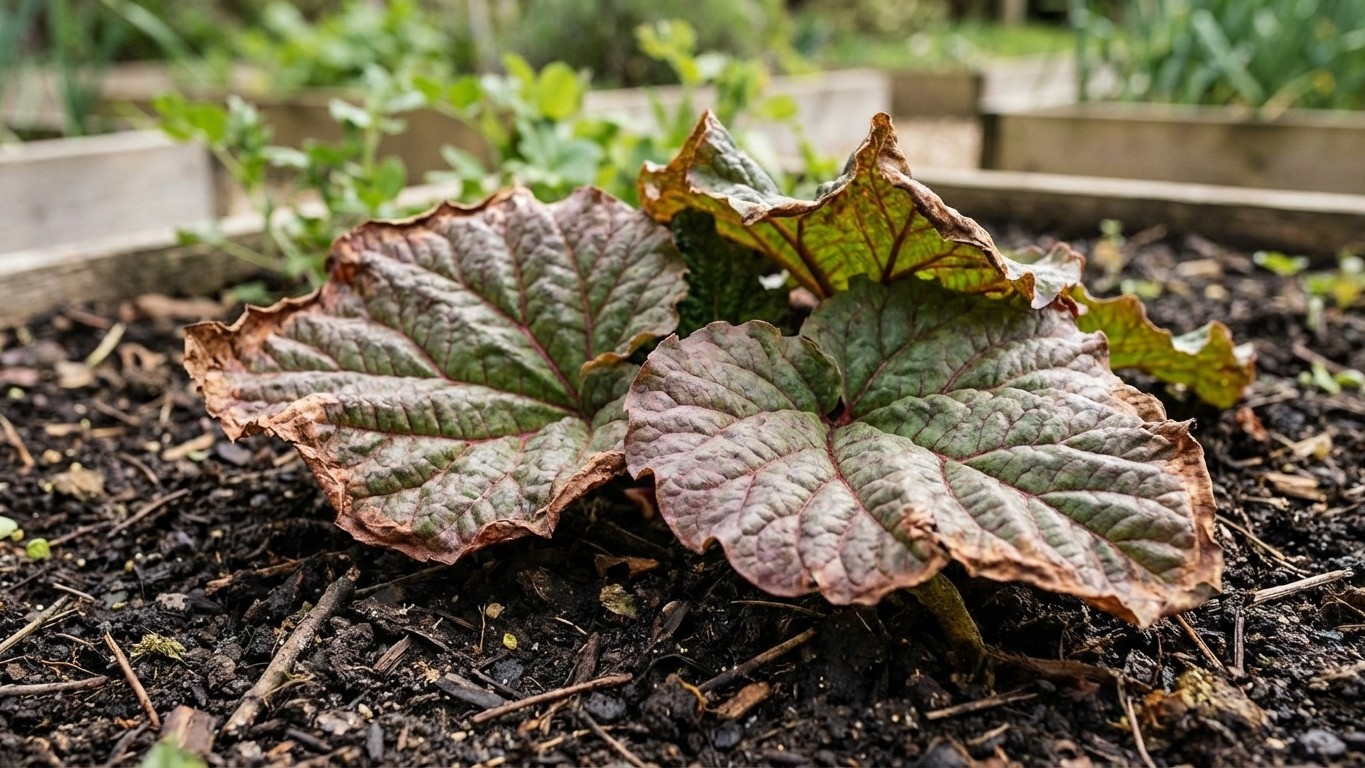
Rhubarb leaves are one of the most commonly composted garden scraps in America. Pull the stalks, toss the leaves in the bin, done. Except the leaves contain oxalic acid at concentrations high enough to raise real questions about whether they belong in the pile at all, and whether your finished compost is silently working against you.
Key takeaways
- One common garden scrap contains a compound that quietly shuts down the microbial engine powering your entire compost system
- The dose and the method matter more than most gardeners realize — what works in industrial facilities fails spectacularly in backyard bins
- There’s a centuries-old solution from British kitchen gardens that turns the problem into a valuable liquid asset
The chemistry behind the problem
Oxalic acid is the compound that makes rhubarb leaves toxic to humans and pets. The concentration in the leaves runs somewhere between 0.5% and 1% by dry weight, enough to cause serious harm if ingested in quantity. But the concern for composting isn’t toxicity to people. The concern is what it does to the microbial ecosystem living in your bin.
Compost works because of bacteria, fungi, and other microorganisms that break organic matter down into stable, nutrient-rich humus. These organisms are sensitive to pH and chemical stress. Oxalic acid, true to its name, drops the local pH in whatever zone it contacts first. A sudden acid spike doesn’t kill your whole pile, but it suppresses microbial activity in that zone, slowing decomposition, sometimes creating anaerobic pockets, and giving you clumpy, half-finished material instead of the crumbly dark gold you were expecting.
A small number of fresh leaves added to a large, well-balanced pile? The pile buffers it. A full season of rhubarb leaves dumped into a small backyard bin? That’s a different story. The dose makes the poison here, even for microbes.
What actually happens when you compost them in bulk
The oxalic acid doesn’t stay in its original form forever. Given time and the right conditions, adequate moisture, enough carbon-rich “browns,” and reasonable temperatures — the acid does break down. This is the argument gardeners who defend rhubarb leaf composting usually make, and it’s not wrong. The problem is the word “adequate.”
Most home composters don’t run hot piles. A properly hot compost pile reaches 130 to 160°F at its core, which accelerates microbial activity and speeds the breakdown of stubborn compounds. Most backyard bins sit in the 70 to 90°F range, which is fine for general composting but means rhubarb leaves decompose much more slowly than in a hot system. In a cool, passive pile, leaves can sit largely intact for weeks, releasing acid gradually into the surrounding material.
There’s a compounding issue: rhubarb leaves are large and leathery. They mat. They form physical barriers in the pile that block airflow and moisture distribution, two things your microbes need to thrive. Even setting the oxalic acid aside, the physical structure of the leaves creates problems. Shredding them before adding them helps significantly, but most gardeners skip that step entirely.
The smarter ways to handle rhubarb leaves
The Royal Horticultural Society’s position, for what it’s worth, is that rhubarb leaves can go in compost, provided they’re mixed well with other material. The key phrase is “mixed well.” Not tossed on top. Not accumulated in a corner. Mixed, layered, balanced with carbon materials like cardboard or straw.
If you’re running a hot compost system, turning the pile regularly, monitoring temperature, maintaining a roughly 25-to-1 carbon-to-nitrogen ratio — rhubarb leaves are manageable. Your pile has the biological firepower to process them without stalling. If you’re running a slow cold pile, the better call is to handle them differently.
One option that works well: steep the leaves in water for several weeks to make a liquid fertilizer. This has been practiced in British kitchen gardens for generations. The resulting liquid, diluted before use, delivers nutrients to soil without the pH disruption to your compost structure. The oxalic acid disperses into the water and then dilutes further when you apply it, making it a non-issue at the concentrations that reach plant roots.
Another option that gets less attention: municipal green waste programs. Most curbside composting operations use industrial-scale windrow systems that reach sustained high temperatures. The volume and heat that those facilities generate degrades oxalic acid efficiently. What doesn’t belong in your backyard bin might be perfectly appropriate for the city’s program. Check your local rules, rhubarb leaves are generally accepted in these systems.
Leaving the leaves to dry on the ground before disposal is also worth considering. Dried leaves have lower oxalic acid concentrations than fresh ones, because some of the acid breaks down as the tissue desiccates. It’s a minor reduction, but it matters if you’re determined to compost them at home in volume.
The broader lesson hiding in plain sight
Rhubarb leaves are not uniquely dangerous. They sit in a category with several other common garden scraps, black walnut husks (which contain juglone, toxic to plants), eucalyptus leaves (high in oils that suppress microbial life), and camphor laurel clippings — where the issue isn’t that composting is impossible, but that most gardeners compost them as if they’re inert. They’re not.
The compost pile is a living system. Every input changes its chemistry, even temporarily. Most inputs are benign enough that the system absorbs the variation without blinking. A few are strong enough to matter, and rhubarb leaves are in that second group when they’re added in quantity, fresh, to a small passive bin.
Worth knowing: the oxalic acid does not transfer meaningfully into mature, finished compost that has been properly processed. Studies on oxalate persistence in compost show that concentrations drop to negligible levels in well-managed systems. The risk to your garden beds, assuming you’re using finished compost, is effectively zero. The risk is upstream, to the process itself, not the product.
If your compost pile has seemed sluggish for no obvious reason, and you’ve been dropping rhubarb leaves in regularly, that might be the diagnosis you weren’t looking for.