
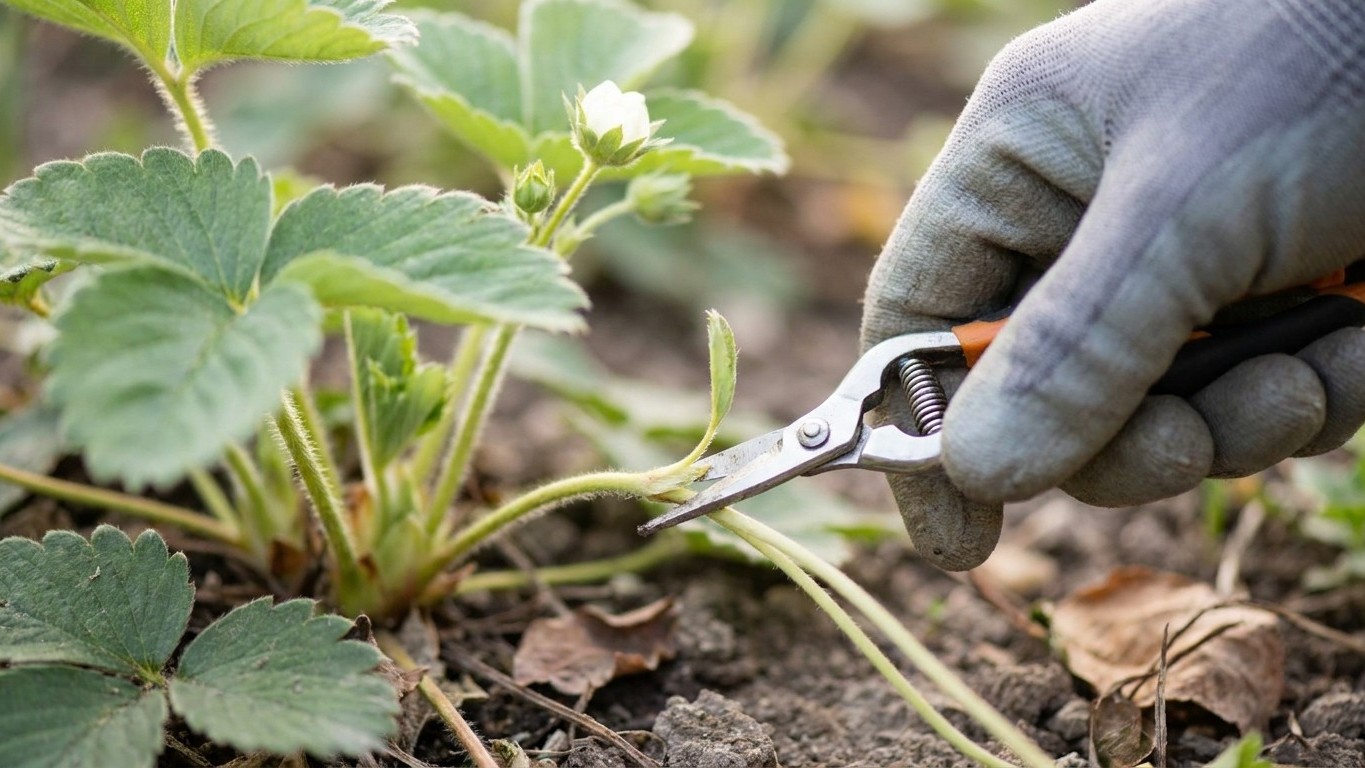
Strawberry runners are robbing your plants blind. Every spring, gardeners fuss over watering schedules and soil pH while the real thief operates in plain sight, those delicate little offshoots snaking across the bed, each one quietly siphoning energy that should be going straight into fruit production. A retired strawberry grower in rural Vermont put it bluntly when I watched him work his rows last May: “Cut the babies off before they drink the sugar.” Harsh? Sure. But his harvest looked like something out of a catalog.
Key takeaways
- A single strawberry plant can produce 3-5 runners that multiply exponentially, each one siphoning carbohydrates meant for fruit
- The timing trap: runners emerge exactly when plants are flowering and setting fruit, forcing plants to choose between berries and babies
- One specific weekly ritual, practiced by a veteran grower for decades, consistently produces nearly double the harvest of casual gardeners
What runners actually do to your harvest
A strawberry runner, botanically called a stolon, is a horizontal stem the plant sends out to clone itself. Left unchecked during the fruiting window, each one can pull significant carbohydrate reserves away from flower and fruit development. A single established plant can produce anywhere from 3 to 5 runners per season, and each of those runners can generate its own secondary runners. The math compounds fast. One overlooked plant becomes a sprawling network of energy consumers before you’ve picked your first berry.
The timing is the trap. Runners typically emerge right as the plant enters peak flowering, late April through May in most temperate U.S. zones. That’s the window when the plant’s energy budget is most stretched. Flowers need resources to set fruit, fruit needs resources to develop, and if runners are competing simultaneously, something loses. Almost always, it’s berry size and quantity that suffer first. You’ll still get strawberries, but they’ll be smaller, fewer, and in some cases noticeably less sweet, because sugar accumulation in fruit is directly tied to photosynthate availability.
The grower’s method, exactly as he showed me
He walked the rows with a pair of ordinary scissors, not pruning shears, not a fancy horticultural tool, just scissors — and cut every runner at the base, as close to the mother plant as possible without nicking the crown. His rule was simple: during flowering and fruiting season, no runner survives. Not even the ones that look like they’ve already rooted. Especially those ones, actually, because a partially rooted runner is still drawing from the mother plant while establishing its own root system, creating a double drain.
He did it weekly. That’s the part most home growers skip. Runners don’t emerge all at once, they’re produced continuously throughout the growing season, so a single early-May cleanup does almost nothing if you ignore the bed for the rest of the month. He treated it like deadheading roses: a recurring task, not a one-time fix. Fifteen minutes per 10-foot row, once a week from first bloom to last harvest. His yield over three seasons averaged nearly double what neighboring hobby gardeners were pulling from comparable-sized beds.
One detail he stressed: never yank runners off. Pulling can disturb shallow feeder roots near the crown, and strawberry crowns are surprisingly vulnerable. Clean cuts only. If the scissors get sticky from sap, wipe them with a damp cloth, not because of disease transmission risk at that scale, but because sticky blades crush rather than cut, leaving ragged wounds that dry out slowly.
When you actually want to keep the runners
There’s a season for everything, including runners. After the final harvest, typically late June or early July depending on your variety and location — letting runners establish is how you propagate new daughter plants for the following year. Most strawberry beds decline in productivity after 3 years, and runners are the free, genetically identical replacements that keep the bed vigorous. The grower kept a dedicated propagation strip at the edge of his main bed specifically for this purpose: runners from his best-producing mother plants were directed there after harvest ended, pegged lightly to the soil with a small stone, and allowed to root over summer.
June-bearing varieties produce runners most prolifically, which makes the spring management window particularly critical for those plants. Everbearing and day-neutral varieties (like Seascape or Albion, both widely available) tend to produce fewer runners naturally, which is one reason some gardeners prefer them for low-Maintenance setups, though they still need monitoring during their own peak flowering cycles.
The other thing he mentioned, almost as an afterthought
Near the end of the row walk, he paused at a plant with noticeably darker, glossier leaves than its neighbors and pointed to the crown. “That one’s been sitting in water.” Drainage, he said, is the silent accomplice to the runner problem. Plants stressed by waterlogged soil send out more runners as a survival response, a kind of reproductive insurance when conditions turn hostile. So a bed with poor drainage doesn’t just risk root rot; it actively triggers the exact behavior you’re trying to suppress. Raised beds or well-amended soil with genuine drainage keeps plants in a growth mode focused on fruit rather than escape.
He’d also stopped using any nitrogen-heavy fertilizer after early spring. High nitrogen pushes vegetative growth, leaves, stems, runners, at the expense of flowering. A lower-nitrogen, higher-potassium feed applied just before bloom encourages the plant to prioritize reproduction over expansion. Potassium specifically supports sugar transport within the plant, which is why high-potassium strawberry feeds tend to produce noticeably sweeter fruit. Wood ash, used sparingly, is a traditional potassium source that several old-school growers still swear by, though its alkalizing effect on soil pH means it needs to be applied with some restraint in beds that are already neutral to slightly alkaline.
The scissors are already in your kitchen drawer. The weekly 15 minutes is the only real investment here, and if a Vermont grower who’s been doing this since before most of us were alive considers it non-negotiable, it’s probably worth taking seriously before your May harvest quietly underperforms again.