
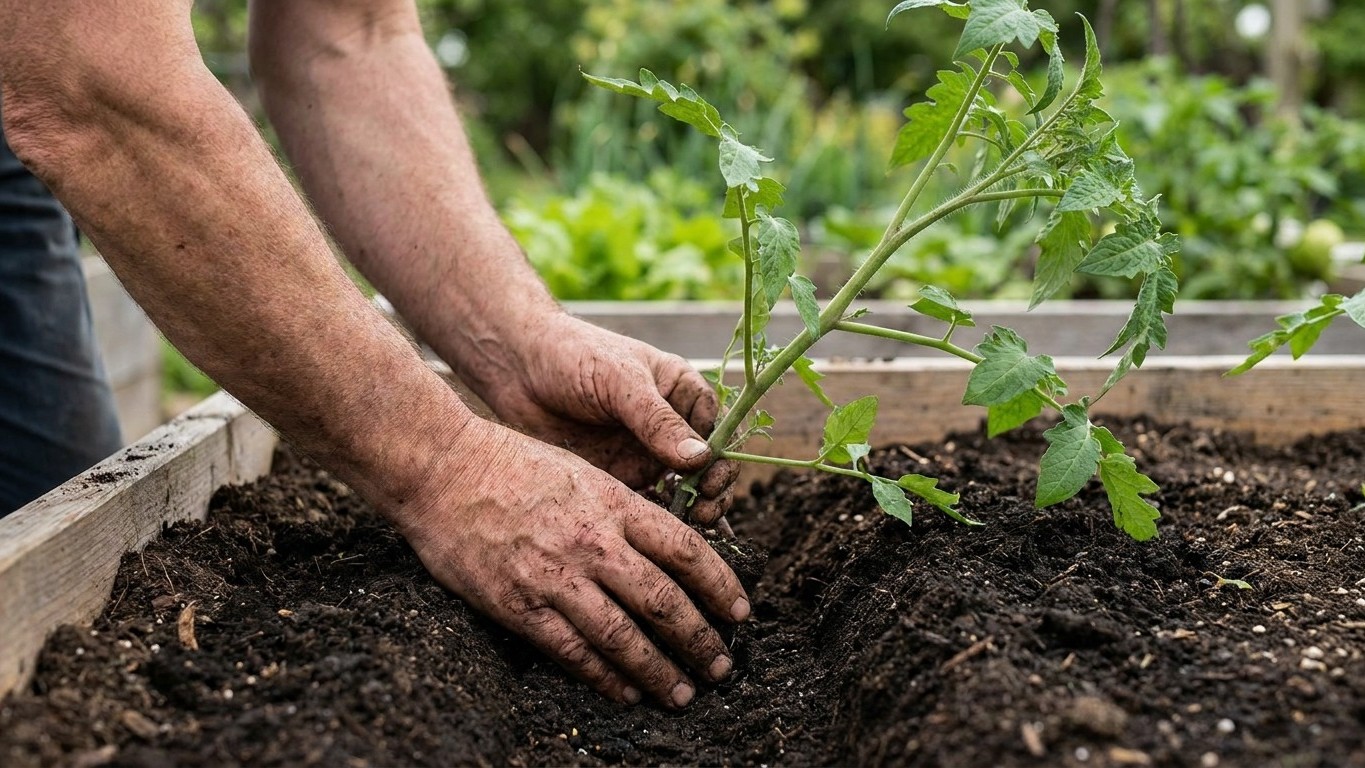
One tip. That’s all it took. An old market gardener, weathered hands pressing a seedling flat into a shallow trench, said: “Bury them sideways.” No explanation needed, apparently, because the results did the talking by mid-July. Tomato plants so vigorous, so lush and anchored, they looked like a different species entirely from the spindly things planted upright in the bed next to them.
The technique is called trench planting, or sideways planting, and it has been passed down through generations of serious vegetable growers. It’s a strategic planting method where you dig a trench and plant a tomato vine sideways, or horizontally, to take advantage of the plant’s ability to grow adventitious roots. That word, “adventitious,” is key to understanding why this works so well.
Key takeaways
- A single sideways planting technique can double or triple a tomato plant’s underground root mass
- Tomatoes naturally grow adventitious roots along their entire buried stem—a biological trait most gardeners never exploit
- The hidden benefit: plants become dramatically more resilient to drought, disease, and nutrient deficiencies like blossom end rot
The Biology Behind the Trick
When you plant tomatoes on their side, all of the stem area that is buried in the ground will send out roots. Most plant stems rot if they’re too far in the ground, but tomatoes have cells in their epidermal layer that will turn into roots instead. This is not a gardening myth, it’s botany. Tomatoes’ tendency to form adventitious roots along the stem has made them famous among botanists. Under good conditions, these adventitious or stem roots expand the plant’s rooting capacity, and when floods occur, they help the plants breathe.
Think of it this way: a wild tomato plant, left to its own devices, wouldn’t grow straight up like a soldier. If a tomato were left to meander in nature, the vines would crawl along the ground and sprawl over small shrubs. Every node that touched the soil would grow roots, and this would eventually form a continuous root system that could absorb water from multiple locations. Commercial growing and home gardening have conditioned us to stand them upright, but in doing so, we’ve been cutting them off from their full potential.
Burying them on their side can lead to two, if not three times, the amount of root mass below the soil, depending on how much of the stem you bury. That’s not a marginal improvement. That’s a fundamentally different plant.
What It Actually Does for Your Harvest
Planting tomatoes sideways promotes the growth of additional roots along the buried stem, which can help the plant absorb more water and nutrients, resulting in a more vigorous and productive plant. More roots mean more reach. More reach means better access to everything the soil has to offer, and that shows up on the vine.
There’s a practical health benefit that often gets overlooked: the bigger the root mass, the tougher and more resilient the tomato plant will be against pests and diseases in the garden. Bigger roots also mean better drought resistance and better uptake of nutrients. In a summer that decides to turn dry and relentless, that difference between a shallow root ball and an expansive underground network can mean the difference between a struggling plant and a thriving one.
This method is particularly beneficial in preventing conditions like blossom end rot by ensuring a robust uptake of calcium. Blossom end rot, that ugly dark patch that appears on the bottom of otherwise perfect tomatoes, isn’t caused by a lack of calcium in the soil, it’s caused by irregular absorption. A bigger, healthier root system keeps the supply chain steady.
The topsoil layer, richer in nutrients and better at draining excess moisture, gives seedlings a strong start, especially if the soil is not of the best quality. Even in ideal soil conditions, tomatoes thrive in warm temperatures, so planting them deeper, where the soil is cooler, might hinder their growth. The horizontal trench keeps roots in the warmest, most active layer of soil. In colder climates especially, this matters enormously in early spring.
How to Do It Properly
The technique is simpler than it sounds. You’ll need to dig a trench that’s roughly 6 to 8 inches deep, and long enough to bury all but the top one-third to one-quarter of the plant. Before laying the plant down, strip every leaf from the section of stem that will be underground. Remove the leaves from any part of the stem that will be buried underground; if the lowest leaves are touching the soil, remove them so you have at least two inches of stem to keep the lower leaves off the ground. Leaving any foliage underground is an open invitation for rot and disease.
Gently remove the plant from its pot and lay it sideways in the trench with the top of the plant sticking out of it. Press the soil back down around the plant, up to about one inch below the first set of leaves and water it in. The exposed top will look awkward at first, maybe even a little defeated, pointing at a diagonal or lying nearly flat. Give it a week. The tomato will naturally grow toward the light, upwards.
One thing experienced growers stress: set your supports at the time of planting, never later. If you wait to put in stakes, cages, or trellises, you risk doing significant damage to the plant’s roots, roots you’ve taken extra steps to establish. Setting supports when you plant ensures the roots are not cut or damaged later on. That extended underground stem is an asset; accidentally driving a stake through it erases half the work.
For an extra edge, add some mycorrhizal fungi to the trench before burying the tomato. These beneficial fungi act like a secondary root system, giving the tomato an even larger nutrient and water network below the ground. Compost works too. Compost is the best all-around soil amendment to prepare for a bumper crop of tomatoes. Spread 4 to 6 inches of compost over the entire tomato plot. Even though you’re planting in trenches, it’s best to evenly improve the entire garden bed to help regulate moisture and encourage a dense web of roots.
A Few Things Worth Knowing Before You Dig
Not every tomato variety responds the same way. Determinate tomatoes tend to have thicker stems, as they’re not vining like indeterminate tomatoes. This means they’re less flexible and more prone to breaking if you try to bend them by burying them sideways and training the plant above ground to grow straight again. For compact, bush-type varieties, consider simply planting them more deeply in a vertical hole rather than horizontally.
The sideways method also excels as a solution for a very common early-season problem: leggy seedlings. As the season warms up, early-started seedlings might become tall and spindly, prone to flopping over or snapping. Sideways planting addresses this issue by burying most of the stem, which prevents breakage. Also, encourages the growth of sturdy, vertical roots, enhancing the plant’s stability as it matures. Those “failed” indoor seedlings that stretched too far toward the grow light? They’re actually perfect candidates for this technique. The longer the stem, the more rooting surface you have to work with.
After planting, water deeply but resist the temptation to water constantly. Water deeply but less frequently; this will encourage the plant to stretch all those new roots deep into the ground to find water. This is what will keep your tomatoes going during periods of drought. Overwatering short-circuits the entire process, roots don’t go exploring when everything they need is delivered to their doorstep. A little strategic neglect, after the initial establishment week, is exactly what builds the kind of deep, drought-hardy root system that makes tomato plants genuinely self-sufficient come August.
Sources : gardenbetty.com | blog.grownowharvestlater.com