
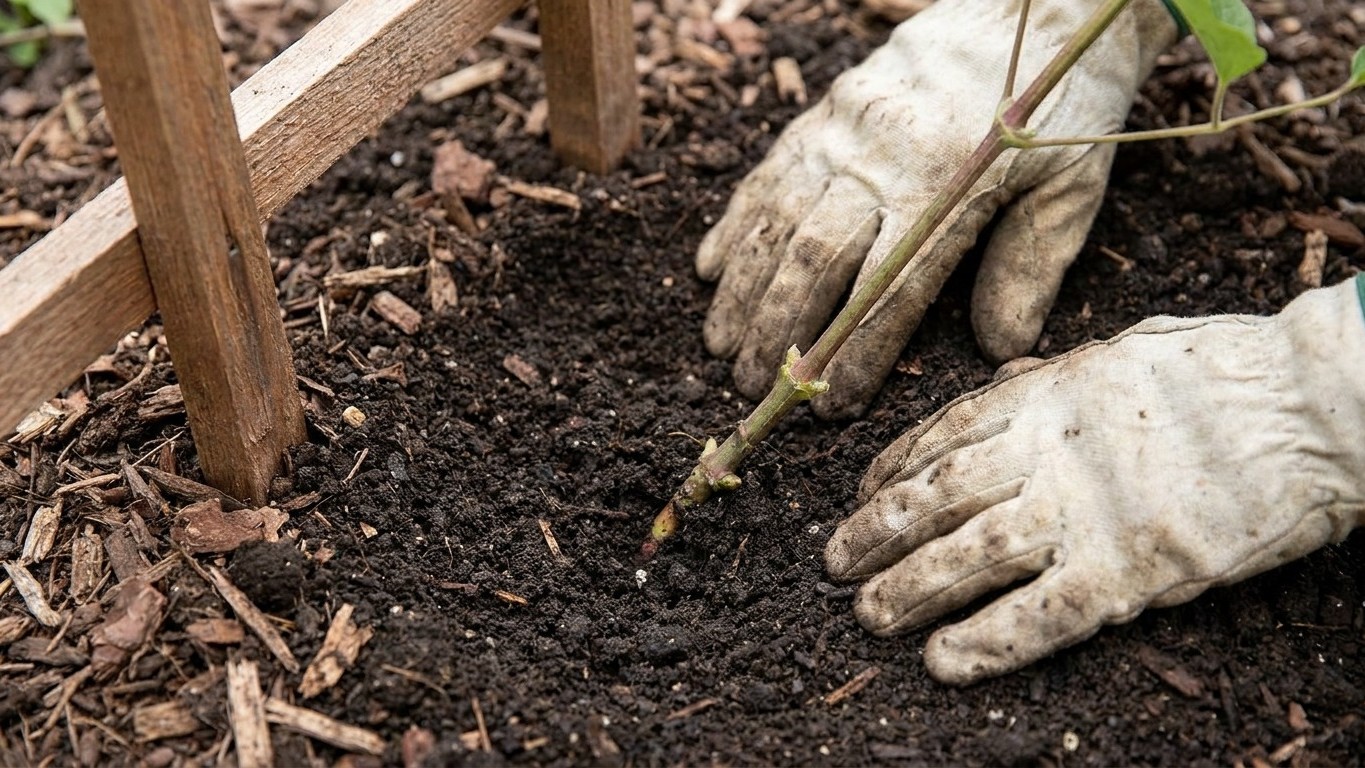
Most gardeners treat clematis like any other perennial: dig a hole, pop the root ball in, cover it up, water it in. Reasonable logic, completely wrong approach. A nursery grower in Vermont, after watching me nearly kill my third clematis in four years, pointed to a spot on the stem and said something I’ve never forgotten: “If this node isn’t underground, you’re gardening against the plant.”
That node, a swollen joint on the stem, typically 2 to 4 inches above where the roots end — is the secret that separates struggling clematis from the ones that climb six feet in a season and come back stronger every spring. Bury it, and the plant gains an insurance policy against its worst enemy. Leave it above ground, and you’re one bad week of weather away from starting over.
Key takeaways
- A tiny swollen joint on the stem holds the key to clematis survival—but only if it’s hidden underground
- The fungus that kills clematis attacks at soil level; buried nodes act as a protected backup plan that keeps the plant alive
- Year two is when deep-planted clematis explode with growth, while shallow-planted neighbors continue to struggle
Why clematis isn’t just another perennial
Clematis wilt is the silent killer most gardeners chalk up to bad luck. One day the vine looks healthy; the next, a stem collapses entirely, turning black from the tip down. The culprit is a fungal pathogen, Phoma clematidina, which enters through damaged tissue at or near soil level. Most perennials can shrug off surface-level fungal infections with minimal permanent damage. Clematis, particularly the large-flowered hybrid varieties, often can’t, unless there’s something buried below the infection point ready to regenerate.
That’s exactly what the buried node provides. Planted 3 to 4 inches deeper than it sat in its nursery pot, the node sits below the soil line, protected from the fungus, from hard freezes, and from mechanical damage caused by foot traffic or enthusiastic weeding. When wilt strikes and kills everything above ground, the plant doesn’t actually die, it simply retreats, pushing fresh growth from those protected nodes the following spring. Without them underground, wilt is often terminal.
This is why you’ll find clematis explicitly excluded from standard perennial planting guides. The Royal Horticultural Society, which has studied clematis culture extensively, recommends deep planting as a non-negotiable step rather than an optional technique. The plant evolved across rocky, well-drained European and Asian hillsides where stems naturally get buried under shifting soil and debris. We’re not improvising, we’re replicating conditions the plant spent millennia adapting to.
The practical mechanics of getting it right
Before you dig, look at the stem. On a healthy clematis fresh from the nursery, nodes are visible as slightly raised bumps or joints along the lower stem, often where leaf pairs attach. Your target is to have at least one, ideally two, of those nodes sit below the finished soil level. The plant’s crown (where stem meets root ball) should end up roughly 3 inches underground.
The hole needs to go deeper than you think. For a standard nursery clematis in a one-gallon pot, that means digging to about 15 inches rather than the usual 8 or 9. Angle the plant slightly toward its support structure, 45 degrees works well, so the stem can begin climbing without stress. Backfill with amended soil rich in organic matter, water thoroughly, and mulch generously, keeping the mulch pulled back a few inches from the stem itself to prevent rot at the surface.
One thing the nursery grower mentioned that genuinely surprised me: the stem you bury doesn’t have to emerge straight up. If the plant is leggy or has a long bare section between root ball and first leaves, you can lay that portion horizontally in a shallow trench before angling it upward. Multiple nodes get buried at once, giving the plant even more regeneration points. Roses gardeners use a similar trick with bare-root planting; clematis just requires it more urgently.
What happens in the seasons that follow
The first year after deep planting often looks underwhelming. Growth is slower than neighbors’ clematis, the vine may not reach the top of its trellis, and you might wonder if you’ve done something wrong. You haven’t. The plant is investing that first season underground, developing a root system and establishing those buried nodes. Year two is where the transformation happens, denser growth, more blooms, and a resilience that plants in shallow soil simply don’t match.
Pruning group also interacts with deep planting in ways worth understanding. Clematis are divided into three pruning groups based on when they bloom. Group 3 varieties, the late-summer bloomers like Jackmannii, get cut back hard each spring, sometimes to within a foot of the ground. Without buried nodes, that kind of aggressive pruning leaves almost nothing with regenerative capacity. With them underground, the plant treats hard pruning as a minor inconvenience rather than a near-death experience.
Group 1 varieties, which bloom on old wood in early spring, require no pruning at all and are generally more robust, so the stakes are lower, though deep planting still helps with wilt resistance and winter survival in colder zones. Group 2, the repeat bloomers, fall somewhere between: light pruning in spring, and they benefit enormously from the buried-node approach since they’re often the most susceptible to the dramatic wilt episodes that leave gardeners baffled.
Across all three groups, there’s a documented correlation between planting depth and long-term plant longevity that most casual gardening resources simply gloss over. A clematis planted at the correct depth in well-prepared soil can thrive for 25 years or more, the equivalent of a small tree in garden time. The ones planted casually, like I had been doing, tend to limp along for three or four seasons before quietly giving up. The difference isn’t luck, variety selection, or soil chemistry. It’s three inches of stem, buried deliberately, before you ever water the plant in.