
Every gardener knows the feeling: you step outside on a dewy morning, coffee in hand, and find your hostas or lettuce reduced to lace overnight. Slugs. Silent, relentless, operating entirely under cover of darkness. And what’s the kitchen scrap that thousands of home gardeners are now sprinkling around their beds to stop them? The very same thing you’re holding in your mug. Used coffee grounds.
The idea feels almost too convenient to be true, that your daily brewing ritual produces a free, ready-made slug deterrent that you’d otherwise rinse down the sink. But the science here is real, even if the practical results are more nuanced than the gardening internet would have you believe.
Key takeaways
- Scientists found that caffeine solutions kill slugs by destabilizing their heart rate—but your morning grounds contain far less caffeine than lab-tested concentrations
- The real magic isn’t just slug prevention: coffee grounds add nitrogen and beneficial microbes while improving soil structure in both clay and sandy soils
- Heavy rain washes away your slug barrier on the exact schedule slugs become most active—here’s the timing trick that actually works
The Science Behind the Cup
Researchers have discovered that solutions of caffeine are effective in killing or repelling slugs and snails when applied to foliage or growing medium, and at high concentrations, this familiar stimulant becomes a lethal neurotoxin to garden pests. The finding emerged somewhat accidentally: while field-testing caffeine as a toxicant against an introduced frog pest infesting potted plants in Hawaii, scientists discovered that large slugs were killed by spray applications containing just 1 to 2% caffeine.
The follow-up results were striking. A drench treatment using a 1% or 2% solution of caffeine caused 100% of slugs to exit treated soil, and the majority subsequently died from caffeine poisoning. A 2% solution applied to orchid growing medium killed 95% of orchid snails and gave better control than a standard Commercial liquid metaldehyde product. That last detail matters: a kitchen scrap outperforming a commercial pesticide is worth paying attention to.
One reason caffeine works so well on slugs specifically, where it fails against most insects, is that most bugs have a water-repelling exoskeleton. Slugs don’t. Their mucus, which is the basis for their locomotion, is very high in water content, and that permits water-soluble caffeine easy entry. Once inside, the neurotoxic caffeine destabilizes the mollusks’ heart rate. Unpleasant, yes. Effective, absolutely.
Grounds vs. Liquid: What Actually Works in the Garden
Here’s where things get more honest. The caffeine concentrations found in your spent coffee grounds are a far cry from the 1–2% solutions used in laboratory trials. Spent coffee grounds retain some caffeine after brewing, and many gardeners scatter them around vulnerable plants as a deterrent, but the grounds won’t deliver the same concentrated dose as a caffeine spray, and can reduce slug damage mainly as part of a broader pest management approach.
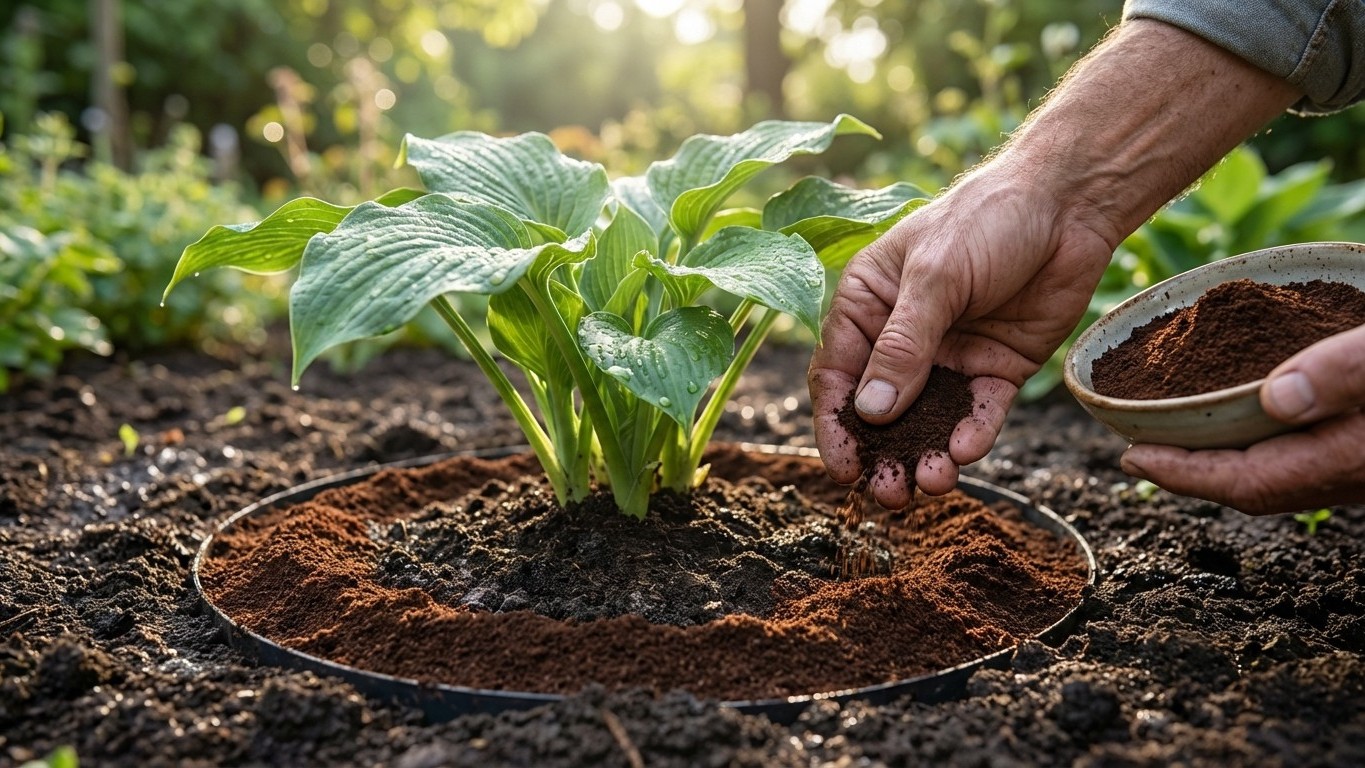
With their soft bodies, slugs and snails don’t like moving over gritty surfaces. Creating a ring of coffee grounds around vulnerable plants discourages slithering pests from bothering them, when a slug touches the coffee grounds, it will feel discomfort and turn around. The operative word is “discomfort,” not death. Think of it as a speed bump, not a wall.
The liquid approach is a different story. Research shows that using a 1% to 2% solution mixed with water as a soil drench caused 100% of slugs to leave the treated soil and subsequently die of caffeine poisoning. So if your slug problem is severe, don’t just sprinkle the grounds and call it done. Brew a strong solution, not decaf, and drench the soil around your most vulnerable plants directly.
A critical caveat: “The caffeine and rough texture can discourage slugs from crossing treated areas, though used grounds are much less effective than fresh ones. Rain quickly washes them away, and too many grounds can make soil overly acidic. For best results, use a light ring of fresh grounds alongside other natural deterrents like copper tape or diatomaceous earth.”
The Bonus: Your Soil Gets a Gift Too
Here’s where this hack genuinely earns its reputation. Even if your slug problem is moderate and the grounds do only partial deterrent work, the soil benefits are real and compounding. Coffee grounds add nitrogen, organic matter, and beneficial microbes to soil. Spent grounds contain about 2.4% nitrogen, a key nutrient for leafy growth, along with potassium, magnesium, and smaller amounts of phosphorus and calcium.
Coffee grounds are a fine-textured organic material, and mixing them into soil improves its physical properties in several ways: in heavy clay soils, grounds help break up compaction and improve drainage; in sandy soils, they increase the ability to hold moisture. That’s a dual fix for two opposite problems most gardeners deal with. If you want more earthworms in your garden, coffee grounds work as an effective lure, research comparing earthworm activity found that earthworms reproduced at higher rates in unwashed coffee grounds than in standard soil. More worms mean better aeration, faster nutrient cycling, and richer beds over time.
One myth worth dispelling before you go overboard: used coffee grounds are not acidic like the coffee we drink, once brewed, they are closer to pH neutral, between 6.5 and 6.8. So don’t count on them to acidify soil for blueberries or azaleas. That’s a persistent misunderstanding that sends gardeners chasing a result the grounds simply cannot deliver.
How to Use Them Right
Restraint is the word. According to Oregon State University Extension Service soil scientist Linda Brewer, coffee grounds can be worked into soil or added to a compost pile, but should be done with some restraint. “The big message is that generally people are too enthusiastic,” Brewer said.
Apply a ring of coffee grounds around vulnerable plants but avoid piling them directly against stems. A barrier one to two inches wide provides protection while allowing the grounds to enrich the soil gradually. After heavy rain, reapply. The moisture that brings slugs out also dilutes your barrier, the two things happen on exactly the same schedule, which is admittedly annoying.
For the best compost, coffee grounds shouldn’t make up more than 20% of the total volume. And if you don’t drink enough coffee to build meaningful quantities at home, many local cafés give away used grounds for free, and some national chains offer them through dedicated programs. A single morning visit to your neighborhood coffee shop could net you enough material to line several raised beds.
Gardening experts note that while slugs are active all year round, their activity ramps up in spring as conditions become warmer and damper, and spring is a particularly damaging time, since slugs will destroy new growth in herbaceous plants and eat holes through tender leaves. That’s when your coffee routine and your garden routine should become one and the same: brew, save, sprinkle. Repeat until the slime trails disappear.
There’s something quietly satisfying about the idea that the most destructive nightly visitor to your garden can be deterred by what you’d otherwise throw away before 8 a.m. Coffee grounds won’t replace every slug-control strategy in your toolkit, nothing will, but as a free, soil-building, daily-renewable barrier that costs you nothing extra, it might be the most practical garden habit you build this season. The real question is whether slugs in your yard have already become resistant to your current approach, and how long you’re willing to hand them the advantage.
Sources : news.oregonstate.edu | gardeningknowhow.com