
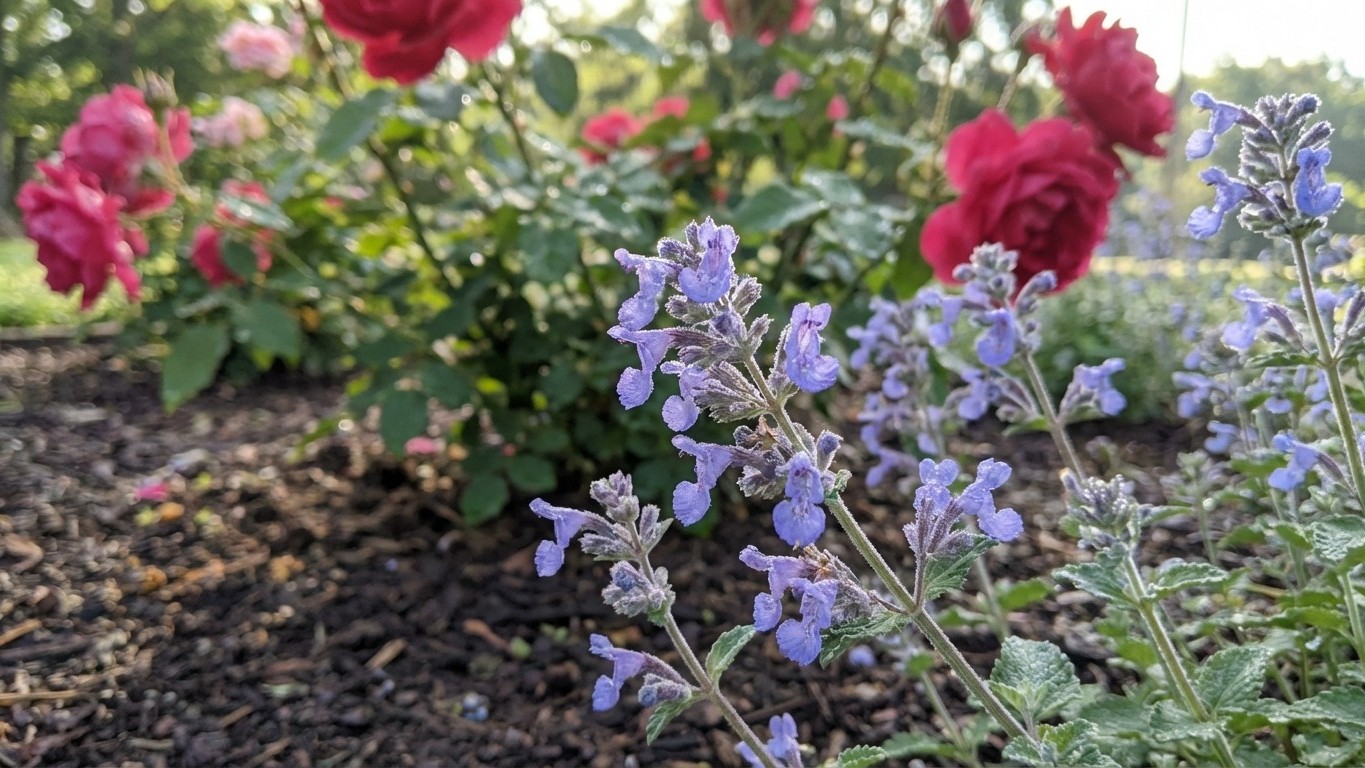
Walk through any thriving rose garden and you’ll notice something: the healthiest plants rarely stand alone. Somewhere close by, tucked between the canes or lining the border, there’s almost always a clump of something else growing. Something aromatic. Something that, if you brush it with your hand, releases a sharp, almost medicinal scent that hangs in the warm air long after you’ve moved on. That plant is catnip — Nepeta cataria and its ornamental cousins, and experienced gardeners have been quietly relying on it for decades as a natural aphid deterrent.
Aphids are one of those garden problems that sneak up on you. One week your rose buds look perfect; the next, the new growth is covered in a shimmering mass of soft-bodied insects, each one feeding on plant sap and secreting a sticky residue called honeydew that invites mold and attracts ants. Chemical sprays work, yes, but they also kill the ladybugs, lacewings, and parasitic wasps that would otherwise handle the problem for free. Gardeners who’ve made peace with their ecosystem figured out long ago that prevention through planting is a smarter play.
Key takeaways
- A common aromatic herb produces a compound that confuses aphids while attracting their natural predators
- Strategic placement within 2-3 feet of roses creates an invisible barrier that works on multiple insect species
- Year-round results require patience, but most gardeners see dramatic improvements by their second season
Why Catnip (Nepeta) Works So Well
The secret is in the chemistry. Catnip produces a compound called nepetalactone, the same substance that sends cats into temporary euphoria. For insects, however, the effect is almost the opposite: a 2011 study from Iowa State University found that nepetalactone repels mosquitoes roughly ten times more effectively than DEET. Aphids, which rely heavily on chemical signals to locate host plants, find the scent of Nepeta deeply disorienting. They don’t land as readily, and when they do, they tend to move on.
There’s a second mechanism at work, too, and this one is more interesting. Nepeta flowers, those soft spikes of lavender-blue that bloom from late spring well into fall — are exceptionally attractive to beneficial insects. Hoverflies, which look like small bees, lay their eggs among aphid colonies so their larvae can feed on them. Parasitic wasps do the same. By planting Nepeta close to your roses, you’re essentially setting up a cafeteria for the insects that keep aphid populations in check. The plant works as both a repellent and a welcome sign, depending on which creature is reading it.
The Right Way to Position It
Placement matters more than most people realize. Catnip needs to be close enough to your roses that its aromatic compounds actually reach the surrounding air space, within two to three feet is the general guideline most experienced growers follow. Planting it at the base of rose bushes works well; so does creating a low border along the front of a rose bed. The sprawling, mounding habit of most ornamental Nepeta varieties (like ‘Walker’s Low’, a Chelsea Flower Show staple that won the Perennial Plant of the Year award back in 2007) makes them natural edging plants anyway.
One caveat worth mentioning: if you have cats, be prepared for some collateral damage. Cats will roll in catnip, particularly when it’s been bruised, which it will be after any garden activity nearby. Some gardeners get around this by choosing Nepeta racemosa over Nepeta cataria — the ornamental forms tend to attract fewer cats while still providing the pest-deterring benefits. A small but useful distinction.
Building a Companion Planting System That Actually Holds Up
Nepeta alone is a good start, but the gardeners who genuinely never touch a spray bottle have usually gone a step further. They think in layers. Alongside catnip, many grow garlic chives near their rose bases, the sulfur compounds in alliums confuse a wide range of insects, including aphids. Marigolds (the French variety, Tagetes patula) planted at the outer edges release a root secretion that deters soil-dwelling pests and adds another aromatic barrier at the perimeter. Fennel, despite being a beautiful plant, is a notorious companion that actually attracts aphid predators, though it can inhibit the growth of many vegetables, it plays more nicely in a dedicated rose garden.
The underlying logic here is biodiversity, and it’s supported by a growing body of horticultural research. Monocultures, roses planted in tidy rows with nothing else around them, are pest magnets. Insects find their host plants partly through sight (looking for masses of similar color and shape) and partly through smell. A diverse planting disrupts both signals. It’s the garden equivalent of hiding in a crowd.
Timing your planting strategically also pays off. Getting Nepeta established before roses leaf out in spring means the beneficial insect population builds up before aphid season peaks, usually in May and June in most temperate U.S. climates. A garden that starts the season with thriving hoverfly and parasitic wasp populations is a garden that almost self-corrects when pressure builds.
What to Expect in Practice
Managing expectations is part of honest Gardening advice. Companion planting with Nepeta won’t produce a rose garden that is completely aphid-free, that’s not how ecosystems work. What you’re building is a system where aphid populations stay below the threshold where they cause real damage. A few aphids on a stem here and there? Completely fine. That’s actually food for the predators you want to keep around. The goal is balance, not sterility.
Most gardeners who switch to this approach report the biggest change happening in the second year, once beneficial insect populations have had a full season to establish. First year results can feel underwhelming, which is why some people give up too early. Stick with it through year two, keep the Nepeta trimmed back after each bloom flush (it re-blooms more vigorously with a hard cut), and most people find they stop even thinking about aphid sprays altogether.
The deeper question this raises is one worth sitting with: how many other “pest problems” in our gardens are really just design problems in disguise? What else might shift if we Stopped treating the garden as something to be controlled, and started thinking of it as something to be composed?