
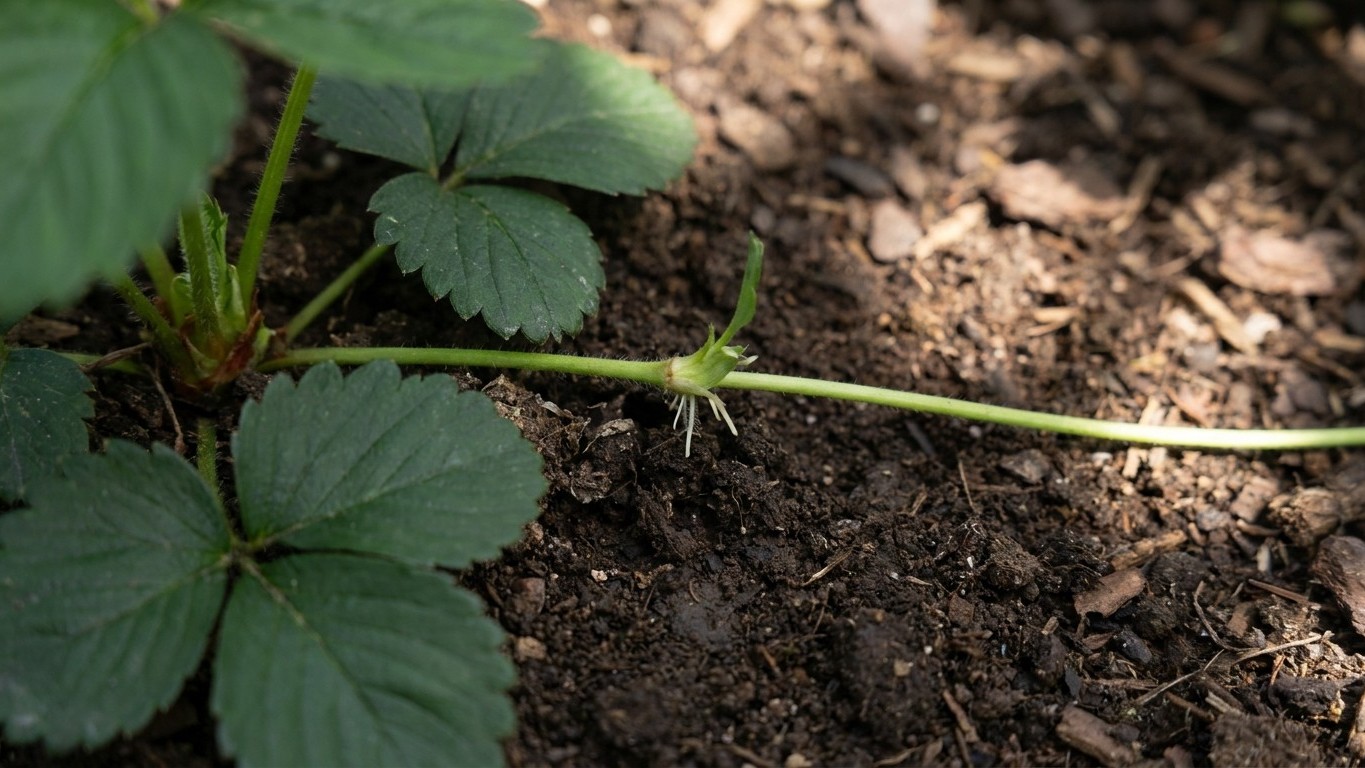
Strawberry runners are seductive. They creep across the soil with such confidence, rooting themselves wherever they land, that it feels almost cruel to cut them. So one May, I didn’t. I let them go, sprawling across the bed, colonizing the edges, threading between the established crowns. By June, the fruit was there. Smaller, yes, but I told myself it was just the variety. By July, I couldn’t ignore the truth anymore.
Key takeaways
- A single rooting runner redirects the plant’s entire fruit-production budget away from the berries you’re growing
- May is the exact critical window when June-bearing strawberries develop their cell structure—let runners root then and you’ve already lost the harvest
- Dense, unmanaged runners create the perfect conditions for gray mold, meaning smaller berries that also rot before ripening
What Runners Actually Do to Your Harvest
A strawberry runner, that long, horizontal stem the plant sends out from its base, isn’t a bonus plant. It’s a drain. The moment a runner touches soil and begins forming roots, the mother plant starts redirecting energy toward it. That energy comes directly from the fruit-production budget. Strawberry plants operate on a fixed physiological budget: photosynthesis generates a certain amount of carbohydrates per day, and the plant decides how to spend them. Runners spend it fast.
Research from the University of California Cooperative Extension found that unmanaged runners can reduce fruit size by 30 to 50 percent in June-bearing varieties. That’s not a marginal loss. That’s the difference between a berry you bite into with satisfaction and one you pop into your mouth wondering if it’s even ripe. The plants I let sprawl freely produced fruit consistently measuring under an inch in diameter. The controlled bed I’d set up two seasons prior, where I clipped every runner religiously, gave me berries closer to golf ball size.
The timing matters more than most gardeners realize. May is exactly when June-bearers are forming their fruit cells. The number of cells a berry develops during this critical window Determines its ultimate size, once that window closes, no amount of watering or fertilizing will make a small berry large. Letting runners root freely during May is essentially borrowing against the harvest you’ve already been growing all spring.
The Biology Behind the Mistake
Strawberry plants are evolutionarily wired to spread, not to feed us. From the plant’s perspective, a runner is a reproductive success story: a genetically identical offspring rooted and thriving nearby. The plant has no way of knowing we’re not interested in a ground cover, we want concentrated, flavorful fruit. That tension between the plant’s agenda and ours is the whole game of strawberry cultivation.
Each runner that roots also pulls water and nitrogen from the soil around the mother plant. In a bed with rich soil and good spacing, one or two runners may go unnoticed in the harvest results. But in the kind of dense, enthusiastic spread that happens when you let May runners do whatever they want, you end up with a bed that’s essentially a colony of juvenile plants competing with their parent. None of them thrives fully. The fruit suffers across the board.
There’s also a crowding effect on airflow. Dense runner growth creates humid microclimates at soil level, exactly the conditions that invite gray mold (Botrytis cinerea), which destroys fruit before it fully ripens. So the size issue compounds: smaller berries that are also more vulnerable to rot. That June, I lost probably a third of my crop to mold before I even got to taste it.
What to Do With Runners Instead
The standard advice, clip every runner as soon as it appears, is correct but incomplete. It leaves the question of what to do with them unanswered, and most gardeners feel the waste keenly. The better approach is strategic selection.
If you want to propagate new plants, identify two or three vigorous runners per mother plant and pin them into small pots of compost placed directly beside the bed. This lets them root in a contained way without stealing resources through a long, connected stem. Once rooted (usually three to four weeks), sever the connection. You get new plants without sacrificing the harvest.
For beds where you’re not propagating at all, clip runners at the base the moment they appear, don’t wait until they’ve started rooting. A rooting runner has already been drawing energy for days. The earlier you cut, the more of that energy stays with the fruit. Some growers do a quick sweep every five to seven days during May and early June, which sounds tedious but takes less than ten minutes for a standard raised bed.
Day-neutral varieties behave differently. They produce runners and fruit almost simultaneously throughout the season rather than concentrating fruiting in one window, so the energy competition is spread out rather than acute. But for June-bearers, which is what most home gardeners grow, May runner management is non-negotiable if yield is the goal.
The Lesson That Actually Stuck
Gardening advice often feels abstract until you’ve experienced the consequences firsthand. I’d read about runner management. I understood it intellectually. But watching a bed of strawberries produce dozens of tiny, underwhelming berries after a May of complete neglect made the biology click in a way no article ever had. The plant told me, directly, what it needed.
The season after that failed June, I clipped obsessively. The harvest wasn’t just better in size, the flavor improved noticeably. Concentrated sugar development in fewer, larger berries produces the kind of sweetness that tastes like the strawberries from your childhood memory, not the pale, watery ones from the grocery store. That’s not nostalgia. That’s plant physiology working exactly as intended, once you stop getting in the way of it.
One detail worth knowing: strawberry plants that are allowed to run freely for two or more consecutive seasons don’t just produce smaller fruit, they gradually exhaust themselves. Most cultivars are already on a three-to-four-year productive lifespan. Letting runners go unchecked accelerates that decline, meaning you’ll need to replant sooner and more often than you would with a managed bed. The short-term laziness of May becomes the long-term cost of replanting by year two.