
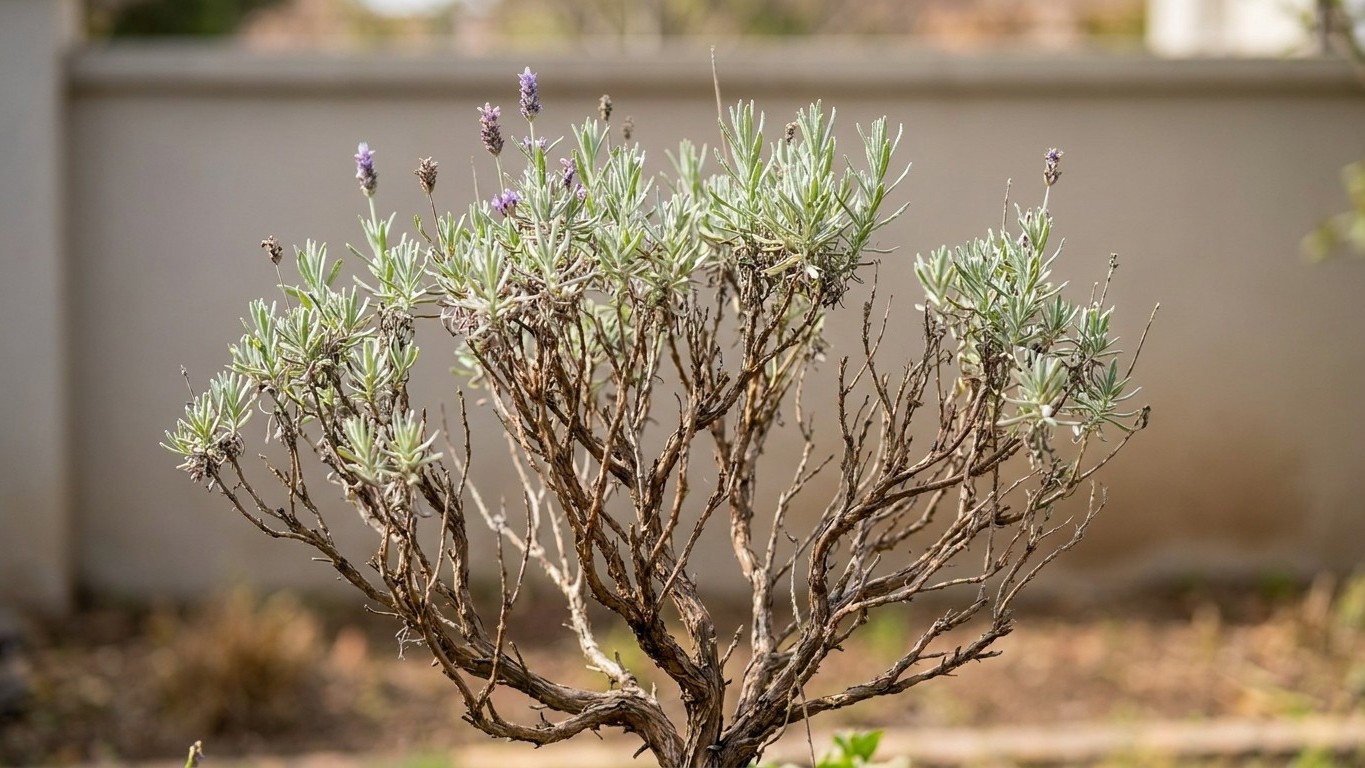
Lavender is forgiving, until it isn’t. For three years running, the plant in the front bed looked increasingly woody at the base, more stick than shrub, while the blooms crept further and further up toward the tips. Each spring, convinced I was doing the responsible thing, I cut back hard into the bare lower stems. The following season: nothing. Just grey, lifeless wood that never pushed a single new shoot. The lavender wasn’t lazy. It was following a rule I hadn’t bothered to learn.
Key takeaways
- Lavender can only regrow from green stems, not hardened brown wood—cutting into bare stems is permanently fatal
- April pruning, though it feels logical, coincides with the exact moment the plant is mobilizing energy upward, making it the worst possible timing
- One simple habit—annual light pruning after summer blooming—prevents the woody, bare-stemmed disaster entirely
What’s actually happening inside a lavender stem
Lavender belongs to the group of woody perennials that botanists describe as having a limited capacity for basal regeneration. Unlike roses, which you can cut to a stump and watch explode back to life, lavender stems lose their ability to produce new growth from wood that has fully hardened. The technical term is adventitious budding — the formation of new shoots from tissue that isn’t a pre-existing bud. Lavender wood, once brown and bark-like, simply doesn’t do this. The green, pliable portion of the stem is the only zone where dormant buds sit waiting.
This is why the advice “always leave some green” isn’t just garden folklore. A 2019 horticultural guide from the Royal Horticultural Society confirmed that pruning into the woody zone below the green foliage almost always results in die-back of that stem. No green, no growth. The plant can’t manufacture new tissue from scratch at that point, it redirects energy elsewhere, often abandoning the cut stem entirely.
The April timing mistake that compounds the damage
April feels logical for pruning. The garden is waking up, ambition is high, and the lavender looks terrible after winter, half-dead, splayed open, the center collapsed. But April is precisely when lavender is mobilizing stored energy upward into those emerging green tips. Cut them off at that moment, and you remove the very growth the plant spent the winter preparing. The window between “too early” and “too late” is genuinely narrow, and it shifts by latitude.
The two windows that experienced growers consistently recommend: late summer, right after flowering (August for most of the U.S.), and early spring, before active growth begins, think late February to mid-March in USDA zones 6 through 8. The August cut removes the spent flower stalks and gives the plant time to harden off before frost. The late-winter cut, if you choose that timing, should be conservative: just enough to shape, never an aggressive chop. April sits awkwardly between these two windows. The plant is already moving, and a hard cut at that stage removes the new growth without the recovery time that late summer provides.
Mediterranean climates, where lavender originates, have a distinct rainfall pattern, wet winters, dry summers, that drives this growth cycle. The plant evolved to push growth in late winter and early spring, then harden and rest through summer heat. Our pruning habits, shaped by general gardening rules, often ignore this origin story entirely.
How to rescue an overly woody lavender (and the honest answer about when you can’t)
If the plant is still producing some green growth, even just at the tips of otherwise bare stems, there is a recovery strategy. The approach requires patience and three seasons, not one dramatic cut. In the first year, trim lightly, removing only about a third of the green growth to encourage the plant to bush out. The second year, cut back a bit further, but always stopping well above the brown wood. By the third year, the plant often develops a denser, more compact habit with green tissue lower on the stems than before. It won’t fully rejuvenate, but it can look significantly better.
The honest answer, though: a lavender that has gone fully woody, where every stem from base to tip is brown and bark-covered, with no green tissue visible — is not coming back from a hard prune. At that point, replacement is the more practical choice. Lavender is not an expensive plant. A one-gallon container starts around $8 to $15 at most garden centers, and a new plant, properly pruned from year one, will look better within two seasons than a struggling woody specimen would after five years of remedial care.
Starting over also gives you the chance to choose the right variety for your climate. English lavender (Lavandula angustifolia) is hardier in cold winters and responds better to pruning than Spanish or French types. In humid southeastern states, where lavender often struggles, ‘Phenomenal’ has shown strong performance in university trials, it’s one of the few varieties that tolerates both cold and humidity without rotting at the crown.
The rule that prevents you from ever being here again
The single habit that keeps lavender healthy for a decade or more: prune every year, lightly, starting from the plant’s first season. A lavender that gets annual attention never develops the extreme woody base in the first place, because green tissue is consistently maintained lower on the stem. It’s the years of skipping, then overcorrecting with a hard chop, that create the problem.
Think of it the way a barber thinks about hair, regular small cuts keep the shape manageable. Let it go for two years, and the attempt to fix it in one session causes more damage than it solves. A good rule of thumb: remove about one-third of the green growth after blooming, cutting just above a node where leaves are visible. Set a calendar reminder for August. The April pruning impulse, however well-intentioned, is the one to resist.
One last detail worth knowing: lavender pruned correctly after its first bloom will often produce a second, lighter flush of flowers in early fall, a bonus that heavy spring pruning reliably eliminates. Less cutting, more flowers. The plant was never the problem.