
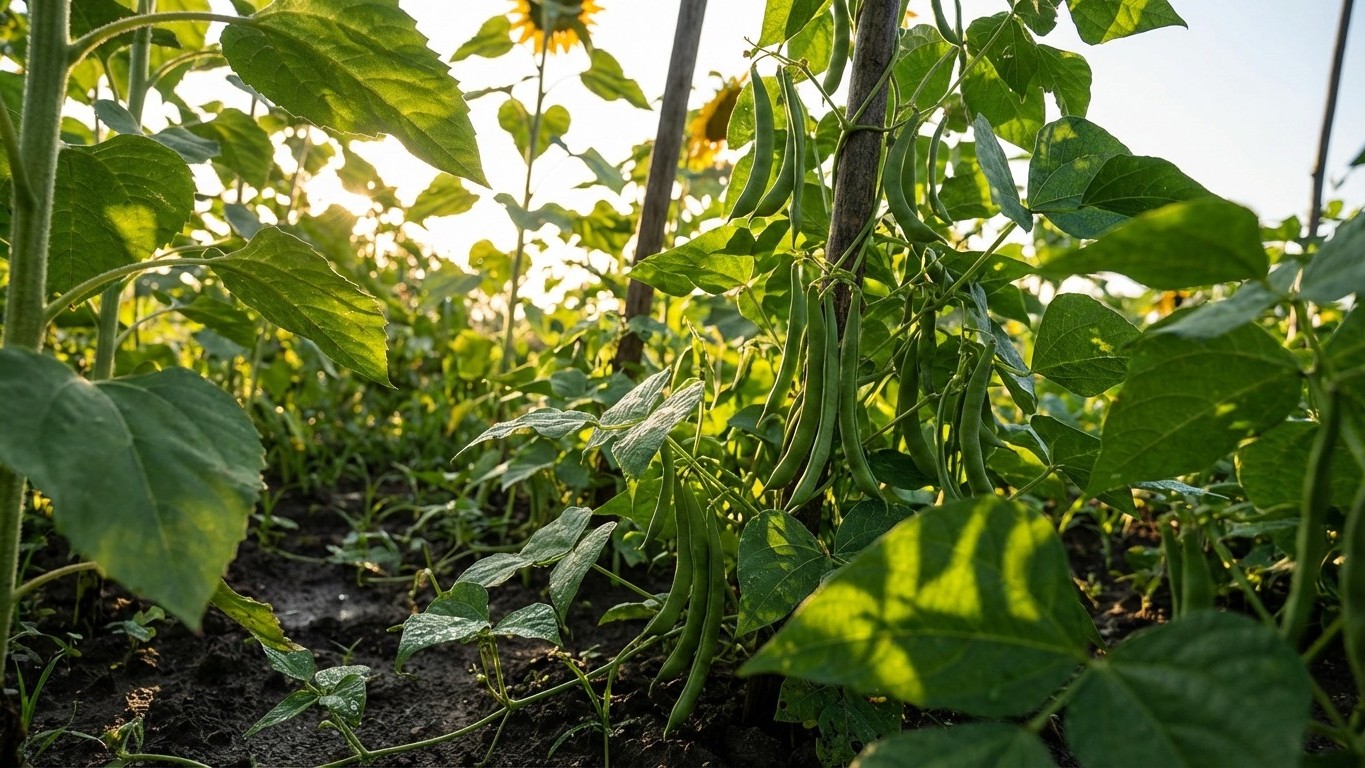
Before garden centers existed, before synthetic shade fabric came in neat rolls with UV ratings printed on the side, farmers and backyard growers solved their problems with plants. The old practice of pairing sunflowers with beans isn’t folklore, it’s applied botany, and it works with a precision that most modern gardeners quietly underestimate.
Key takeaways
- Afternoon sunflower shadows shift with the sun, unlike static shade cloth—and beans prefer this moving dappled light
- The placement isn’t random: west-side positioning and specific spacing between plants determines whether this trick actually works
- Beans and sunflowers form a hidden partnership—beans fix nitrogen for sunflower roots while sunflower pollen feeds the bees that pollinate bean flowers
The Light Problem That Beans Have Always Had
Pole beans and bush beans are not the same plant in terms of light tolerance. Bush beans prefer full sun, yes, but pole beans, and especially runner beans, produce better pods when afternoon heat is softened. Direct western sun from roughly 2 p.m. onward raises soil temperature, stresses the foliage, and shortens flowering windows. The result is fewer pods setting and more flowers dropping before they ever develop. A shade cloth addresses this mechanically. Sunflowers address it biologically, which is a different thing entirely.
A mature sunflower head, the classic Helianthus annuus — sits between five and twelve feet off the ground depending on variety. That disk face, which can span twelve inches across on a well-fed plant, tracks the sun through most of the morning and then holds a relatively fixed westward orientation by late afternoon. That’s the key detail most people miss. The large head and the broad leaves below it cast a moving, dappled shadow that shifts with the sun, landing exactly where afternoon bean rows need relief most. No static shade cloth does this. A fabric hung over a row shades from the same angle all day, which can suppress growth in the morning when beans Actually want full light.
Where Exactly “This Exact Spot” Is
Placement matters more than most guides admit. Old gardeners weren’t vague about it: sunflowers go on the west or southwest side of the bean row, spaced roughly eighteen inches to two feet away from the outermost bean plant. Too close, and the sunflower roots compete aggressively for water, sunflowers are deep drinkers with surprisingly wide lateral roots. Too far, and the shadow angles miss the target during the hottest hours.
The spacing between sunflowers along that west edge is equally important. Plant them every two to three feet, and you get a soft green wall that filters light rather than blocks it. A single sunflower every six feet gives you gaps where afternoon sun punches through. Think of it less like a fence and more like a loose canopy, coverage with breathing room. Old gardeners in the American South often staggered them, planting a row of tall varieties at the back with a row of medium varieties slightly offset in front, creating layered shade that moved with the angle of afternoon light.
There’s also a timing trick worth noting. Sunflowers germinate fast and grow faster than almost any garden vegetable. Direct sowing your sunflowers two to three weeks before your beans go in means the sunflowers will be well established, knees-high, already leafing out, right around the time the bean seedlings need protection. Time it wrong in the other direction and you’re transplanting beans beside bare sticks.
What the Beans Give Back
This isn’t a one-sided relationship. Beans fix atmospheric nitrogen through rhizobial bacteria in their root nodules, depositing usable nitrogen compounds into the surrounding soil as the season progresses. Sunflowers are hungry for nitrogen. They’re not shy about it, a nitrogen-deficient sunflower turns pale and develops spindly stalks that can’t support a large head. Plant them beside a healthy bean row, and the sunflowers quietly benefit from the nitrogen the beans are banking in the soil. By late summer, when bean plants start dying back and releasing even more nitrogen as they decompose, the sunflowers are often in full bloom, drawing on exactly that deposit.
The connection goes further than soil chemistry. Sunflower pollen is among the richest available to bees in late summer, fat, sticky, nutritionally dense stuff. Beans require pollination to set pods, and a patch that reliably attracts bumblebees and native bees through its sunflowers will see better bean yields almost automatically. Gardeners using this pairing often report fuller pod sets in late-season plantings where pollinator visits tend to drop off. It’s not magic; it’s just an incentive structure that benefits everyone in the row.
Choosing the Right Sunflower for the Job
Not every sunflower variety makes a good companion. The single-stem giants (Mammoth Russian, Titan, and similar tall heritage types) are the workhorses here. Branching varieties, which send up multiple smaller flowers, tend to be bushier and lower, they create more lateral competition for water without building the vertical shade structure you’re after. Pollen-free varieties, bred for cut flower markets, are poor choices too. No pollen means no benefit to your bean pollinators.
Heritage varieties tend to perform better in companion planting contexts not because of nostalgia, but because they haven’t been selected against the traits that made them useful in a working garden. They’re taller, their leaves are broader, and they keep producing pollen-rich flowers across a longer window. One more practical note: once the season ends, don’t pull the sunflower stalks immediately. Left standing through early fall, they become bird feeders and habitat structure, and their decaying roots add organic matter right where next year’s beans might go.
There’s something worth sitting with here. Modern gardening has given us excellent tools: reliable fabric, drip irrigation, soil amendments that come with guaranteed NPK ratios. But the old companions were doing several jobs simultaneously, invisibly, at no extra cost. The sunflower wasn’t just shade cloth. It was the shade cloth, the pollinator magnet, the nitrogen-hungry neighbor that cleaned up the bean surplus, and the late-season bird garden. What else in your garden is quietly doing five things at once, and would you recognize it if it were?