
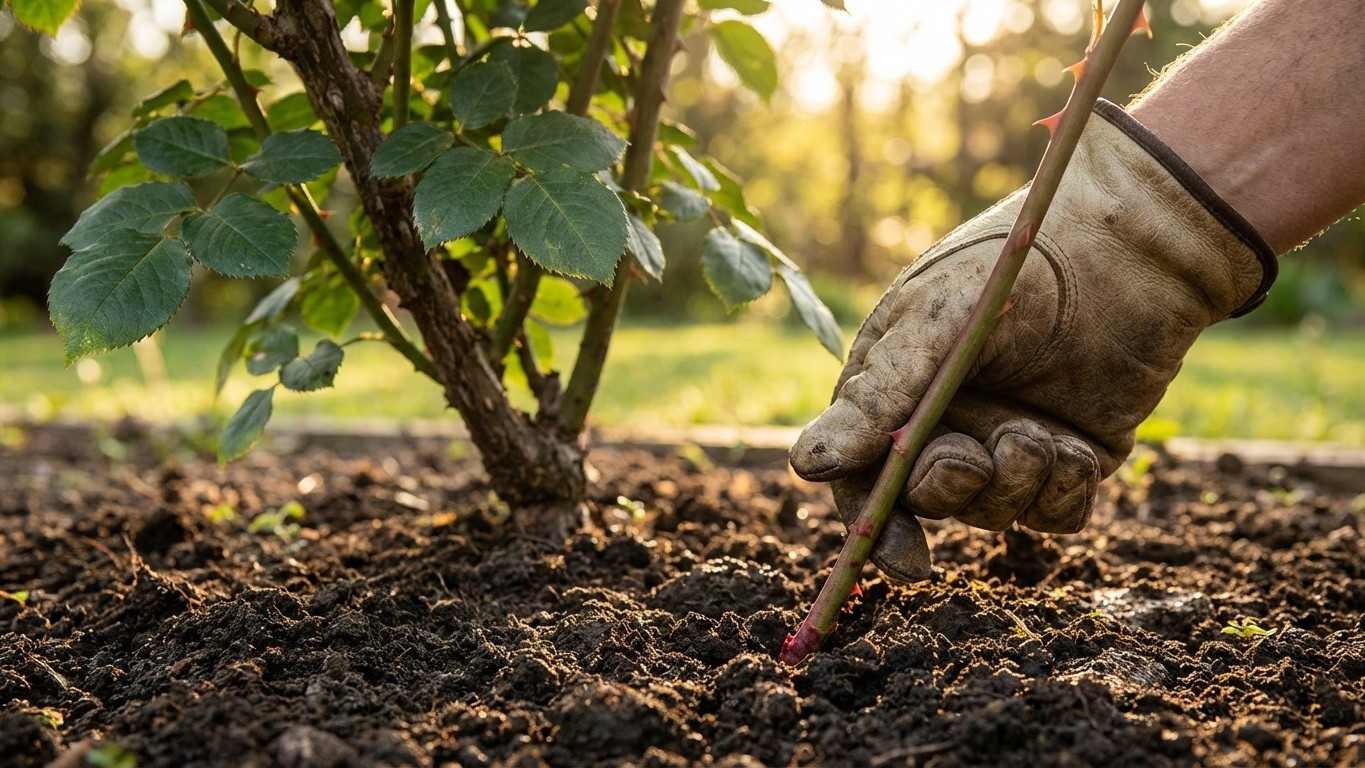
That vigorous shoot growing straight up from the base of your rosebush, the one that looks different from everything else, that’s not a bonus. It’s a takeover attempt. And if you’ve been snipping it off and moving on with your day, you’ve actually been doing exactly the right thing, even if you had no idea why.
Key takeaways
- Those weird shoots at your rose base are genetically a completely different plant trying to take over
- Cutting them at soil level actually makes the problem worse—there’s one method that actually works
- Where you plant your rose and how you mulch it can prevent 90% of sucker problems before they start
The Stranger in Your Rose Garden
Most roses sold at nurseries are grafted plants. A desirable rose variety (the part you actually want, with the beautiful blooms) is joined to the rootstock of a different, hardier rose species. The graft union, that knobby, slightly swollen area near the base of the stem, is where these two plants become one. The top does the flowering; the bottom does the surviving. It’s a good system, mostly.
The problem is that rootstocks are wild at heart. They were chosen for their vigor, their disease resistance, their ability to push through poor soil and cold winters. And sometimes, that vigor gets a little too enthusiastic. The rootstock sends up its own shoots, called suckers, from below the graft union. These shoots are genetically a different plant. They grow faster than your cultivated rose, they produce smaller, often less attractive flowers, and left unchecked, they will gradually steal water, nutrients, and light until your prized variety weakens and eventually disappears. The rootstock doesn’t know it’s supposed to be invisible. It just grows.
How to Tell a Sucker From a Legitimate Shoot
This is where a lot of gardeners get tripped up. A sucker doesn’t announce itself with a neon sign. It looks like a rose shoot, and in a way, it is one. The key is knowing what to look for.
First, location matters. Suckers emerge from below the graft union, often coming straight out of the ground or very low on the main stem. A shoot growing above the graft union is part of your cultivated variety and should be left alone.
Leaf count is another clue. Many common rootstocks produce leaves in sets of seven leaflets, while hybrid tea roses and many modern varieties tend to have five. If you suddenly notice a shoot with a different leaf pattern than the rest of the plant, pay attention. The color can differ too, sucker growth is sometimes paler, a lighter, more yellow-green, compared to the deeper color of your named variety.
Thorns can also tip you off. Rootstock thorns are often more numerous and differently shaped than those on the grafted top. Run a gloved hand along the stem and compare. If something feels off, it probably is.
Why Cutting Isn’t Actually the Solution
Here’s where most well-meaning gardeners go wrong. You spot the sucker, grab your pruners, and snip it off at soil level. Clean, tidy, done. Except you’ve just pruned a root system that has no interest in giving up. Cutting a sucker at ground level leaves the base intact, and the rootstock responds by sending up two or three new shoots from the same point. You’ve essentially pruned it into overdrive.
The correct approach is removal, not cutting. Trace the sucker back to its point of origin on the root, this means digging carefully around the base of the plant with a trowel or even your gloved hands. Once you find where the sucker connects to the rootstock, pull or tear it off at that junction rather than cutting. Tearing removes the latent buds at the base; cutting leaves them behind. It sounds counterintuitive, and it feels a little rough, but it’s significantly more effective at preventing regrowth.
After removal, firm the soil back around the base and water the plant. The cultivated rose barely notices; the rootstock gets the message.
Prevention and the Long Game
Planting depth makes a bigger difference than most people realize. When a grafted rose is planted too shallowly, the graft union sits above the soil line and becomes vulnerable to temperature stress. The rootstock, sensing instability, responds by pushing out suckers as a kind of survival mechanism. Planting so that the graft union sits just below (or right at) soil level in most climates gives the cultivated variety a better foothold and reduces sucker production considerably.
Physical damage also triggers suckering. If you nick a surface root with a hoe, disturb the soil aggressively around the base, or let the root zone dry out repeatedly, the rootstock interprets stress as a signal to propagate itself. Mulching generously around (but not touching) the base of the plant buffers soil temperature, retains moisture, and incidentally protects those shallow roots from accidental damage. A three-inch layer of wood chip or bark mulch does more for sucker prevention than any spray or treatment on the market.
Some rootstocks are simply more aggressive than others. The species Rosa multiflora is widely used because it’s practically indestructible, but it suckers readily. Rosa canina, common in European stock, tends to be more restrained. If you’re dealing with persistent sucker problems despite correct planting and careful removal, it may be worth asking your nursery which rootstock your roses are grafted onto before your next purchase.
There’s a quiet satisfaction in understanding what your garden is actually doing beneath the surface. Roses have been navigating this two-plant identity for over a century of commercial cultivation, and the balance can hold for decades with minimal intervention. The question worth sitting with: how many other “helpful” garden habits are quietly working against the plants you’re trying to grow?