
Every experienced composter has done it. You spot a plump white grub curled deep in the pile, and the reflex kicks in before you even think: you crush it. You’ve been doing this for years, maybe even feeling a little virtuous about it. The problem? You may have been executing your most loyal workers.
There are many species of grubs, and most of those found in compost piles belong to the scarab beetle family. That much is true. But here’s where it gets more complicated than most home composters realize: while there are several different kinds of white grubs you might find in your compost heap or barrel, there is a good chance that the one you see most often is the larval form of the black soldier fly. And those two are not even remotely the same thing.
Key takeaways
- Most white grubs in compost aren’t pests—they’re black soldier fly larvae doing extraordinary work
- These larvae consume up to 4x their weight daily and produce frass packed with nitrogen, phosphorus, and potassium
- Crushing them stops a critical link in your compost food chain that can set decomposition back weeks
Two Grubs, Two Very Different Destinies
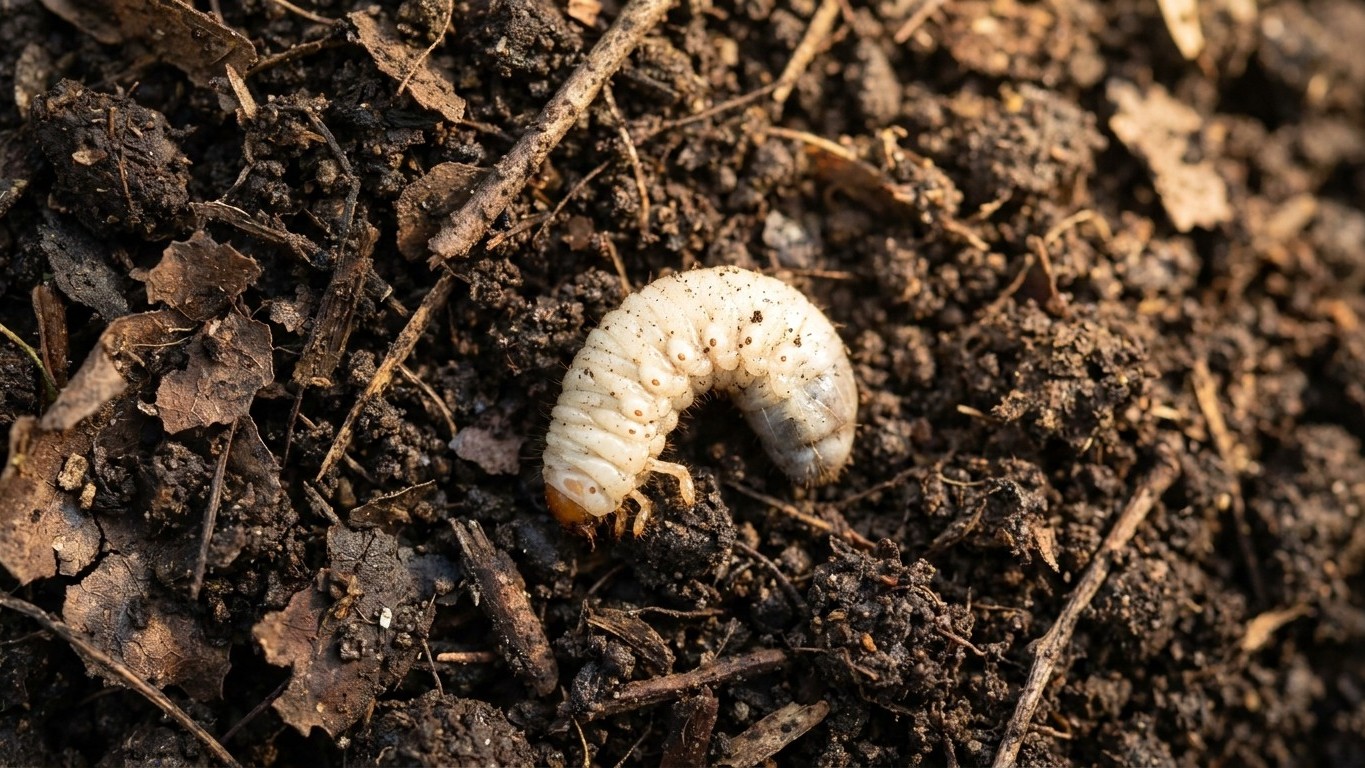
When disturbed, beetle grubs curl up into a C-shape. They usually have a brown head, three pairs of legs, and a plump white body. The size varies from about 1/4 of an inch to over two inches long, depending on the species. This is the classic image most people have in their heads when they hear the word “grub.” These C-shaped grubs have three pairs of legs and feed on plant roots. Look for them in lawns and flower beds. Examples include Japanese beetles and masked chafers. That “C” posture is your first real clue.
The black soldier fly larva is a different creature entirely. It has a flat, gray, palm-shaped body with a distinct tapered head that protrudes from the front. They are common in compost piles and decaying organic matter. Young larvae are gray-white, segmented, about 1 inch long and very active. As they mature, they turn dark brown, become flattened and torpedo-shaped, and develop tough-looking skin. Their head is small and narrower than the body, which features only hairs and spines, no legs. No legs. Flat body. No tight C-shape. Flip one on its back, and you’ll see the difference immediately.
The backstory matters here too. It’s unlikely that the grubs you’re finding in your vegetable garden beds are Japanese beetles, they feed on living plant roots and prefer turfgrass. More likely are the larvae of bumbleflower beetles, which feed on decaying organic matter and are commonly found in both compost piles and highly amended soils. Real Japanese beetle grubs are much more at home in your lawn than in your pile of kitchen scraps.
What the “Good” Grubs Are Actually Doing in There
Soldier fly larvae are voracious consumers of nitrogen-rich materials such as food scraps and manure. They accelerate decomposition and inoculate compost with beneficial bacteria and fungi. That last part is worth pausing on: they’re not just eating your waste, they’re actively seeding the pile with the microbial life that makes compost rich.
Black soldier fly larvae are voracious eaters. While red worms nibble at scraps, grubs can consume up to four times their weight in food daily. This means faster composting and less time for your waste to rot and smell. For context, that’s like a 150-pound person eating 600 pounds of food a day. The metabolic engine on these things is extraordinary.
Their outputs are just as impressive. The black soldier fly larvae aren’t just efficient composters, they leave behind a potent by-product called frass. Grub frass is packed with essential nutrients like nitrogen, phosphorus, and potassium, making it a top-tier organic fertilizer. This nutrient-rich excrement is far more concentrated than typical worm castings, and a small amount can go a long way in supercharging your plants.
There’s another advantage that rarely gets mentioned: their large size relative to houseflies and blowflies allows BSFL to prevent houseflies and blowflies from laying eggs in decaying matter by consuming larvae of other species. if black soldier fly larvae are running your compost pile, the flies you actually don’t want, the disease-carrying kind, are largely kept out. The use of BSFL in a compost system typically reduces the volume of compost by around 50%. Half the volume, double the potency. That’s a trade most gardeners would take every time.
When a Grub Genuinely Deserves Your Concern
That said, not Everything wriggling in your pile deserves a standing ovation. While most grubs are beneficial to the composting process, some can become harmful pests if their populations get out of hand. Chafer beetles are in this category, and you’ll probably want to keep them away from your plants. The root-feeding grubs of certain beetles like the Japanese beetle can seriously damage your plants. And certain types of Chafer grubs can destroy root systems. They particularly like to establish a home under lawns where they can destroy root systems.
The real danger isn’t the grub in your compost, it’s the adult beetle it becomes once it leaves. The larval stage of these beetles is quite harmless, even beneficial. When they become adults, they can damage desired plants. So the actual strategy isn’t to destroy every larva on sight, it’s to identify what you’ve got before you spread finished compost near vulnerable plants. When sifting compost, pick white grubs from the good stuff with a trowel or gloved hands and toss them back into the compost bin with the matter that still needs to break down. That’s all the management most home composters ever need.
If you’re genuinely concerned about population control, the fix is simpler than crushing by hand. Balance your compost by adding carbon-rich materials like dried leaves or wood chips. Regularly turn the compost to discourage excess moisture. A drier, better-balanced pile is a less attractive nursery for the species you’d rather not have in abundance.
Making Peace With the Pile
Grubs in your compost are actually beneficial for the compost. They help aerate and loosen compacted areas of compost materials, and their casts (poop) are high in nitrogen. The same creatures that look like a horror movie extra are quietly doing the work that turns your coffee grounds and vegetable peels into something your tomatoes will love.
There’s a broader lesson here that goes beyond the compost bin. As grubs grow, eat, and excrete, they boost the populations of bacteria and fungus in compost. Fungi and bacteria are essential in the degradation process, and they serve as earthworm food, too. The whole system is layered, one creature’s waste becomes another creature’s dinner, which becomes your garden’s fertility. Crushing the middle of that chain, without knowing which link you’re breaking, is the kind of mistake that costs you weeks of decomposition time.
One detail that puts the whole thing in perspective: the adult soldier fly has no functioning mouthparts, it spends its time searching for mates and reproducing. It doesn’t eat. It doesn’t sting. It doesn’t bite. It lives its entire adult life on reserves built up during the larval stage, emerges, reproduces, and dies within days. The grub phase is its one productive season on Earth — and it spends that season cleaning up your kitchen scraps.
Sources : ovipost.com | bettertermite.com