
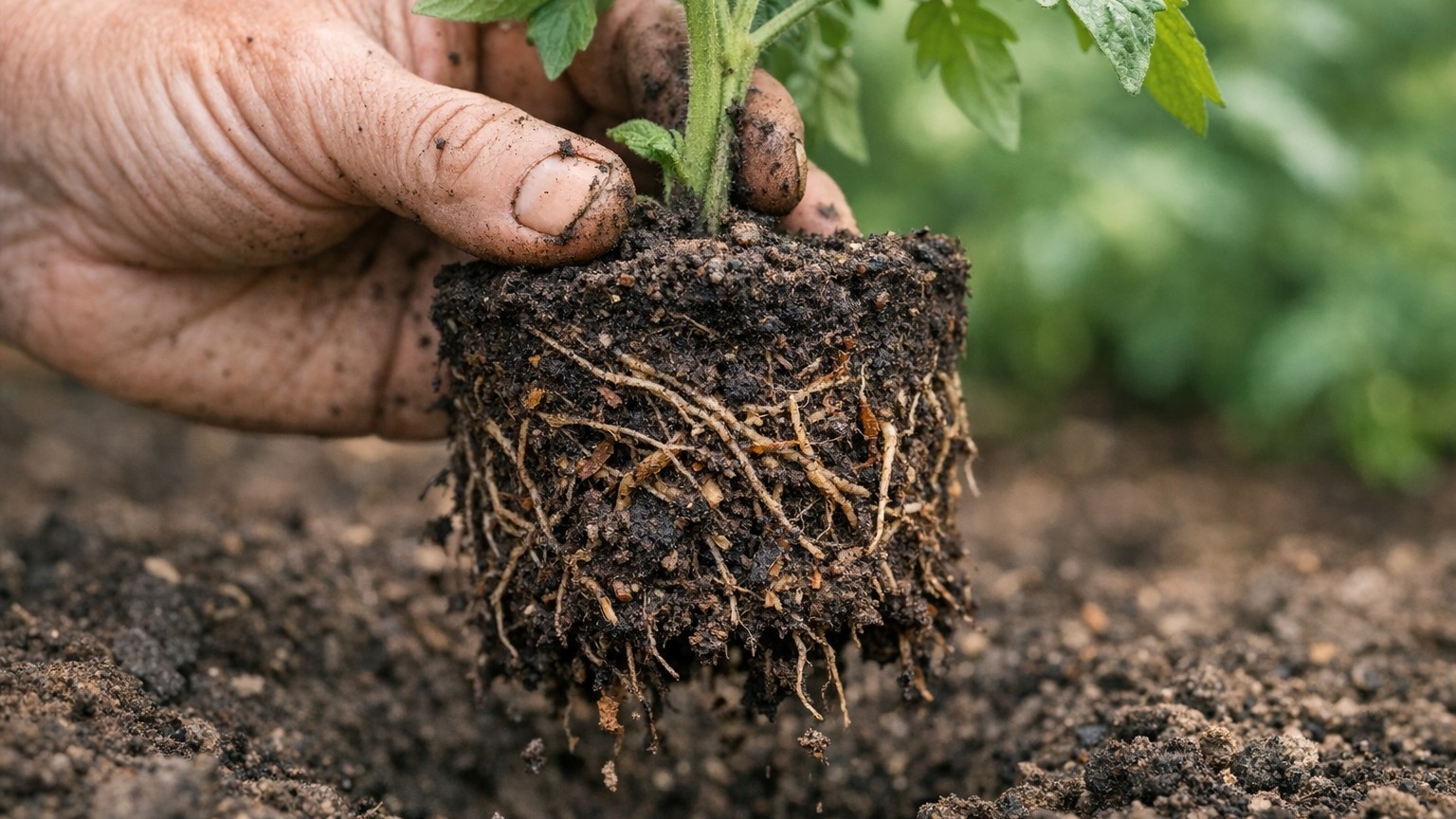
Tomato roots can extend more than three feet deep in loose, well-drained soil, and they start that vertical journey within the first two weeks after transplanting. That single fact changed how I grow tomatoes entirely. For years, I was a reactive gardener: I’d wait until plants looked floppy or heavy before driving in a stake, convinced I was being thoughtful, letting the plant “establish itself” first. Then a struggling plant got pulled, and what the roots showed me was hard to argue with.
Key takeaways
- A tomato plant staked six weeks in revealed its feeder roots had been damaged and never fully developed
- Most water and nutrient uptake happens in the top 12 inches, spreading horizontally before going deep
- Staking at transplant time, not later, prevents root damage and keeps fruit production on schedule
What the roots actually looked like
The plant I pulled had been in the ground for about six weeks. It was a Roma variety, planted at the same time as two others in the same bed. Those neighbors were already setting fruit clusters. This one? Barely flowering. When I worked it out of the ground, carefully, because I was hoping to replant it, the root system was a compact, tangled ball no bigger than a softball. Barely wider than the original transplant plug. The roots hadn’t spread. They’d circled back on themselves.
The reason became obvious once I thought about it. A few days after transplanting, I’d pushed a wooden stake into the ground about four inches from the stem. Right through the root zone. The plant didn’t die, tomatoes are resilient, but the feeder roots on that side had nowhere useful to go. They’d been cut or compressed during the staking. The plant spent weeks compensating instead of expanding, and that metabolic delay pushed fruit production back significantly. Three weeks behind the identical plants flanking it. Same soil, same water, same variety.
Why timing your stake matters more than you think
The conventional advice, stake early to avoid disturbing roots, turns out to be right, but the reasoning usually given is incomplete. Most guides say “stake at planting time” to prevent wind rock, which is true enough. But the deeper issue is that tomato feeder roots fan out horizontally before they go deep, and they do it fast. University of California Cooperative Extension research on tomato root architecture shows that the majority of water and nutrient uptake happens within the top 12 inches of soil, radiating outward from the stem. Driving a stake in after that lateral root system is established is essentially driving it through your plant’s circulatory system.
A stake placed at transplant time, when the root ball is still contained to the original plug, slots into undisturbed soil. The roots then grow around it, even using the stake’s soil disturbance channel in some cases to go deeper. Place that same stake six weeks later, and you’re not “supporting a plant.” You’re performing minor surgery on it without anesthesia.
The delay also compounds. A tomato plant that loses feeder roots at the six-week mark doesn’t just stop, it redirects energy. Instead of pushing sugars into developing flower clusters, it prioritizes root repair. Fruit set stalls. This isn’t catastrophic for a backyard gardener with a long season, but in shorter growing windows, the Northeast, the Pacific Northwest, three weeks of delay can mean you’re racing the first frost for tomatoes that should have ripened in August.
The right approach, rebuilt from the ground up
Stake at planting, not after. This sounds simple, but it requires changing the mental model. Many gardeners stake reactively because young transplants don’t look like they need support, they’re small, they’re upright, the stem is still thin. The stake feels premature. It isn’t. A 5- or 6-foot wooden stake or metal conduit driven 12 to 18 inches into the ground at transplant time causes almost zero root damage because there’s almost no root system yet to damage. That’s the window.
Position the stake two to three inches from the stem on the side away from prevailing wind. This gives the plant something to lean into rather than away from. As it grows, tie loosely with soft twine or strips of old t-shirt fabric, never wire, never tight, leaving room for the stem to thicken. The figure-eight tie method, where the twine crosses between plant and stake rather than cinching both together, prevents the stem from rubbing against the wood as wind moves it.
Cage-grown tomatoes present a slightly different situation. Wire cages can be placed at transplant time too, but the key is that they shouldn’t compress the soil around the plant as you push them in. Twist gently rather than driving straight down, and stop if you feel resistance, you may be hitting early root spread sooner than expected in warm, fast-draining soils where establishment is quicker.
The other thing your roots might be telling you
That pulled plant taught me a second lesson, unrelated to staking. The compact root ball wasn’t only about stake damage. The soil directly beneath the transplant hole was noticeably denser than the surrounding bed : I’d amended the top layer with compost but hadn’t broken up the subsoil. The roots had hit a harder layer and stopped rather than pushing through. This is common in raised beds built on clay or compacted ground, and it creates a phenomenon sometimes called a “perched water table,” where water pools at the layer boundary instead of draining. Roots suffocate rather than spread.
The fix is simple: before planting, push a garden fork 8 to 10 inches deep in the planting area and rock it gently to fracture the subsoil without fully turning it. No amendments needed at that depth, just physical disruption to give roots a path. Tomatoes that can go deep during dry spells access moisture that surface-watered plants can’t reach, which is why some gardeners in hot climates get through July with far less irrigation than their neighbors. The root architecture you enable in May is still paying dividends in August.