
Walk through any suburban neighborhood this spring, and you’ll notice the same thing: gaps in hedges where thuja trees used to be, dead brown patches filling entire fence lines, stumps where a wall of green once stood. The great thuja era is quietly ending, and gardeners who have already pulled the plug are not looking back.
Long prized for its fast coverage and dense foliage, the thuja has steadily lost its appeal. Its uniform, monotonous appearance lacks character, and diseases like browning, amplified by increasingly dry summers, are becoming more frequent. Add to that destructive insects like the buprestid beetle, which continue to weaken and hollow out these conifer hedges, and the picture becomes clear: what was once the lazy gardener’s default choice has become a constant headache.
Regular trimming, intensive watering during heat waves, and constant vigilance against pests, none of that sounds like gardening. It sounds like a second job. The good news? The plants replacing thuja in 2026 are faster-growing, more resilient, and frankly, far more beautiful.
Key takeaways
- Why are gardeners suddenly ripping out thriving thuja hedges after decades of dominance?
- One replacement plant grows at double the speed while delivering bold crimson foliage that changes with the seasons
- The plants winning this replacement race demand half the maintenance and actually attract wildlife instead of repelling it
Photinia: The Red-Tipped Superstar Taking Over Every Fence Line
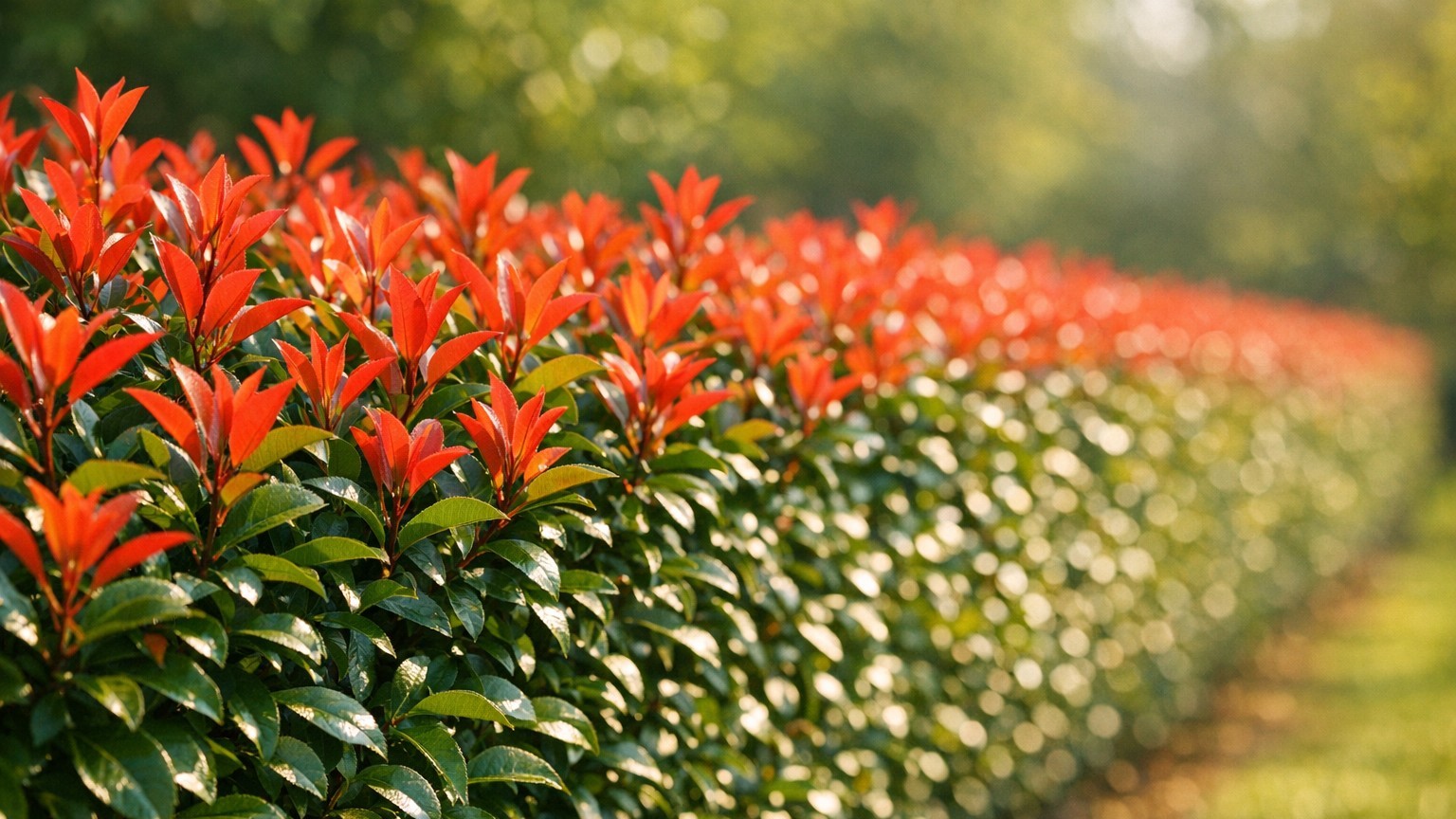
Drive through any well-kept neighborhood today and you’ll spot it: deep green hedges with vivid crimson tips blazing like a torch in spring. Photinia has established itself as the go-to alternative. This evergreen shrub produces bold fire-red young shoots that transform a hedge line from a boundary into an actual visual statement, while still doing the practical job of blocking the view.
New leaves emerge bronze-red to bright red, then mature to a glossy green. That color contrast delivers seasonal excitement without relying on blooms, and the effect is especially striking when the hedge is lightly sheared to push out fresh growth. Trim it, and it rewards you with another flush of red. The more you cut, the more color you get. That’s a deal no thuja ever offered.
On the growth rate question, photinia holds its own solidly. With an annual growth rate of around 30 to 50 cm, photinia quickly forms a dense, evergreen hedge that provides excellent privacy. Some newer cultivars push this further: the Photinia ‘Super Hedge’ cultivar is even faster-growing than the classic Red Robin, capable of reaching 1 meter of growth per year with a dense, compact habit. That’s roughly twice the pace of a standard thuja, and with none of the monotony.
Photinia adapts easily to poor soils and handles drought periods well. After the first year of establishment watering, it becomes largely self-sufficient. Its moderate growth rate also means fewer exhausting trim sessions: a light cut after the flowering period keeps it perfectly structured.
Cherry Laurel, Fargesia Bamboo, and the Case for Mixing It Up
Photinia isn’t the only plant winning the post-thuja competition. Cherry laurel (Prunus laurocerasus) wears the crown for the fastest-growing evergreen non-conifer hedge available, reaching up to 60 cm of growth per year. It’s hardy down to -20°C and grows in almost all soil conditions except shallow chalky or very wet ground. For anyone who just wants a dense, reliable green wall as fast as possible, laurel is still the no-nonsense answer.
Then there’s Fargesia bamboo, an option that surprises people with its contemporary look. Non-spreading varieties like Fargesia create a modern, architectural screen through their dense clumping growth, with zero risk of the invasive spreading that gives bamboo its bad reputation. The Fargesia rufa variety resists cold well and stays under 2.5 meters. It’s ideal for tight urban spaces where a thuja would quickly become overbearing.
Mixing species is the smartest play of all. A diverse hedge resists pests far better than a single-species planting, and creates a living landscape that shifts with the seasons. Think of it this way: a row of 20 identical thujas is a monoculture waiting for one bad pest to wipe it all out. A hedge combining photinia, viburnum tin, and cherry laurel is an ecosystem.
What Gardeners Are Actually Planting in 2026
The shift isn’t just aesthetic, it’s also ecological. Where thuja hedges are notoriously poor for wildlife, photinia actively supports biodiversity: its early flowers feed bees and Butterflies at a time when most garden plants are still dormant, and its berries attract thrushes and blue tits seeking shelter in winter. Replacing a thuja row with photinia or laurel effectively turns a dead zone into a wildlife corridor.
These thuja alternatives also demand less Maintenance overall. Trimming is less frequent and can follow each plant’s natural rhythm. For mixed native-style hedges, a single cut in late winter covers most of the year’s work. Respecting bird nesting periods between March and July, which most gardeners ignore with thujas, becomes simpler when you only need one annual session anyway.
For those committed to the evergreen look but wanting something with stronger structure, common hornbeam (Carpinus betulus) handles pruning beautifully and holds its dried leaves through winter, creating a dense, structured hedge that provides year-round cover even while technically dormant. It looks deliberate. Architectural. Nothing like the tired green wall it’s replacing.
The practical advice from gardeners who made the switch early? Plant in autumn when possible, roots establish over winter before spring pushes new growth, giving the plant a full season’s head start before summer heat arrives. Space photinia plants around 50 cm apart for a standard privacy hedge, and don’t skip the mulch: it suppresses weeds and keeps moisture at the root zone during those first critical months. One detail worth knowing — photinia’s white spring flowers are a pleasant bonus, but its real currency is what it does from October through March, when everything else in the garden has gone quiet and its glossy leaves still hold the light.