
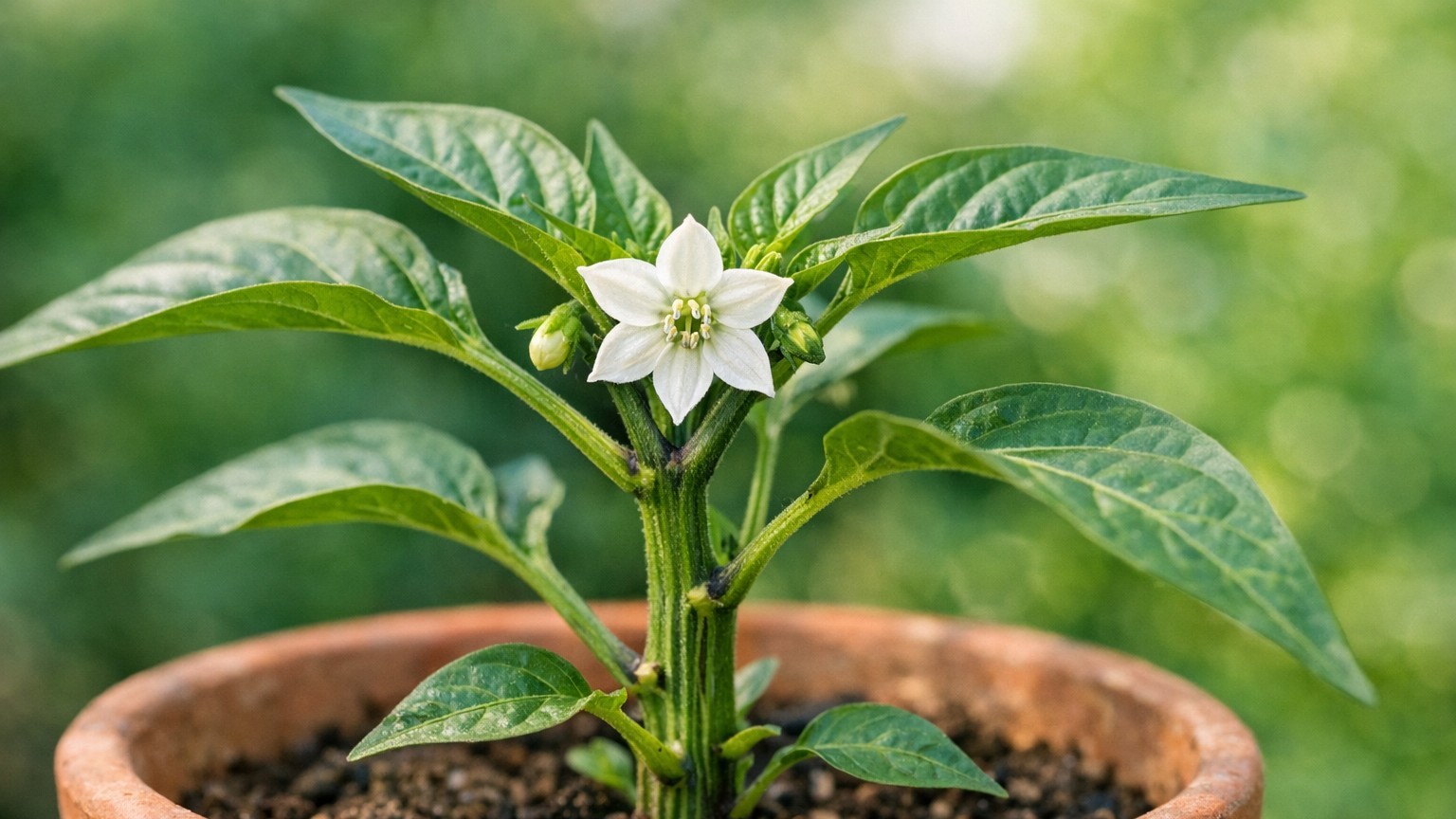
The first bloom on a pepper plant feels like a reward. You’ve watered carefully, moved the pot to catch the light, maybe even talked to the thing. Then a perfect little flower appears right at the fork of the main stem, and removing it feels borderline cruel. Most gardeners leave it. And most gardeners wonder, weeks later, why their plant looks exhausted before summer even peaks.
That first flower has a name: the king bloom, or king flower. It’s the plant’s first reproductive attempt, appearing at the primary crotch, the Y-shaped split where the main stem divides into branches. Leaving it doesn’t just cost you one early pepper. It redirects the plant’s entire energy budget at the moment it should be building the root system, leaf mass, and branching structure that will sustain a full season of production.
Key takeaways
- The king flower diverts 30-40% of the plant’s daily energy to one early pepper when it should be building roots and branches
- Commercial growers remove all flowers for 2-3 weeks after transplanting—home gardeners only need to pinch one
- Container pepper plants are even more vulnerable to early fruiting because root space is already limited
Why the King Flower Is a Trap, Not a Gift
Pepper plants are what botanists call indeterminate growers, meaning they keep producing flowers and fruit continuously rather than in one concentrated burst. For this strategy to work, the plant needs a solid structural foundation first. Think of it like a small business: you can’t scale operations before you’ve built the infrastructure. The king flower, appearing early and prominently, is essentially the plant offering to go into production before the warehouse is even finished.
When that first fruit sets, the plant interprets the signal as “mission partially accomplished” and diverts resources toward swelling that single pepper. Root expansion slows. New lateral branches, the ones that will eventually carry dozens of flowers, get less energy. The main stem hardens off prematurely. By the time you notice the plant seems stalled, you’re already weeks behind. The fruit you saved will ripen, probably to a decent size, but the overall yield from that plant across the season will be lower than it could have been. Research from extension programs at land-grant universities consistently shows that early fruit removal on peppers leads to significantly higher total harvests by the end of the growing season.
What Actually Happens Inside the Plant
Photosynthesis produces a fixed pool of sugars and nutrients each day. Every growing point, root tips, new leaves, branch nodes, flowers, and developing fruit — competes for a share of that pool. A maturing pepper fruit is metabolically demanding. Even a small one, at the size of a marble, can claim 30 to 40 percent of a young plant’s daily photosynthate. That’s not a minor diversion. The root zone, which would otherwise be expanding to improve water and nutrient uptake for months to come, gets shortchanged during a window that can’t be recovered.
There’s also a hormonal dimension. As fruit develops, it produces signals that suppress new flower formation temporarily, a mechanism that prevents the plant from overcommitting. Leave the king fruit, and you may notice a gap in flowering that follows shortly after. Remove the king flower before fruit sets, and the plant enters a kind of productive momentum: more branching, more flower sites, and a more even distribution of energy across the whole canopy.
How to Actually Do It (and When)
The timing matters more than most guides admit. The king flower should be removed before it opens fully, either as a tight bud or at the very first sign of petals. At that stage, the removal is almost trivially easy: a light pinch or a clean snip with scissors. If you’ve already let it open and even set a tiny fruit, remove it anyway. The earlier, the better, but late removal still helps more than leaving it.
Some growers go further and pinch all flowers for the first two to three weeks after transplanting, regardless of position on the plant. This is standard practice in commercial greenhouse production, where pepper plants are expected to yield for six months or more. For home gardeners working with a shorter season, the minimum effective intervention is just that one king flower. After it’s removed, let the plant flower freely once it has developed four to six strong lateral branches.
One practical note: wear gloves or wash your hands after handling pepper plants. Capsaicin is present in all parts of the plant, including flowers and stems, and a careless touch near the eyes is an unpleasant reminder of that fact.
The Broader Lesson That Changes How You Grow Everything
Peppers aren’t unique in this regard. Tomatoes benefit from early fruit removal for similar reasons. Strawberry plants are routinely de-flowered in their first season to build root strength for years two and three. Even squash plants will produce more over a season if the first few female flowers are removed to let the vine extend. The pattern is consistent: plants that invest in structure before reproduction outperform those that rush into fruiting.
The difficulty is psychological, not horticultural. Removing a healthy flower or a tiny developing fruit triggers something in the gardener’s brain that reads as waste. It isn’t. A plant with five strong branches and sixty flower sites across a season will produce more food than a plant that set one early pepper at the cost of developing only three branches with twenty sites each. The math isn’t subtle.
For those growing peppers in containers, the king flower removal is even more important. Container plants have limited root space, which already constrains their energy-gathering ability. Asking a pot-bound plant to support early fruit is like asking someone to run a marathon while carrying a backpack. The plant will try. But it will arrive at the finish line with considerably less left to give.
One thing most guides skip: after removing the king flower, give the plant a modest dose of balanced fertilizer with slightly lower nitrogen than usual. Nitrogen-heavy feeding at this stage encourages lush leafy growth at the expense of flower development later. A phosphorus-forward formula nudges the plant toward reproductive readiness once the structural work is done, which is exactly where you want it.