
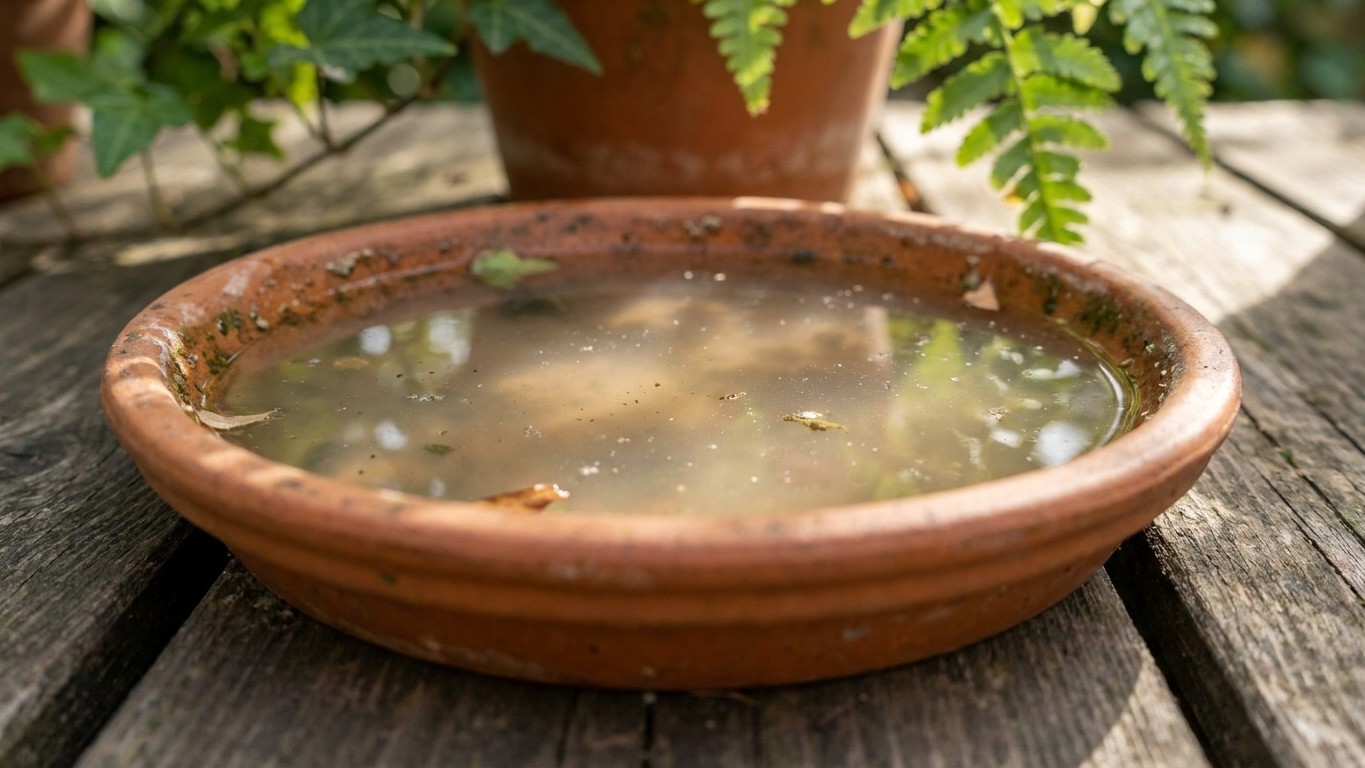
A saucer of standing water left under a plant pot for seven days can produce a full generation of mosquitoes. Eggs to biting adults, start to finish, in less time than it takes a package to ship. That’s the timeline the Centers for Disease Control and Prevention lays out for several common mosquito species, and it’s the exact math that turned my “efficient” watering habit into a backyard breeding operation.
Here’s how the habit started: water the plants, let the saucers catch the runoff, skip refilling them next time because there’s already moisture sitting there. Two minutes saved per watering session, maybe three times a week. Add it up over a summer and that’s a couple of hours reclaimed. Except I wasn’t saving time. I was running a nursery for the one insect responsible for more human deaths worldwide than any other animal, mosquito-borne diseases included.
Key takeaways
- A gardener’s time-saving trick created dozens of mosquito breeding sites without their knowledge
- What looked like plain water under a plant pot was actually teeming with larvae and pupae
- The CDC-recommended solution is simpler than the ‘efficient’ habit that caused the problem
What I Actually Found in the Water
The saucer under my largest planter, the one that gets partial shade and rarely dries out, had gone cloudy. Not dirty-cloudy. Alive-cloudy. Small comma-shaped larvae hung just below the surface, twitching in that jerky, unmistakable way when the container shifted. A few pupae, shaped like tiny commas with tails, drifted near the edge. These weren’t random bugs that wandered in. This was a nursery, and it had been running on schedule.
Female mosquitoes need standing water to lay eggs, and they’re not picky about volume. The CDC notes that some species will lay viable eggs in as little as an inch of water sitting undisturbed for a week or more. A saucer under a 10-inch pot easily holds that much after a thorough watering, especially if it’s shaded from direct sun and evaporation slows down. I’d essentially built a climate-controlled incubator and placed it three feet from my back door.
The species most likely responsible, based on where I live and the container-breeding pattern, is Aedes albopictus, the Asian tiger mosquito. It’s become one of the most common backyard mosquitoes across much of the U.S., and unlike the mosquitoes that breed in swamps or ditches far from people, this one prefers exactly the kind of small, human-made containers found in a typical yard: saucers, buckets, clogged gutters, forgotten watering cans.
Why This Matters Beyond the Itch Factor
A mosquito bite is annoying. It’s also, depending on the species and the region, a potential vector for West Nile virus, dengue, or Zika. The Environmental Protection Agency lists standing water elimination as the first and most effective line of defense against mosquito populations, ahead of repellents, ahead of traps, ahead of anything you can spray. That’s not a minor detail buried in fine print. It’s the headline recommendation from the agency tasked with public health guidance on this exact problem.
What struck me wasn’t just that I’d created a breeding site. It’s that I’d created dozens of them without realizing it, because every single potted plant with a saucer was doing the same thing. Fifteen pots on my patio meant fifteen tiny reservoirs, each one capable of producing dozens of mosquitoes per cycle. Multiply that by a neighborhood where plenty of people practice the same “leave the water for later” logic, and you start to understand why some blocks feel unbearable by July while others don’t.
The larvae themselves are oddly fascinating once you stop recoiling. They feed on organic debris and bacteria in the water, wriggling to the surface to breathe through a tube at intervals, then diving back down when disturbed. Under a strong flashlight at night, a saucer that looks like plain water during the day reveals itself as genuinely crowded. I counted at least twenty individual larvae in one saucer alone, which tracks with research showing a single container can produce anywhere from dozens to hundreds of mosquitoes depending on size and how long it’s left undisturbed.
The Fix Took Less Time Than the Problem
Emptying every saucer after watering, rather than letting them sit, takes roughly ten seconds per pot if you’re already out there with a watering can in hand. I’d been “saving time” by skipping a step that costs almost nothing. The actual time sink was never the emptying. It was the mental math I’d built around avoiding a task that barely registers once you’re already outside.
For plants that genuinely benefit from a bit of standing water, like certain tropicals that prefer consistently moist roots, the better move is filling the saucer with pebbles or sand first. That lets water pool below the surface where roots can wick it up, without leaving an open reservoir where eggs can be deposited. It’s a small adjustment, and it means the plant still gets what it needs without the container doubling as a hatchery.
Gutters deserve the same scrutiny, honestly more of it, since they’re easy to forget and hold water for weeks after a single storm. Same goes for anything else that collects rain passively: an overturned lid, a tarp with a low spot, a kiddie pool nobody’s used since June. The EPA’s guidance is consistent across all of these: standing water for more than a few days is the trigger point, regardless of the container.
I still water the same way I always did. The only change is what happens in the thirty seconds after, tipping each saucer over the grass instead of leaving it to sit until the next round. It’s not a dramatic fix, and it didn’t require buying anything or researching mosquito repellent formulas. It just required looking closely at something I’d been ignoring, which turned out to be the whole problem in the first place. The saucers under my pots are empty now within the hour. The mosquitoes, as far as I can tell, have moved on to someone else’s “time-saving” habit.