
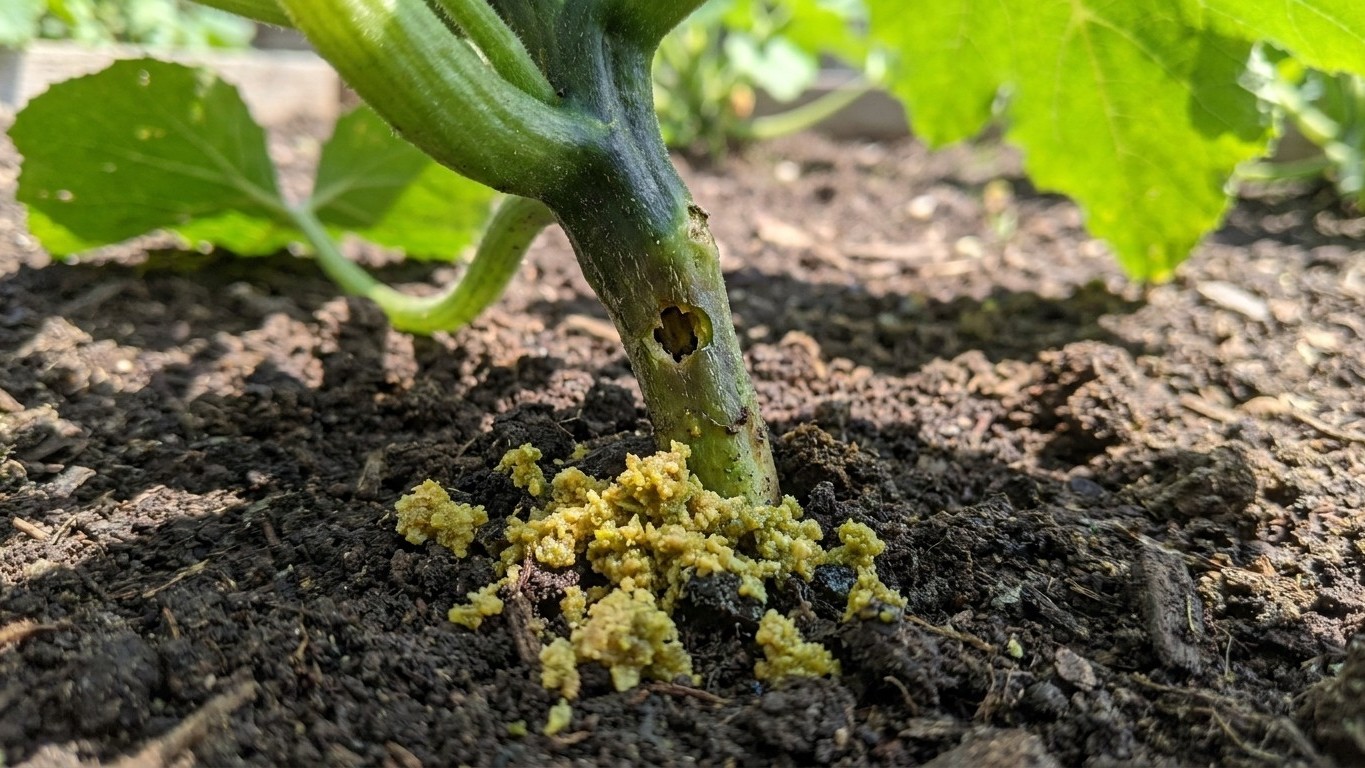
The stem was hollow. Not wilted, not dry, hollow, packed with a wet sawdust-like mush and a fat white grub curled inside like it owned the place. That’s what three weeks of extra watering had actually been feeding: a squash vine borer larva chewing its way through the base of the plant while the leaves above wilted every afternoon, right on schedule, exactly like a plant stressed by heat.
That mistake is common. Squash and zucchini wilt for a dozen reasons, and heat stress is the obvious one, especially during a July heat wave when every plant in the garden droops by 3 p.m. and perks back up at dusk. But when the wilting doesn’t reverse overnight, when one entire vine collapses while its neighbor stays upright, something else is going on. And by the time the whole plant is down, the borer has usually been inside for two to four weeks already.
Key takeaways
- A wasp-like moth lays eggs at the base of squash stems, and the larvae tunnel inside where no spray can reach them
- Heat-stressed wilting looks uniform across the plant; borer damage hits one vine at a time and leaves a telltale pile of wet sawdust at the stem base
- You can save an infested plant by surgically removing the larva and burying the wounded stem to encourage new roots
The moth that looks like a wasp
The adult squash vine borer (Melittia cucurbitae) doesn’t look like a typical moth. It flies during the day, has an orange-red abdomen with black dots, and clear-tipped wings, so most gardeners mistake it for a wasp and wave it off without a second thought. That’s exactly the problem: it’s laying eggs the whole time.
Females lay small, flat, brownish eggs individually at the base of stems, usually within a few inches of the soil line, starting in late June and continuing into July depending on region and climate. One female can lay upward of 150 eggs over her short adult life. The eggs hatch in about a week, and the newly emerged larva does the one thing that ends a summer squash plant’s life: it bores directly into the stem and starts feeding on the inside, where nothing can touch it, not row cover, not insecticide spray, not neem oil.
Zucchini and yellow summer squash (both Cucurbita pepo) take the worst of it. Butternut and other Cucurbita moschata varieties have naturally tougher, more solid stems and get attacked far less often, which is why gardeners who’ve been burned once often switch their main crop over to butternut and keep pepo varieties as a smaller gamble.
Reading the signs before the whole plant goes down
The classic heat-stress wilt is uniform: the whole plant droops evenly, leaves curl inward, and everything recovers once temperatures drop in the evening. Borer damage looks different, and once you’ve seen it once you’ll never confuse the two again.
- Wilting starts on one vine or one section, not the whole plant at once
- A small hole near the base of the stem, often with a pile of yellow-green, moist frass that looks like wet sawdust
- The stem near the soil line feels soft or spongy when pinched
- Wilting doesn’t reverse overnight, even after a cool evening and a full watering
That frass pile at the base is the single most reliable early warning sign, and it usually shows up a week or two before the plant visibly collapses. Check the base of stems weekly starting in late June if you’re anywhere in USDA zones 4 through 9, since that’s the general window when adult moths are active and laying eggs.
What to actually do once you find one
Splitting the stem, which is what accidentally solved the mystery in the first place, is also the standard field treatment. Use a sharp knife, make a shallow lengthwise slit starting just above where the frass is concentrated, and work carefully since the larva is usually only an inch or two into the stem at that point. Pull it out, kill it, and don’t worry too much about the surgery scarring the plant. Squash stems are remarkably good at healing over a clean cut.
After removing the larva, mound moist soil over the wounded section of stem. Squash vines can root at nodes that touch soil, and burying the injured area encourages new roots to form above the damage, which often keeps the plant alive and producing for the rest of the season even after losing part of its original root system. Some gardeners skip the surgery entirely and just bury several nodes along the vine preemptively, betting that extra root points will keep the plant going even if one section gets hit.
Beneficial nematodes (specifically Steinernema species) applied to the soil around the stem base can also help control larvae that have already entered, since the nematodes can penetrate the entry hole and attack the larva directly, something no topical spray can do once the pest is inside the tissue.
Stopping next year’s damage before it starts
Prevention works far better than surgery, and it starts with timing. Wrapping the lower 4 to 6 inches of stem in aluminum foil or a strip of nylon stocking right after transplanting blocks females from reaching the spot where they’d normally lay eggs. Floating row cover over young plants does the same thing, but has to come off once flowers open so pollinators can reach them, which is exactly the window when the moths are also most active, so timing that removal carefully Matters More Than it sounds.
Crop rotation helps too, since pupae overwinter in the soil right where the infested plant grew, sometimes just a few inches down. Moving squash to a different bed each year, even a modest 10 to 15 feet away, cuts down on the number of moths emerging right next to a fresh crop. Succession planting is another underused trick: a second sowing in early July often escapes the worst of the egg-laying window entirely and produces a clean fall harvest even in a season where the first planting was a total loss.
One more detail worth knowing: adult moths are strongest fliers in the morning, roughly between 9 a.m. and noon on warm, sunny days, which is also the best window to spot and physically remove them by hand if you’re patrolling the garden with a net instead of relying on sprays.