
Two years of thick green growth, branches shooting up like they were reaching for a prize, leaves the size of dinner plates. And figs? Barely a handful, most of them shriveling before they ripened. If that sounds familiar, you’re not doing anything catastrophically wrong. You’re just feeding the wrong part of the plant.
That’s exactly what a longtime gardener explained to me one afternoon, standing in front of my sulking fig tree with a pair of pruning shears. The tree wasn’t sick. It wasn’t stressed. It was, if anything, too healthy for its own good. When a fruit tree is younger, it puts most of its energy into producing leaves and shoots, and until the plant becomes mature and slows down in the production of leaves and shoots, it will produce few to no fruit. my tree was still in growth mode, pouring every drop of sap into new wood instead of flowers and fruit.
Key takeaways
- A simple pinching technique can redirect your fig tree’s energy from endless leaf growth to fruit production
- The plant’s natural hormones are working against fruiting—and one gardener’s trick can override them
- Not all fig trees respond the same way, and there’s a critical window where pinching helps instead of hurts
Where the sap was actually going
Here’s the part that changed how I look at pruning entirely. Fig trees don’t distribute their energy evenly. They have a built-in chain of command called apical dominance: the topmost bud on a branch releases a hormone that suppresses growth everywhere below it, so the plant keeps racing upward and outward instead of branching out and setting fruit. Pinching removes the apical dominance of the main shoot and reduces the IAA concentration in lateral shoots, since apical buds produce IAA to suppress bud growth in competing nodes, and removing the tip removes the source of IAA. Once that chemical brake is released, buds that had been sitting dormant along the stem suddenly have permission to develop, including the ones that would become fruit.
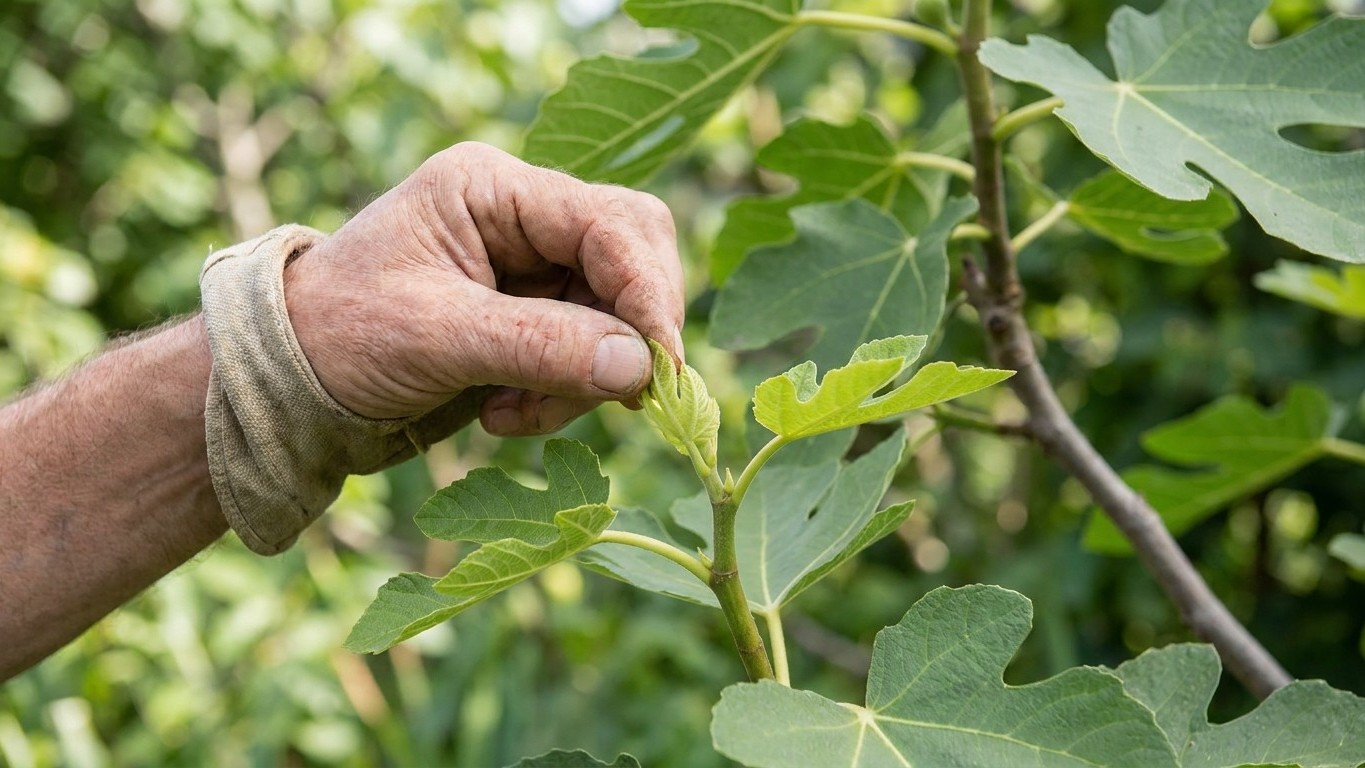
My tree had spent two seasons with all its sap rushing to the tips of ever-lengthening branches. Nothing was stopping it. There was no signal telling the plant to slow down and invest in fruiting wood instead. That’s the mechanism behind what gardeners often call the “fifth leaf trick,” and it’s not some folk myth passed around online. The technique involves pinching out the shoot tips after five leaves in early summer. The RHS spells out the logic bluntly: for a fig that produces barely any fruit, the fix is to remove the tip of every other young shoot once they have five leaves, to encourage branching and reduce the production of fruit that won’t ripen.
How the fifth-leaf pinch actually works
The method itself takes about ten seconds per branch. You let a new shoot grow until it has produced five leaves, then you pinch off everything beyond that fifth leaf, usually just with your fingernails. No shears required for young, soft growth. The advice circulating among experienced fig growers is to let the actively growing branch grow until it has at least five leaves, then pinch the tip off after that so it won’t get longer. Growers who’ve tracked the results describe a fairly consistent pattern afterward. What tends to happen is some combination of lots of figs and new growth nodes forming on that branch.
Timing Matters More Than people expect. Pinch too early and you’re just interrupting growth without giving the plant time to redirect its resources. Pinch too late and you create new shoots that never mature. The consensus among growers is to pinch branches after five leaves in May and June to promote fruit set, then stop pinching after early to mid July and focus on thinning branches instead. Stop pruning back new growth by mid-summer, when the embryonic fruitlets for next year’s crop start forming at the shoot tips, because pruning after mid-summer means the resulting new growth won’t have time to form fruit embryos before the season ends. Miss that window, and you’re pinching for nothing. Worse, you might be sabotaging next year’s harvest by removing the very buds that were about to turn into fruit.
One thing I wish I’d known sooner: pinching isn’t universally recommended, and even experienced growers disagree about it. Some fig enthusiasts who’ve run their own side-by-side comparisons report the opposite effect entirely, with pinched branches yielding fewer figs than branches left alone. Modest experiments comparing pinching to no pinching found it did not accelerate fruit production, with unpinched verticals producing roughly 20 figs each compared to about 5 figs plus a cluster of extra branches when pinched. The takeaway isn’t that the technique is fake. It’s that fig trees are wildly variable depending on variety, climate, and how the plant was trained in its first years, so what works on a container fig in a warm zone won’t necessarily behave the same way on an in-ground tree in a shorter season.
The other culprit: too much of a good thing
Pinching alone won’t fix a fig tree that’s fundamentally out of balance. Vigor itself is often the real problem, and it usually traces back to two things: overfeeding and overpruning. Too much fertilizer, especially nitrogen, or severely pruning the tree will result in the tree becoming overly vigorous at the expense of setting and maturing fruit. That nitrogen doesn’t even have to come from a bag you bought. Fertilizer that the tree pulls up from a nearby lawn area counts too, since a tree’s roots grow outward two to three times beyond its branch spread into adjacent lawn areas. My fig, it turned out, had roots creeping straight into a fertilized flower bed. That alone may have done more damage than any pruning mistake.
Root restriction is the other lever experienced growers pull, and it’s oddly counterintuitive: you make the tree perform better by giving its roots less room, not more. You can reduce a fig’s excess vigor by pruning it regularly and restricting its roots in a lined pit, root-control mesh bag, or large container, which also encourages it to produce fruit rather than too much lush, leafy growth. Growing a fig in a large pot, or lining an in-ground planting hole, essentially forces the plant to stop investing in root expansion and start investing in reproduction instead. It’s the botanical equivalent of a deadline: limited resources push the plant toward the thing that actually matters for survival, which is seed production. Figs, luckily for us, wrap that seed production in something delicious.
Sources : youtube.com | figboss.com