
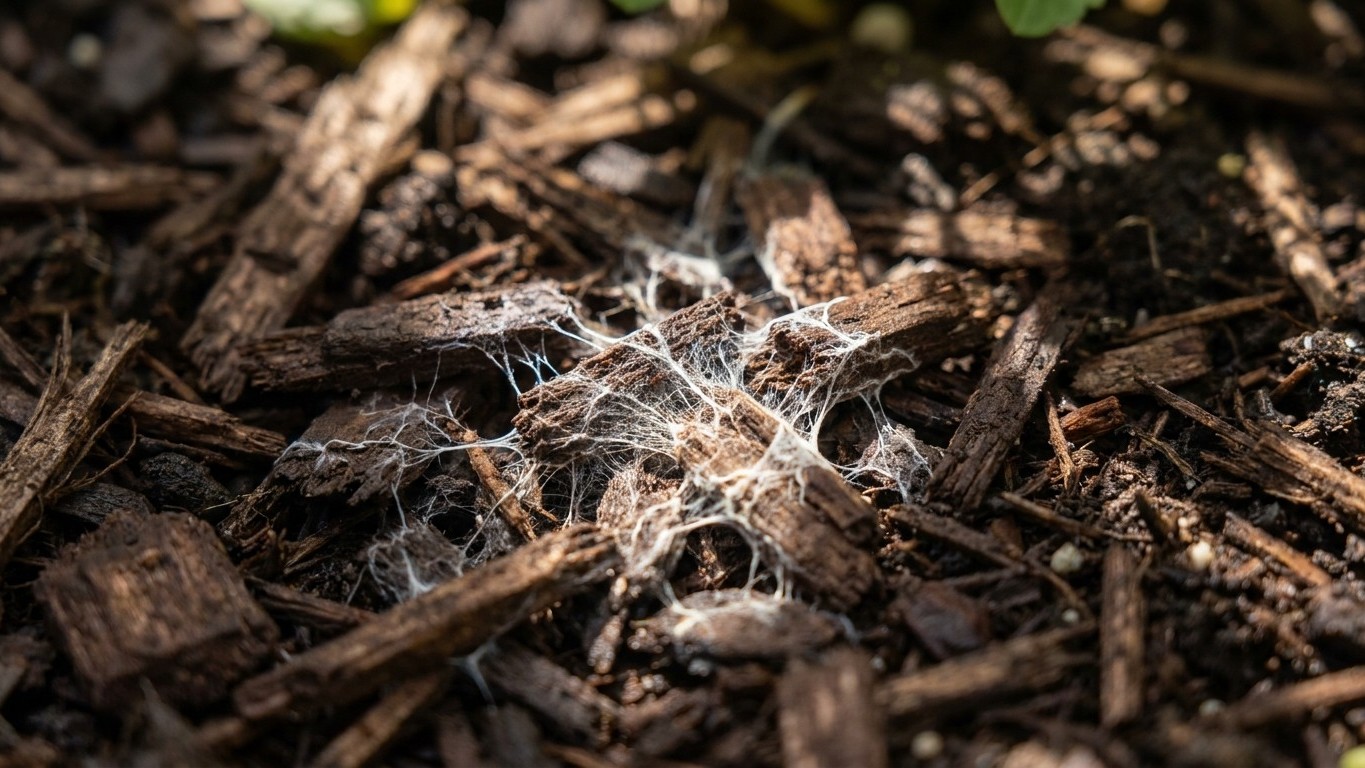
That white webbing spreading through your mulch every July isn’t mold at all. It’s mycelium, the thread-like body of a fungus quietly rebuilding the soil under your feet, and scraping it away every summer means undoing months of free, invisible work.
The confusion is understandable. Those fine white filaments look exactly like something gone wrong, especially when they show up fast after a humid stretch and seem to multiply overnight. The white threads are the underground growth of fungi, otherwise known as mycelium. Fungus grows in mulch just the same as it does in decomposing wood on the forest floor. This is no cause for concern. Mushrooms, when they eventually poke through, are just the visible tip of an operation that’s been running underground the whole time.
Key takeaways
- What looks like mold destroying your mulch is actually a nutrient factory actively feeding your plants
- Fungi connect plant roots in an underground network, expanding nutrient access by up to five times
- One summer of leaving the webbing alone reveals what it was doing all along
What that webbing is actually feeding
Pull back a layer of wood chips and you’re looking at a nutrient factory in motion. Fungi break down wood, leaves and mulch into nutrients that plants can absorb. They connect roots in a living network, moving water and minerals through the soil. This isn’t a passive process. The fungus is actively converting carbon-heavy material, the stuff bacteria can’t easily touch, into forms your plants can actually use. While bacteria break down simple materials, fungi handle the harder work. They break down tough, carbon-rich inputs like wood chips, leaves, cardboard, and mulch.
Some of that mycelium goes further than decomposition. Certain species form direct partnerships with plant roots, a relationship so extensive scientists gave it its own nickname. Mycelium connects the roots of plants in what scientists have called the “wood wide web,” an underground network where plants and fungi trade resources and information. The math on this exchange is honestly a little startling: how much can fungal mycelium expand the total reach of a tree’s root system? Estimates range from five times the normal spread of a root system and up, resulting in increased water and nutrients available to the tree for growth, defense or storage at a reduced energy cost. Your tree isn’t just standing there. It’s outsourcing a huge chunk of its foraging to a partner most people spend July trying to destroy.
Phosphorus is the nutrient plants struggle hardest to access on their own, and it’s where fungi earn their keep most dramatically. Increased nutrient uptake from the soil with the help of fungi. Plants can get up to 80% of their phosphorus from mycorrhizal fungi. In exchange, the plant isn’t giving away something for nothing. In this relationship, the fungus helps the plant reach water and nutrients beyond its natural root zone. In return, the plant shares some of its sugars with the fungus. It’s a trade, not charity, and both sides come out ahead.
Why summer is prime scraping season, and why that’s a mistake
Heat and humidity are exactly what mycelium wants. Moist mulch sitting under a July sun creates the same conditions fungi evolved for on a forest floor, which is why the webbing seems to explode right when you’re out weeding and notice it disturbed. It is common to see white mycelia (the thread-like filaments of fungal growth) when organic mulches are dug into (you also see them in compost piles). There is no need for concern or treatment for control.
The instinct to scrape it out usually comes from a fear that it’s harming plants. It isn’t. The white fungi living in the decaying leaves are beneficial saprophytic fungi. Saprophytic fungi decay dead organic matter and do not attack or damage living plants. These organisms aren’t in competition with your tomatoes or your hydrangeas. They’re breaking down dead material so those plants have something to eat.
There’s a real ecological reason your yard doesn’t disappear under decades of fallen leaves and dropped needles. This is because organic material, like leaves and pine needles, decay and rot over time. As the organic matter is decayed it disappears. That’s why the layer of leaves and needles is not several feet thick despite years of deposits. The decaying organic matter helps build healthy soil and is very beneficial to the trees in your yard. Fungi are the reason that math works out. Remove them constantly and you’re left with mulch that just sits there, inert, doing none of the soil-building it’s supposed to do.
What actually deserves a second look
Not everything white and weird in a garden bed is harmless, so it’s fair to stay a little vigilant. A bright yellow, spongy blob that shows up after warm rain is a different organism entirely. This is another primitive organism called a slime mold. Some refer to it as “dog vomit fungus,” which gives you a good idea of what it looks like. It’s ugly, but not a threat. The mold on your mulch serves a beneficial role by breaking down dead plants and wood and returning nutrients to the soil. These organisms aren’t parasitic and won’t harm your plants.
Where actual caution matters is with a small handful of named pathogens rather than the generic white webbing. Rhizoctonia solani can cause seedlings to “damping off” which is a fungal disease that may occur in seedlings when fresh mulch is used. That’s a specific, identifiable problem affecting young seedlings, not the lacy white network spreading through an established bed. If you’re not sure which one you’re looking at, the safest move is patience rather than a rake.
Leaving the mycelium alone doesn’t mean ignoring your mulch entirely. Fungi still need the right conditions to keep doing their job well, and that mostly comes down to moisture and disturbance rather than removal. Tilling is like taking a chainsaw to a spiderweb, it shreds the very structure you’re trying to build. Instead, adopt no-till or low-till practices, and top beds with a thick layer of organic mulch, which creates a cool, moist, stable environment that fungi love, and provides the organic matter they need for food. A shovel through the bed does more damage to that network than an entire summer of humidity ever could, and it’s worth remembering that the next time July rolls around and the webbing reappears right on schedule.
Sources : nola.com | soilpluskona.com