
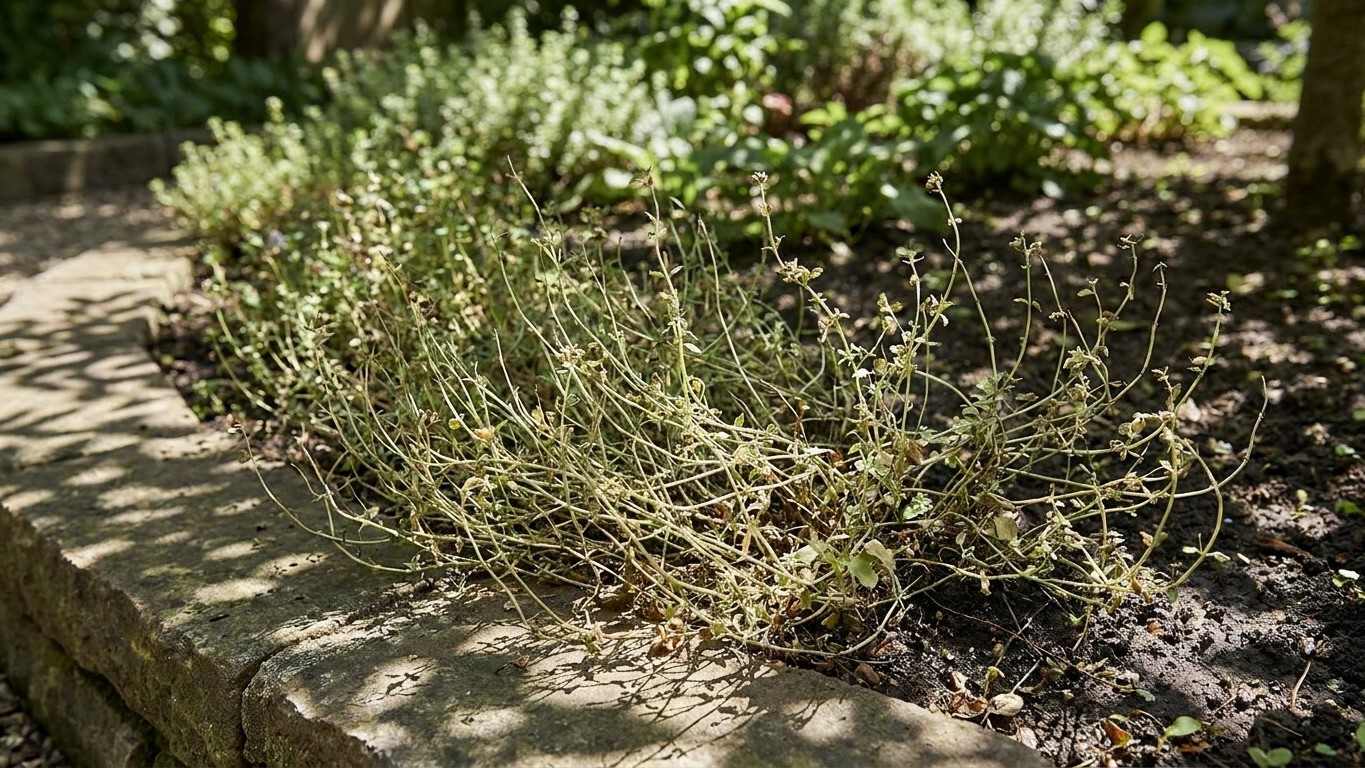
By August, the strip that was supposed to save you weeding time looked more like straw than a lush green carpet. That’s the cruel irony of planting creeping thyme (Thymus serpyllum) in a shaded spot: the very choice meant to cut corners on maintenance is often what dooms the plant to failure. And once the growing season is winding down, there’s no quick fix. The damage of a summer spent underlit is already baked into those thin, sparse stems.
Here’s what actually happened, biologically speaking. The most immediate response to shade is etiolation, where stems stretch upward in search of light, resulting in a plant that looks thin and sparse and fails to create the uniform, dense groundcover mat you were picturing when you bought those little starter plugs in spring. It’s not a disease. It’s not a watering mistake. It’s the plant literally reaching for something that isn’t there.
Key takeaways
- A plant bred for sun-baked Mediterranean hillsides doesn’t just grow slower in shade—it becomes a completely different, weaker plant
- Morning shade and afternoon shade have drastically different impacts on thyme survival, and most gardeners don’t know the threshold that matters
- By August, the damage is already done, but the real lesson reveals which ground covers actually thrive where thyme fails
Why the Shaded Side Was a Losing Bet From Day One
Creeping thyme has a reputation as an easygoing, “plant it and forget it” ground cover, and in the right spot, it is. But that reputation comes with fine print. Creeping thyme performs best in full sun, needing at least six hours of direct sunlight each day, and several growing guides push that number even higher. Creeping thyme thrives best in full sunlight for at least 6-8 hours daily, and partial shade can stifle growth and reduce flowering and essential oil production. That’s not a plant that tolerates a shaded path out of politeness. It’s a Mediterranean herb, adapted to rocky, sun-baked hillsides where nothing else wants to grow.
Skip the sunlight and you don’t just get a slower plant. You get a fundamentally different one. Full sun maximizes photosynthesis efficiency, leading to denser growth and more blooms; sun exposure reduces moisture retention on leaves, minimizing fungal risks like powdery mildew; and the essential oils responsible for fragrance are more concentrated in sun-grown plants. In the shade, you lose all three benefits at once: density, disease resistance, and that signature herbal scent that’s half the reason people plant thyme paths in the first place.
Morning Shade and Afternoon Shade Are Not the Same Problem
“Shaded side of the path” is doing a lot of work in that sentence, and it matters enormously which hours of the day are actually affected. Creeping thyme prefers morning shade over afternoon shade since it allows the plant to receive more light during its active growth period. If your strip gets shadowed by a fence or a neighbor’s tree until 10 a.m. but bakes in direct light all afternoon, you might have gotten lucky. If it’s the reverse, blocked from noon onward, the plant was fighting an uphill battle every single day of summer.
There’s a rough threshold worth knowing for next time. Full shade, meaning less than 3 hours of direct sun per day, isn’t recommended; partial or light shade, with 3 to 6 hours of sun (preferably morning light), is acceptable with monitoring; and dappled shade filtered through tree canopies is often suitable because of indirect brightness. A “shaded” strip that still logs four or five hours of decent morning sun can limp along. One buried under a solid tree canopy or a north-facing wall all day genuinely can’t.
What To Do With the Strip Now
End of summer isn’t the moment to rip Everything-to-stop-back-pain-in-the-kitchen”>everything out in frustration, but it is the moment to be honest about what you’re looking at. If the mat is patchy and leggy rather than dead, a light prune can help. Pruning lightly in spring encourages branching and reduces legginess caused by etiolation, so mark this as a task for next spring rather than now, when cutting back stressed plants heading into cooler weather adds insult to injury.
Check the soil while you’re at it. Shaded areas retain moisture longer, and that’s a separate trap entirely. Poor drainage or overwatering can lead to fungal diseases and root issues in creeping thyme, and a shaded strip that never fully dries out is exactly the kind of environment where root rot creeps in on top of the light problem. If the soil feels consistently damp rather than dry and gritty, that’s a second strike against the spot, independent of sunlight.
If you’re determined to keep thyme in that location, some cultivars handle the compromise better than others. Compact cultivars like ‘Elfin’ or ‘Pink Chalk’ handle lower light slightly better than the straight species, and one Wisconsin garden database lists a related variety as tolerating “Full sun, Filtered shade” rather than full sun alone, which is about as close to a shade-tolerant thyme as the genus offers.
When It’s Time to Swap the Plant, Not the Spot
Sometimes the honest answer is that thyme was never the right plant for that particular strip, and no amount of tinkering with pruning or soil will change the sun math. For genuinely shaded ground, a handful of low, spreading alternatives actually want the conditions you have. Bugleweed establishes a dense, spreading mat and thrives in deep shade, valued for its dark green or bronze-purple foliage and spikes of blue spring flowers. For a mossy, stepping-stone look, Irish moss forms a bright green, dense cushion that tolerates light foot traffic and works well between stepping stones. And if the spot stays cool and damp under a tree canopy, sweet woodruff prefers cool, moist, heavily shaded locations and features whorls of bright green leaves with masses of delicate white flowers.
None of these substitutes smell quite like a Provençal hillside when you brush past them, and that’s a real loss if fragrance was the point. But a thriving patch of bugleweed beats a leggy, brown-tinged thyme strip every time a neighbor walks by. The lesson from this one shaded planting isn’t that ground covers are unreliable. It’s that “low maintenance” only applies when the plant and the site actually agree on the basics, starting with how many hours of direct sun hit that soil between breakfast and dinner.
Sources : plantin.alibaba.com | gardenia.net