
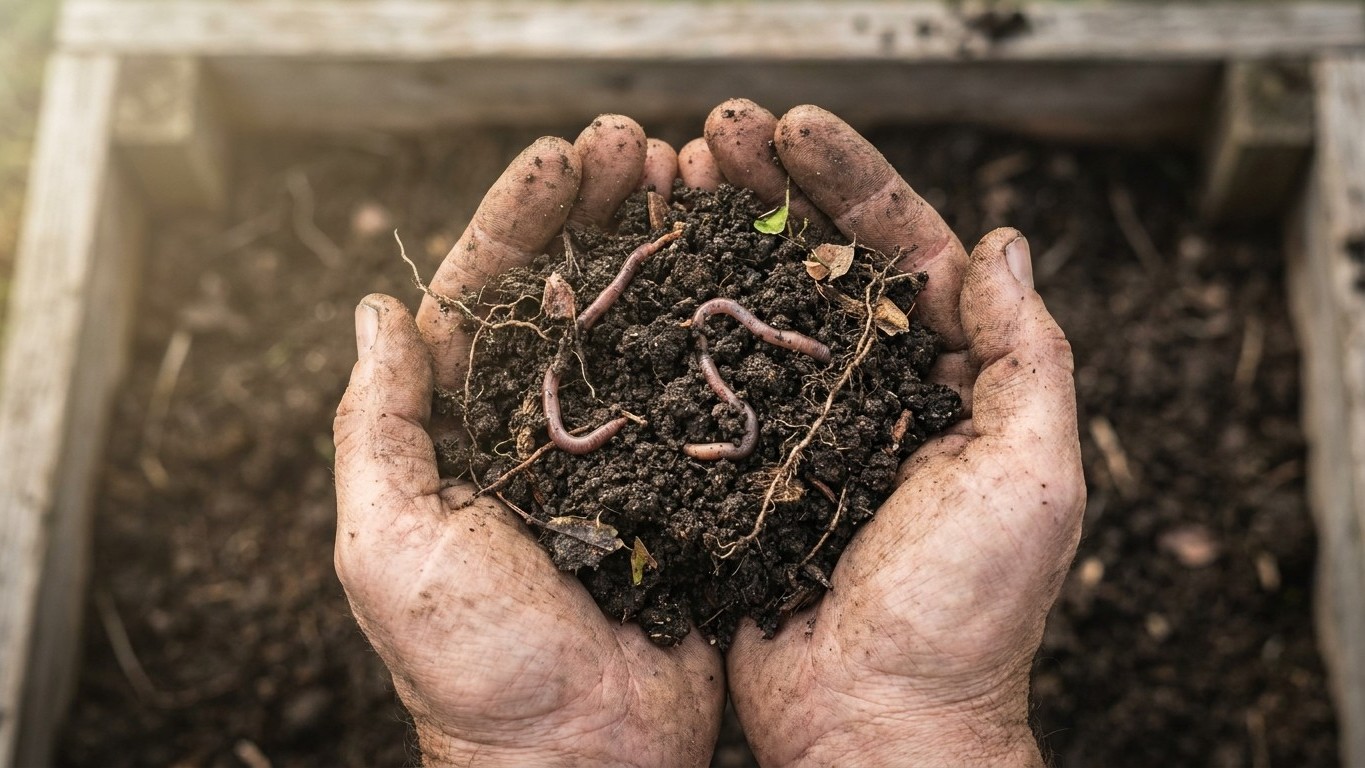
The wilting started in July, right when the tomatoes should have been at their peak. Leaves curled by mid-morning despite a soaking the night before. I dragged the hose out daily, sometimes twice, and still watched squash plants droop like they’d been forgotten for a week. The answer wasn’t in the weather forecast. It was six inches down, in the exact spot where my spade had sliced through every spring for years.
That spring, like every spring before, I’d turned the whole bed over. Fork in, heave, flip, repeat. It felt productive. Fluffy, dark soil looked like success. But that visual transformation tricks a lot of gardeners into equating fluffy soil with healthy soil, when in reality structure matters far more than softness. What I was looking at wasn’t rebuilt soil. It was demolished soil, dressed up to look fine for a few weeks before gravity and rain packed it right back down.
Key takeaways
- A simple spade cuts through an invisible water-delivery system that took years to build
- Daily watering can’t save plants when soil has lost the ability to hold moisture
- One change reversed the wilting—but it meant stopping the one thing that felt productive
What the spade actually cuts through
Underneath every established garden bed runs a network most people never think about: threadlike fungal filaments called hyphae, extensions of arbuscular mycorrhizal fungi that partner with roots. These aren’t decorative. Mycorrhizal fungi extend in microscopic threads through the soil, connecting plant roots to nutrients and water several feet beyond where the roots themselves can reach. Some estimates put the extension at a staggering scale. These fungi can extend plant root systems by up to 1,000 times through their hyphal networks, dramatically improving water and nutrient uptake.
A single season of digging doesn’t just disturb this network. It severs it. Researchers studying agricultural tillage found that conventional tillage can disturb and homogenize soils to a depth of 20 to 30 centimeters, distributing broken fungal hyphae and spores through a much larger volume of soil, even though the greatest abundance of these fungi is normally found within the top 10 centimeters of undisturbed soil. In plain terms: my spade wasn’t loosening soil. It was scattering a functioning water-delivery system into fragments too diluted to work.
The damage isn’t subtle either. A single pass with a tiller can reduce mycorrhizal populations by 50 to 75 percent, and it can take years for these networks to fully recover. I’d been resetting that clock every spring, right before the plants needed the network most.
Why daily watering couldn’t fix it
Earthworms took the same hit. These are the engineers responsible for the vertical tunnels, known as biopores, that let water travel deep instead of pooling or running off the surface. Earthworms build biopores, vertical channels that allow water to drain deep into the soil profile and air to reach root zones. Digging destroys those tunnels outright, and the population takes a real hit too. Research shows that tillage can reduce earthworm populations by up to 90 percent, and these creatures normally process 10 to 15 percent of the top six inches of soil annually, creating nutrient-rich castings and improving soil structure through their tunneling.
So when I poured water on that bed every evening, it had nowhere useful to go. Without stable clumps of soil, organic matter, and microbial glue holding things together, water either sat on the surface and evaporated by 9 a.m. or drained straight through without being held anywhere near the roots. Healthy soil forms stable aggregates, tiny clusters of sand, silt, clay, organic matter, fungi, bacteria, and microscopic life that bind together and create air pockets and drainage channels, and aggressive tilling shatters those aggregates. I wasn’t under-watering. I was watering soil that had lost its ability to hold onto water at all.
There’s a chemistry angle too, and it’s not flattering. Frequent tilling reduces organic matter over time because it introduces oxygen that accelerates decomposition, and that organic matter is what fuels soil life and improves water retention. Every spring dig was quietly burning through the very reserves my plants would need to survive a dry July.
Switching to no-dig changed the outcome
The following autumn I stopped digging entirely. Instead of turning the bed, I laid down a thick layer of compost on top and left the soil structure alone underneath, an approach that’s gained real traction among market growers over the past several years. No-dig vegetable gardens work across USDA hardiness zones 3 through 9 and have been adopted widely by market gardeners across North America who find it outperforms conventional tillage on long-term crop yields. The logic is straightforward once you’ve seen the underground damage firsthand: stop breaking what took years to build.
The compost sits on the surface and gets pulled down gradually by worms and rain, exactly the organisms I’d been wiping out annually. Rather than tilling the garden before spring planting, you can top-dress the soil with an inch or so of finished compost, and it may be scratched into the first half inch or inch of soil, though even that isn’t necessary. No tiller, no spade turning the whole bed, no interruption to whatever fungal network is quietly rebuilding itself down there.
By the second season without digging, the difference showed up in the simplest way possible: I watered less and the plants looked better doing it. That’s consistent with what other gardeners who’ve made the switch report. After going without tilling for five years, one gardener described soil that now absorbs heavy rainfall without runoff, stays moist during dry spells, and produces healthier plants with fewer pest problems. It’s not a magic fix in one summer. Structure that took a beating for years doesn’t reassemble overnight.
One detail still catches me off guard whenever I’m out there with a trowel now, checking on root depth rather than turning anything over: not every vegetable relies on this fungal partnership the same way. Studies have shown that most flowers and vegetables form mycorrhizal relationships, with the notable exception of Brassica species like broccoli, kale, and arugula, along with beets. So if your brassica bed struggled less than Everything else during a dry spell, that’s not luck. It’s biology that never needed the network you’d been cutting through every spring.
Sources : ncbi.nlm.nih.gov | researchgate.net