
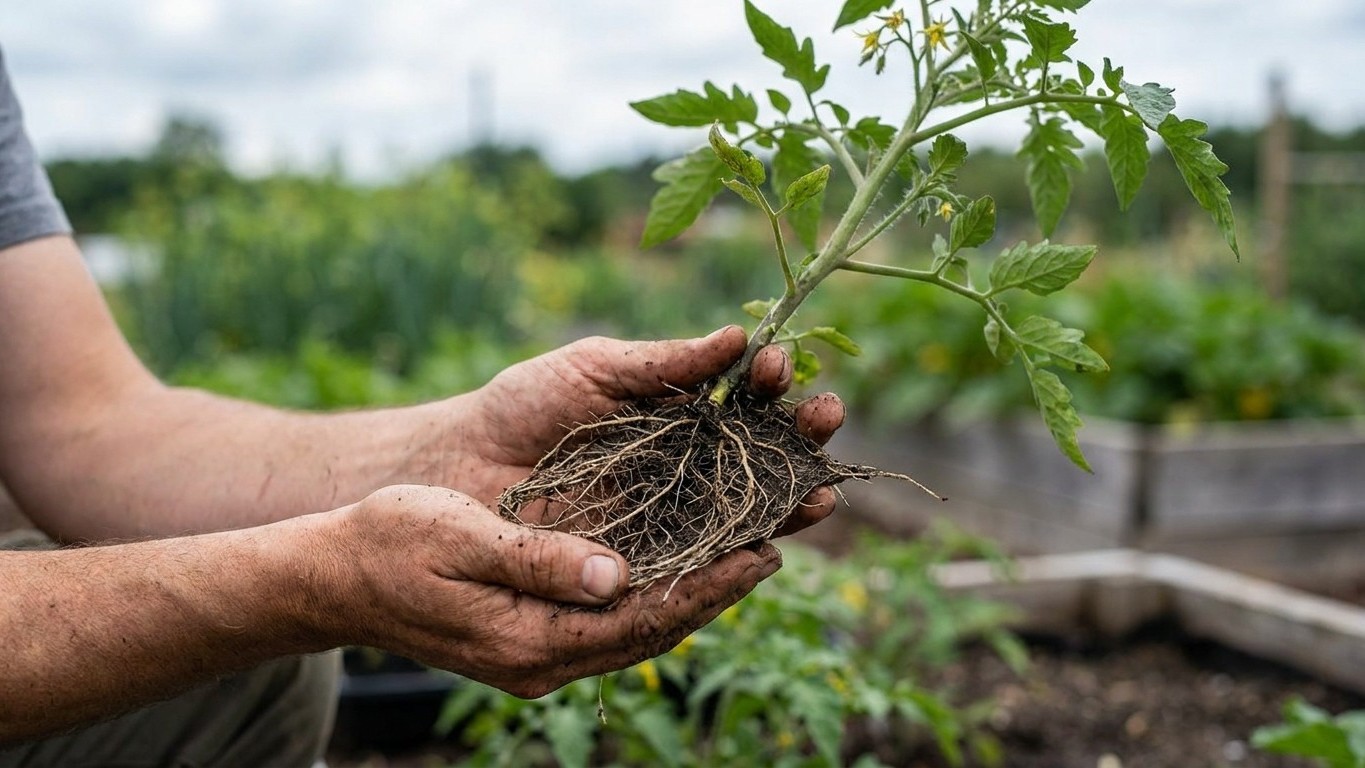
Ten minutes a day sounds responsible. Water-wise, even. That’s exactly what I told myself for two summers while running my buried drip line every evening, patting myself on the back for being the neighbor who wasn’t wasting a drop. Then I pulled up a struggling tomato plant that had been limping along despite what I thought was consistent care, and the root ball told a different story: a flat, shallow mat of roots barely three inches deep, spread wide but never diving down. No taproot reaching for stability. No deep anchoring system. Just a nervous little network hugging the surface, exactly where I’d been feeding it, drop by drop, every single evening.
Key takeaways
- A cup of daily water creates a nervous root system that hugs the surface instead of reaching deep
- Shallow-rooted plants become dependent on your schedule and collapse during any water interruption
- The fix requires patience: stretching intervals while doubling duration, forcing roots to chase water downward
Why Short, Frequent Watering Backfires
The math behind drip irrigation is almost embarrassingly unglamorous. A standard one-gallon-per-hour emitter running for five minutes doesn’t deliver a satisfying soak. A drip irrigation system puts out water much slower than a sprinkler system, usually a gallon or two an hour, and in five minutes, a 1 gallon per hour emitter will put out about 10 ounces of water, slightly more than a cupful. That’s it. A cup of water, delivered daily, right at the surface.
Roots are opportunists. They don’t grow where water might be someday. They grow where water actually is, right now, and if that’s always the top inch or two of soil, that’s where they’ll stay. That small amount won’t saturate the width of the plant’s root zone, which can extend well beyond the canopy, and it won’t penetrate more than an inch or two, then it won’t stay there very long. The result is a plant living paycheck to paycheck, water-wise, with roots that stay very near the surface, where they are more subject to drying out quickly, creating a boom and bust cycle that stresses the plant.
This isn’t just garden folklore. A study on cotton irrigation published in Irrigation Science found that daily drip irrigation, which wetted only the top 40 centimeters of soil, encouraged root development mainly around the drippers, with water extraction taking place mostly from the top 20 centimeters where roots concentrated. Even more telling: the shallowness of root growth wasn’t fixed simply by expanding or deepening the wetted zone through more water. The frequency was the problem, not just the volume. And that shallow root system came with a hidden cost. A shallow and restricted root system resulted in strong dependence of the plants on frequent and sufficient water supply, meaning temporary minor changes in irrigation immediately affected plant health and productivity. my ten minutes a day hadn’t made my plants resilient. It had made them fragile, hostage to a schedule they could never afford to miss.
What “Deep and Infrequent” Actually Looks Like
Extension horticulturists have been saying the same thing for years about lawns, trees, and garden beds alike, and the phrase that keeps surfacing is deep and infrequent. According to University of Nebraska research, common irrigation mistakes include frequent, shallow watering from automatic systems, applying too much water at once so it drains past the root zone, and not moistening a wide enough area of the root zone. The fix sounds almost too simple: deep and infrequent is the correct description for watering landscape plants, though it means different things depending on the plant, with deep for turfgrass meaning 4 to 6 inches and deep for a tree meaning 12 to 18 inches.
Soil type changes the equation too. Sandy soil drains fast and needs shorter, more frequent runs. Clay holds onto water and needs long, slow sessions to avoid runoff. Sandy soils drain rapidly and benefit from shorter sessions of around 30 to 45 minutes run more frequently, while clay soils absorb water slowly and require longer sessions of 60 to 90 minutes to achieve proper penetration, and loamy soils typically perform well with sessions of 45 to 75 minutes every two to three days. None of those numbers look anything like ten minutes nightly.
The real trick, according to multiple extension sources, isn’t guessing. It’s digging. Scratching down into the soil to see how moist it is an inch down matters more than looking at the surface, and checking the next day how far the water has penetrated tells you whether you’re overdoing it or underdoing it. One Oregon extension answer put it plainly, too: with drip irrigation, water moves downward and sideways, creating a balloon-shaped wetted zone, and the shape and depth depend heavily on soil texture, organic matter, compaction, and how long you run the system, so the surface can look dry even when the root zone is wet.
Retraining a Root System That’s Already Shallow
Fixing this isn’t instant, and it isn’t supposed to be. Weaning a plant off daily shallow watering means slowly stretching the interval between sessions while lengthening each one, forcing roots to chase water that’s retreating deeper into the soil. Farmer Fred, a longtime California garden radio host, frames the mental shift simply: don’t think minutes, think hours, and water deeply but infrequently, once or twice a week, with the goal of penetrating the soil to a depth of at least 8 inches, preferably more.
For new plantings, there’s nuance. Fresh transplants genuinely do need more frequent moisture at first because they haven’t built the root architecture to go looking for water yet. New plants don’t have the root structure to absorb water and need more of it as a result, and it takes at least a year for a plant to start reaching lower into the soil where moisture is held. The mistake isn’t watering new plants often. It’s never graduating established ones to a deeper, slower rhythm once their roots are ready to do the work.
My tomato plant recovered, eventually, once I switched to two long soaks a week instead of nightly sips. But I still keep a hand trowel by the back door now, a small ritual before I trust any watering schedule again. Every few weeks, I dig down six inches near a few plants, just to see where the roots actually are, not where I assume they should be. It takes thirty seconds and tells you more than any timer ever will.
Sources : ask.extension.org | ilsirrigation.co.uk