
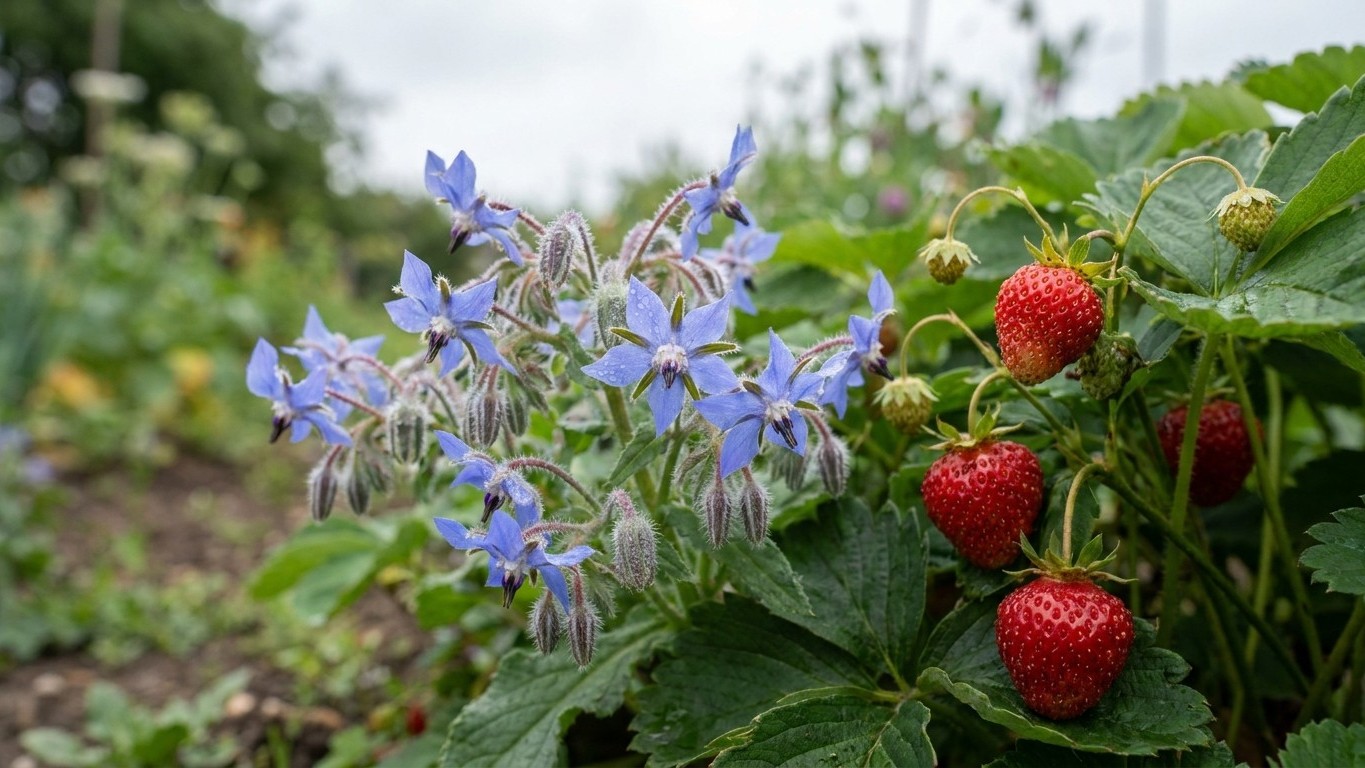
Borage doesn’t look like much at first glance. A slightly coarse, bristly plant with star-shaped blue flowers that most gardeners either overlook or mistake for a weed. But plant it next to your Strawberry patch in April, and something quietly extraordinary begins to happen, something no nitrogen-rich fertiliser or synthetic growth booster has ever managed to replicate.
The relationship between borage (Borago officinalis) and strawberries is one of the oldest companion planting partnerships in European cottage gardening, documented as far back as the 17th century in English kitchen garden records. What’s striking is that modern horticulture is now catching up with what those early gardeners observed intuitively: the presence of borage measurably improves strawberry fruit quality, yield, and even flavour. April is the critical window to plant it, just as strawberry runners are establishing their root systems and preparing for their summer output.
Key takeaways
- A single garden flower does something no synthetic fertilizer can replicate for strawberry plants
- This partnership has been documented since the 1600s, but modern science is only now explaining why it works
- The timing of April planting creates an almost suspiciously perfect synchronization with strawberry bloom cycles
What borage actually does in the soil and above it
The plant works on two levels simultaneously. Underground, borage has a deep taproot that breaks up compacted subsoil layers, drawing up trace minerals, particularly calcium, potassium, and silica, from depths that strawberry’s shallow roots simply cannot reach. As borage leaves decompose (and they decompose fast, being exceptionally soft-tissued for such a robust-looking plant), those minerals become available in the top layer of soil where strawberries feed. Think of borage as a natural mineral elevator, pulling resources from 18 inches below and depositing them right where they’re needed.
Above ground, the dynamic shifts entirely to biology. Borage flowers are among the most attractive to pollinators of any garden plant, bees visit them at roughly twice the frequency they visit most other flowering herbs, according to research from the Royal Horticultural Society. Strawberries are notoriously dependent on successful pollination to develop full, well-shaped fruit. Poorly pollinated strawberries produce those frustrating misshapen berries that are half-sized and pithy in the middle. More bees around borage means more bees visiting adjacent strawberry blossoms, and better-formed, sweeter fruit as a direct result.
The flavour question: is there real science behind this?
Gardeners have claimed for generations that borage makes strawberries taste better. More intense. Sweeter, with a deeper berry note. For a long time, this was dismissed as romanticised nostalgia, the kind of thing people believe because they want to. The reality is more nuanced.
Strawberry flavour complexity depends heavily on sugar-acid balance and the concentration of aromatic compounds called esters and terpenes. Both are influenced by mineral uptake, specifically the potassium and silica that borage cycling delivers to the soil. Higher potassium levels in strawberry plants correlate with increased sugar content in the fruit. Silica strengthens cell walls, which slows moisture loss in ripening berries and concentrates flavour compounds rather than diluting them. So the old gardeners weren’t wrong; they just didn’t have the vocabulary to explain what they were tasting.
There’s also a stress-response mechanism worth mentioning. Borage contains trace amounts of pyrrolizidine alkaloids in its leaves, compounds that some companion planting researchers believe may act as mild chemical signals, detectable by neighboring plants at the root level. Whether strawberries actually “respond” to these signals by increasing their own antioxidant production remains contested, but the hypothesis is actively studied. The University of Reading’s plant sciences department has explored how root exudate communication between companion plants affects fruit quality, though the borage-strawberry pathway specifically needs more controlled trials.
How to plant it to get the effect right
Spacing matters more than most guides acknowledge. A single borage plant placed too far from the strawberry patch, say, more than three feet away, delivers most of its pollinator benefit but far less of its soil-mineral advantage. The optimal placement is one borage plant for every four to six strawberry plants, interplanted directly within the row or in an alternating pattern. April sowing works because borage germinates in around 7-10 days in 60°F soil, which means it flowers by late May just as strawberry blossoms open. The timing is almost suspiciously perfect.
One practical note: borage self-seeds aggressively. If you plant it in April and let it go to seed through summer, you’ll have a permanent colony by the following spring, which is either a gift or a nuisance, depending on your garden philosophy. Many strawberry growers deliberately let it naturalize along the edges of their beds for exactly this reason. Others pull it after flowering and direct-sow fresh seed the following April to control placement.
Borage also deters tomato hornworm and cabbage worms when grown near brassicas, so any plants pulled from the strawberry bed can immediately go to work elsewhere in the vegetable garden rather than the compost. The plant earns its space twice over.
A partnership worth taking seriously
Companion planting often gets lumped in with folk remedies and garden mythology, and admittedly, some of it deserves that skepticism. But the borage-strawberry pairing has enough mechanistic evidence behind it, pollinator attraction, mineral cycling, physical soil structure — to treat it as practical agronomy rather than superstition. Commercial strawberry growers in the UK and the Netherlands have begun incorporating flowering companion borders, including borage, into their field designs specifically to reduce pesticide dependency while maintaining yield. The shift is gradual, but it’s happening.
What’s particularly telling is that the benefit runs in one direction only. Borage gains nothing obvious from the association, strawberries don’t enrich the soil for it, don’t attract its pollinators, don’t offer it chemical signals. It’s an entirely generous partnership. Which, in a garden as in most things, is the kind that produces the best results.