
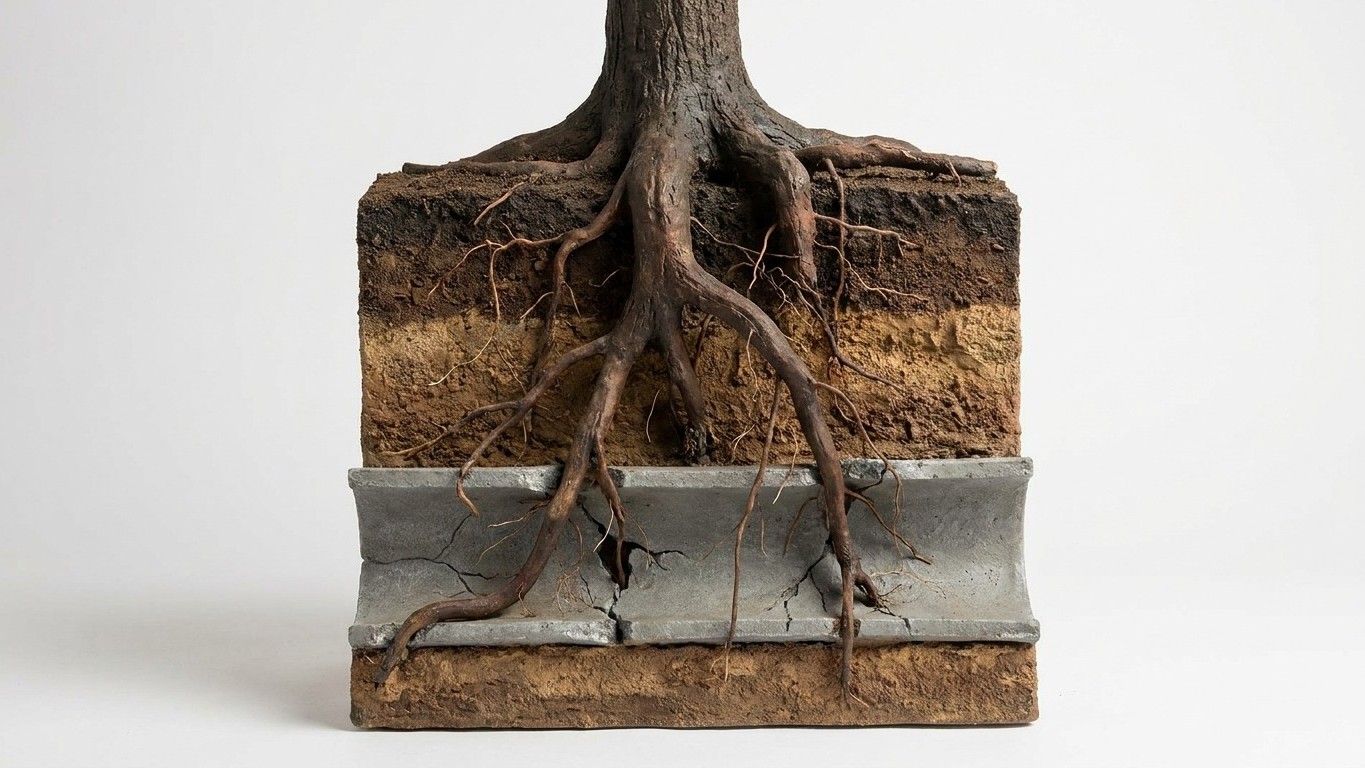
Somewhere in your front yard, a tree you planted years ago is working around the clock underground, sending out roots in every direction. You can’t see it. You can’t hear it. And by the time you realize something is wrong, your plumber’s invoice might make you wish you’d read this sooner. Tree roots are reported to cause more than 50% of all sewer blockages, making this one of the most common and most overlooked threats to a home’s plumbing system.
Key takeaways
- Tree roots are attracted to sewer pipes like a homing beacon, seeking moisture and nutrients underground
- Popular landscaping trees like willows, silver maples, and English elms pose serious threats to plumbing systems
- Multiple slow drains, unusually green patches in your yard, or sinkholes are red flags that roots have invaded your pipes
How Roots Find Your Pipes in the First Place
Tree roots are naturally drawn to sewer pipes because they provide exactly what roots need to survive: water, nutrients, and oxygen. Your sewer line creates a warm, moist environment that releases vapor through any openings in the pipe. Think of it as an underground homing signal. The tree doesn’t “know” what’s down there, but its root system has been evolving for millions of years to detect the faintest trace of moisture in the soil.
Even a hair-thin crack gives roots enough space to sneak in. Over time, they expand, tangle, and trap waste until your sewer line becomes completely blocked. When roots enter your sewer line, they usually start as tiny, hair-like strands sneaking through small cracks or joints. They can establish themselves within three months to a year. Once inside, they absorb water and nutrients, causing them to thicken and spread.
Interference between trees and sewer systems is likely to occur in old systems and in cracked pipes. Factors that contribute to damage include old pipes with joints, shallow pipes, small-dimension pipes, and fast-growing tree species. Homes built before the 1970s carry a disproportionate risk: if your home was built before the 1970s, there’s a good chance you have old pipes, like clay or cast iron, connecting to the main sewer. Clay pipes and Orangeburg sewer pipes are the most susceptible pipe materials to tree root invasion, but even concrete and PVC pipes can sustain damage under certain circumstances.
The Trees You Should Keep Away from Your Sewer Line
Not every tree in a nursery is equally dangerous. Troublesome species include aspens, elms, poplars, silver maples, and oak trees, just to name a few. These aren’t rare or exotic choices; they’re some of the most popular landscaping trees sold at your local garden center, often marketed for their shade, fast growth, or curb appeal.
Willows top the list of worst trees near plumbing due to their massive, water-hungry root systems. These roots can extend up to three times the tree’s height, actively seeking moisture sources like sewer lines. A weeping willow that looks serene near a garden path can be quietly dismantling 40 feet of pipe underneath your yard. With a highly aggressive root system, the silver maple is another messy tree that you never want to plant in your yard. Its shallow, invasive root system will seek out your pipes and even septic systems.
In a 2025 study on root intrusion published in Environmental Challenges, English Elm trees were found to be likely to cause serious problems for your pipes, posing a damage rating of 8 on a scale of 9. Oak trees have roots that can grow up to 100 yards from the base of the tree, which makes them dangerous for pipes and sewer lines within that radius. That means a tree planted at the far end of a suburban lot can still threaten a sewer line running near the house.
The good news: not every species is a threat. Trees that are typically recommended near pipes include Amur maple, Japanese maple, dogwood, redbud, and fringetree. Japanese maples offer stunning seasonal color with shallow, non-invasive root systems perfect for properties with sewer concerns. Their mature size rarely exceeds 6 meters, and roots typically stay within the drip line. These ornamental trees provide excellent landscape value without threatening underground infrastructure.
The Warning Signs You Shouldn’t Ignore
Tree root problems rarely announce themselves with sudden failure. Instead, most homeowners notice gradual plumbing issues. The most telling signal? When a single drain runs slowly, you’re probably dealing with a localized clog. But when multiple fixtures drain slowly at the same time, the problem is likely in your main sewer line. Root growth gradually restricts the pipe’s diameter, making it harder for water to flow through.
Your yard can betray the problem too. If a tree root has penetrated your sewer line, that means sewage is probably seeping out of the pipe. And since sewage works like fertilizer, it can make your yard look a lot more lush than usual. A suspiciously green patch of grass directly above your sewer line’s path, during dry weather especially, is not a sign of a healthy lawn. As the tree roots grow deeper into the pipe, the damage will get worse. Eventually, enough sewage will leak from the pipe to create sinkholes and standing puddles of sewage in your yard.
If the pipe collapses due to root intrusion, it can disrupt the entire sewer system and may require costly excavation and replacement. A broken sewer line can also lead to sewage leaks into the surrounding soil, potentially contaminating the groundwater and nearby water sources. This can harm the environment and create further health hazards.
What It Costs and What You Can Do Now
The financial gap between catching this problem early and dealing with it late is stark. The cost of removing roots in pipes ranges from $100 to $7,000, with most homeowners paying an average of $1,500 for professional root removal services. But let it slide into full pipe replacement territory, and sewer line replacement falls within an average range of $1,388 to $5,323, with most homeowners spending $3,319 on average, not counting any landscaping, driveway repairs, or restoration work that may follow. Root removal costs may be one-sixth the cost of pipe replacement and renewal due to roots, which frames the math plainly: prevention is dramatically cheaper.
A video camera inspection is the fastest way to know where you stand. This service usually costs between $200 and $300, which may seem pricey, but keep in mind that if you wait until there is a problem, you may end up with two inches of water in your basement and spend thousands on cleaning and restoration. Once roots are confirmed inside the line, several removal options exist. Water jetting uses high-pressure water to blast through root blockages and scour the entire pipe clean. This method is more thorough than mechanical cutting because it removes not just roots but also grease and debris. For moderate damage, pipe relining may be recommended, where a new lining is inserted inside the existing pipe, creating a “pipe within a pipe” resistant to tree root intrusion.
On the prevention side, the single most actionable step before planting any tree is calling 811, the national utility location service, to have underground lines marked on your property. Root barriers are physical barriers that can be installed between trees and sewer lines. They should be installed before roots grow too close to pipes. This should help to prevent the roots from infiltrating the pipes by redirecting their growth downward or away from the plumbing.
One detail most homeowners miss: a tree or shrub needs plenty of room to grow upward. Also, outward. Many homeowners don’t consider this when they make their landscaping design; however, the distance for a tree’s maximum height is the same as the distance you should leave around the tree for the root system to grow. This space needs to be unobstructed, or the roots will grow around and into whatever is in the way, including pipes, sewer systems, or housing foundations. The tree that looks manageable at six feet today can have a root radius of sixty feet a decade from now, and your sewer line has no say in the matter.
Sources : sciencedirect.com | housedigest.com