
Raspberry canes are deceptive. They look like progress, those bright green shoots pushing up from the soil in April, vigorous and promising, exactly what you want after a long winter. The problem is that not all of them are working in your favor. Some of those fresh sprouts are actively robbing your established canes of water, nutrients, and energy, and by midsummer you’ll be wondering why your harvest looks thin despite all your early optimism.
This isn’t a rare gardening edge case. Studies on small fruit production consistently show that overcrowded raspberry beds can lose 40 to 60 percent of their potential yield simply because too many canes are competing for the same resources. That’s not a marginal loss, it’s the difference between a colander overflowing with fruit and a handful you could finish in one sitting.
Key takeaways
- Overcrowded raspberry beds lose 40-60% of potential yield due to resource competition
- April shoots that look promising actually prevent light and air from reaching productive canes
- A June follow-up pass catches what you missed and protects fruit during the most nutrient-demanding phase
Why April Shoots Are a Trap
Raspberry plants spread aggressively through underground runners called suckers. Every spring, new primocanes emerge from the root system, and they have no concept of moderation. A single established plant can send up anywhere from a dozen to twenty new shoots in a season. Left unchecked, the bed transforms from an organized row into a dense thicket where nothing thrives particularly well. Light can’t penetrate to the lower leaves. Air circulation drops, which sets up a breeding ground for fungal diseases like botrytis and cane blight. And the root system, which isn’t unlimited, gets stretched across too many hungry mouths.
The psychological trap here is real. Gardeners, especially those who have coaxed a new raspberry patch through its first year — are understandably reluctant to cut anything down in spring. Every shoot looks like abundance. Removing them feels counterintuitive, almost punitive. But keeping them all is the equivalent of letting a hundred seedlings germinate in a six-inch pot and expecting all of them to thrive.
The Math Behind Cane Management
The standard guidance from horticultural extension programs is to keep between four and six strong canes per linear foot of row for summer-bearing varieties, and roughly the same for fall-bearing types. That number exists for a reason: it reflects what the root system can realistically support while still pushing enough sugar and water into developing fruit.
When you exceed that density, canes grow taller and spindlier as they compete for light, a phenomenon called etiolation. Tall, weak canes are more susceptible to wind damage and cane diseases. The fruit they do produce tends to be smaller and less flavorful, because photosynthesis is compromised. A raspberry’s sweetness is directly tied to how much sunlight the leaves receive during fruit development, so shade within a crowded row isn’t just an aesthetic inconvenience; it’s a flavor killer.
There’s also the disease math to consider. Botrytis fruit rot alone, which thrives in the humid microclimate of a dense cane thicket, is responsible for significant pre-harvest losses in home gardens every wet summer. The University of Minnesota Extension specifically flags poor air circulation as a primary driver of fungal issues in raspberry plantings, something that starts with decisions made in April, not July.
How to Thin Without Second-Guessing Yourself
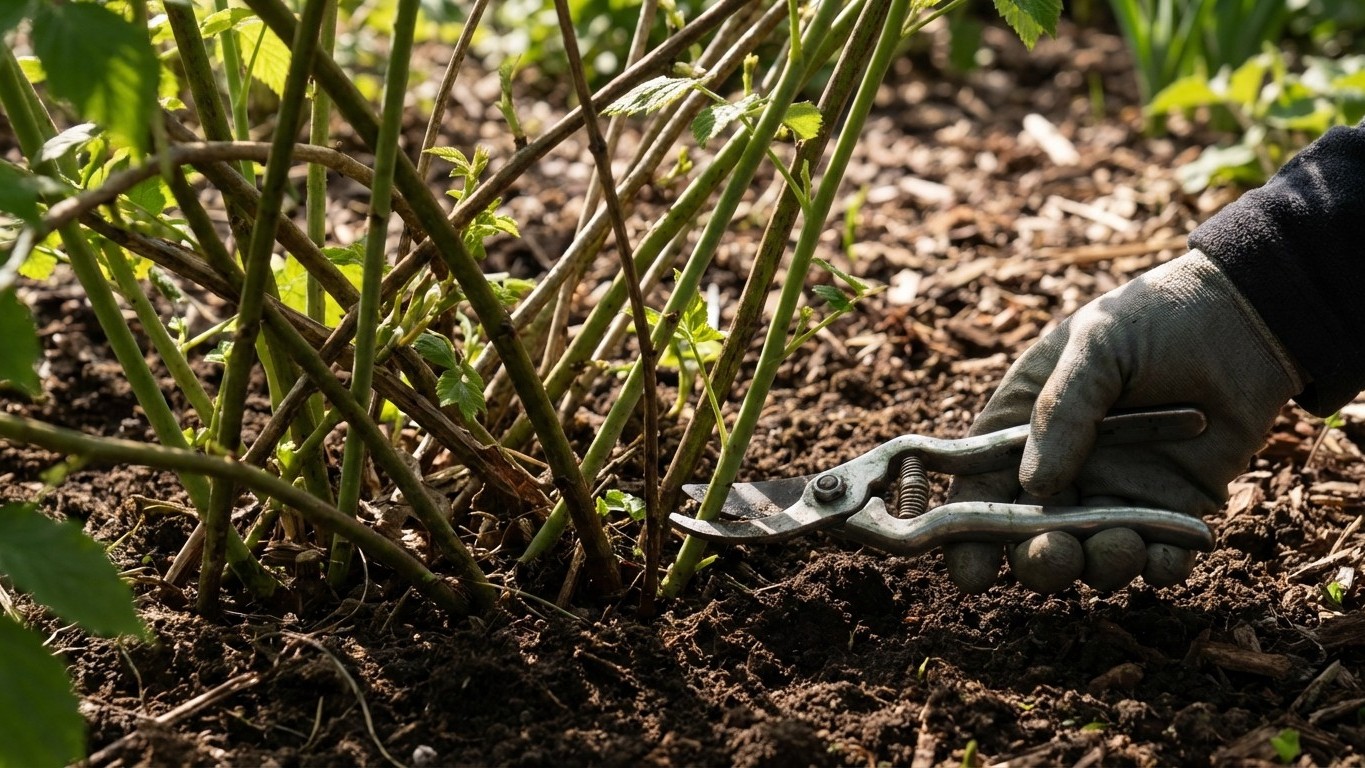
The window for thinning primocanes is now, in early-to-mid April, before they get tall enough to tangle with your floricanes (the second-year canes that will actually bear fruit this summer). Work through the row in sections. Start by removing any shoot that’s growing outside the intended row boundary, these are suckers spreading into your paths or lawn, and they offer nothing to the planting. Cut them at soil level or pull them up if the root connection is shallow.
Within the row itself, keep the thickest, most upright shoots spaced roughly four to six inches apart. Anything crowded against an existing floricane should go, it’ll shade the bearing cane during the critical weeks when berries are sizing up. Thin, reddish, or already-bent new shoots are also candidates for removal; they rarely develop into productive canes regardless of how much space you give them.
Use clean, sharp pruning shears and cut flush with the ground. Leaving stubs invites cane borers, a beetle larva that tunnels into the pith of raspberry stems and weakens them significantly. If you’re squeamish about the waste, the removed shoots can go straight into a compost pile, they break down quickly and don’t harbor disease the way spent floricanes sometimes do.
The One Thing Most Guides Skip
Thinning primocanes in April is half the job. The part that often gets glossed over is a second pass in June or early July, once you can clearly see which new canes are growing vigorously and which are lagging. By then, any late-emerging suckers that slipped through your April thinning will be obvious, and you can remove them before they steal resources during fruit set, the single most nutrient-demanding phase of the raspberry’s growing cycle.
A well-thinned bed also makes harvesting significantly easier, which sounds trivial until you’ve spent twenty minutes wrestling with a thorny thicket to reach fruit buried three layers deep. Scratched forearms are one thing. Missed fruit that over-ripens inside a dense canopy and never gets picked, rotting in place and spreading spores to healthy fruit nearby — is an actual yield and health problem for the planting.
Raspberries are one of the most productive small fruits per square foot when managed properly. The University of Maine Cooperative Extension estimates that a well-maintained ten-foot row can yield ten to twelve quarts per season. Most home gardeners see three or four, and the gap almost always traces back to a spring where the shoots looked too good to touch.