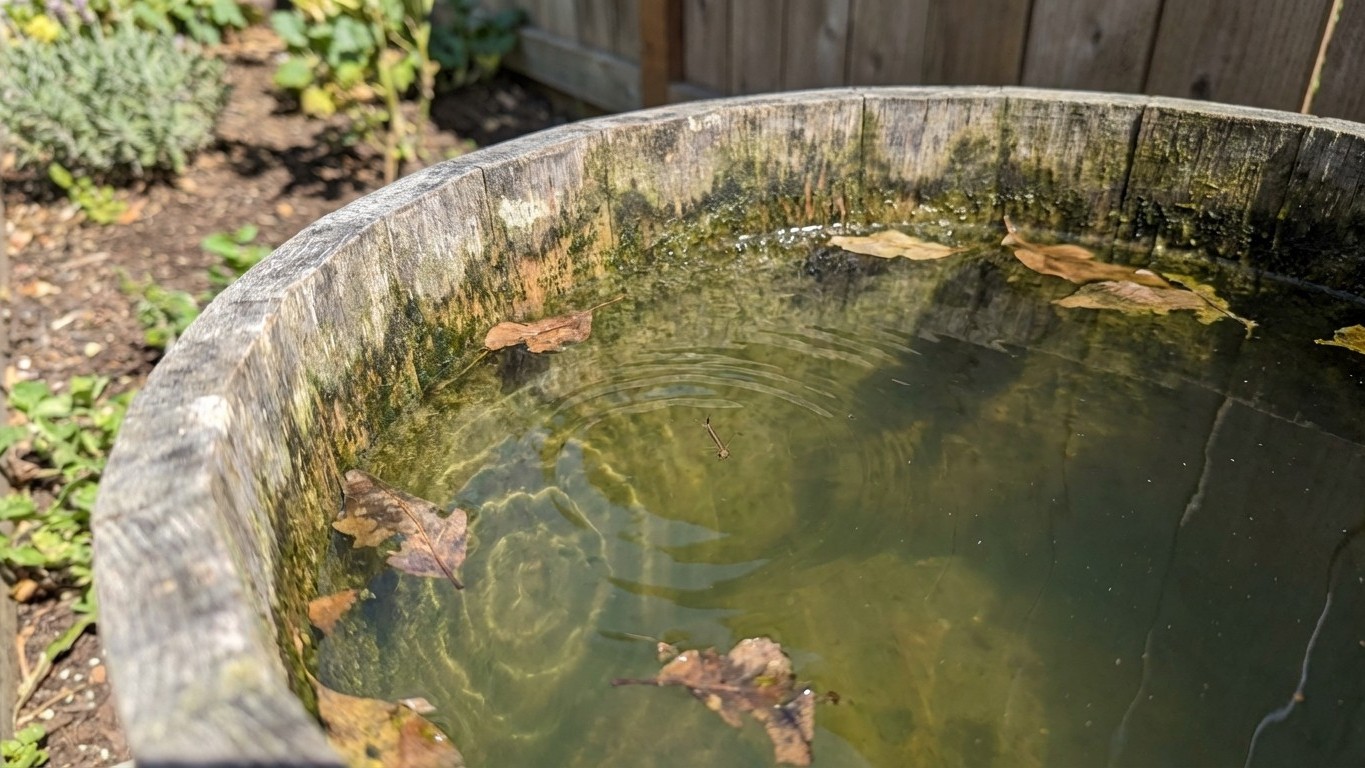
Three days of sitting open under a warm sky is all it takes. That rain barrel you set up last spring, the one you felt quietly proud of for being environmentally responsible — has quietly become a mosquito nursery, a bacterial incubator, and depending on your region, a potential health hazard. The water looks fine. That’s the problem.
Key takeaways
- Female mosquitoes can lay thousands of eggs in your rain barrel within 48 hours—turning it into a hatchery by day three
- Open barrels accumulate more than just water: bacteria like Legionella, biofilm, and rooftop pollutants create a chemical cocktail
- The mosquitoes breeding in your barrel carry West Nile virus and can reach neighbors up to 3 miles away
What’s Actually Growing in There
Mosquitoes don’t need much. A bottle cap of standing water is enough for Aedes albopictus, the tiger mosquito, to lay eggs. A 55-gallon rain barrel, the standard size sold at most hardware stores, represents an almost luxurious breeding ground. Female mosquitoes lay their eggs directly on the water surface or along the inner walls just above the waterline, and the larvae hatch within 24 to 48 hours in temperatures above 60°F. By day three, you’re not looking at a water source. You’re looking at a hatchery.
Beyond mosquitoes, open barrels collect organic debris: leaves, pollen, bird droppings, dead insects. That organic load feeds bacterial growth, including strains of Legionella in warm conditions, as well as various algae species that further deplete oxygen in the water. The green tinge that sometimes appears on barrel walls after a few weeks? That’s biofilm, a sticky microbial community that’s extremely difficult to remove once established. Pressure washing it out in autumn doesn’t fully reset the clock.
There’s also the less-discussed issue of atmospheric fallout. Rain itself carries particulates, nitrogen compounds, and trace pollutants absorbed during the cloud-formation process. The first flush of water off a rooftop concentrates whatever has accumulated there since the last rain: asphalt shingle residue, bird feces, dust, and in urban areas, fine particulate matter from vehicle exhaust. Many gardeners use this water directly on vegetable gardens without realizing they’re also applying a light slurry of rooftop chemistry.
The Covered vs. Open Barrel Gap
A properly sealed barrel with a mesh screen over the inlet changes the equation dramatically. The screen, when intact and fitted correctly, blocks mosquito access to the water surface while still allowing rain to flow in. The lid prevents evaporation, keeps debris out, and slows bacterial growth by limiting light and oxygen exposure. Public health agencies in several states, including Florida and Texas where mosquito pressure is highest, specifically recommend mesh-covered, opaque barrels as the baseline standard for residential rainwater collection.
The challenge is maintenance. Mesh screens tear. Lids warp in summer heat. The spigot at the base, often the weak point, can develop gaps that mosquitoes exploit. The CDC’s standing water guidance recommends checking rain barrels weekly during warm months and confirms that even covered barrels need periodic inspection. Weekly. Most people check theirs approximately never.
If your barrel is already open or has a compromised cover, the fastest short-term fix is a Bti dunk, a tablet containing Bacillus thuringiensis israelensis, a naturally occurring bacterium that kills mosquito larvae without harming plants, pets, or beneficial insects. One dunk treats 100 gallons for 30 days and costs around $2. It’s available at garden centers and online. This buys time while you sort out a proper cover, but it doesn’t address the bacterial or chemical issues in the water itself.
Can You Still Use the Water Safely?
For ornamental gardens, flowers, shrubs, lawn, barrel water after a few days of sitting is generally fine, though the bacterial load is higher than fresh rainwater. The soil acts as a filter, and most garden plants aren’t sensitive to the concentrations involved. The risk calculus shifts when you’re watering edible crops, especially leafy greens or root vegetables where the water contacts the edible part directly.
The EPA’s guidance on harvested rainwater stops short of recommending barrel water for edible crops without treatment, citing contamination risks from rooftop runoff. A reasonable middle ground: use barrel water at the base of vegetable plants rather than overhead, and avoid applying it within 48 hours of harvest. This reduces surface contamination on the edible portions without abandoning the environmental benefit of rainwater collection entirely.
Drip irrigation systems connected to rain barrels reduce the problem further by delivering water directly to the root zone, keeping it off plant surfaces and reducing evaporation. The setup requires a bit more initial investment, a gravity-fed drip system with the barrel elevated on a platform — but the combination of water conservation and reduced contamination risk makes it the preferred setup for kitchen gardens.
The Setup Worth Actually Maintaining
Most rain barrel problems trace back to an initial setup that prioritized ease of installation over long-term function. A barrel positioned under a downspout with no first-flush diverter will collect the most contaminated water from every rain event. A first-flush diverter, a simple device that automatically discards the first gallon or two of runoff before directing cleaner water into the barrel — costs around $30 and removes a significant portion of the rooftop debris and bacteria before they ever enter your storage. They’re rarely included in starter kits, and rarely mentioned at point of sale.
Draining the barrel completely every two to three weeks during the growing season, then refilling it with the next rainfall, prevents the worst accumulation. It sounds counterintuitive when water conservation is the goal, but a barrel that’s been sitting for a month in August isn’t storing water anymore. It’s fermenting it. The net environmental benefit of rainwater collection depends entirely on the water actually being usable when you need it.
One detail worth knowing: the mosquito species that breed most readily in rain barrels, particularly Culex quinquefasciatus, are the primary vectors for West Nile virus in the continental United States. That context reframes the barrel not as a passive inconvenience but as a yard-scale public health variable, one that spreads risk not just to your household, but to neighbors whose yards the adults will reach within their 1-to-3 mile flight range.