
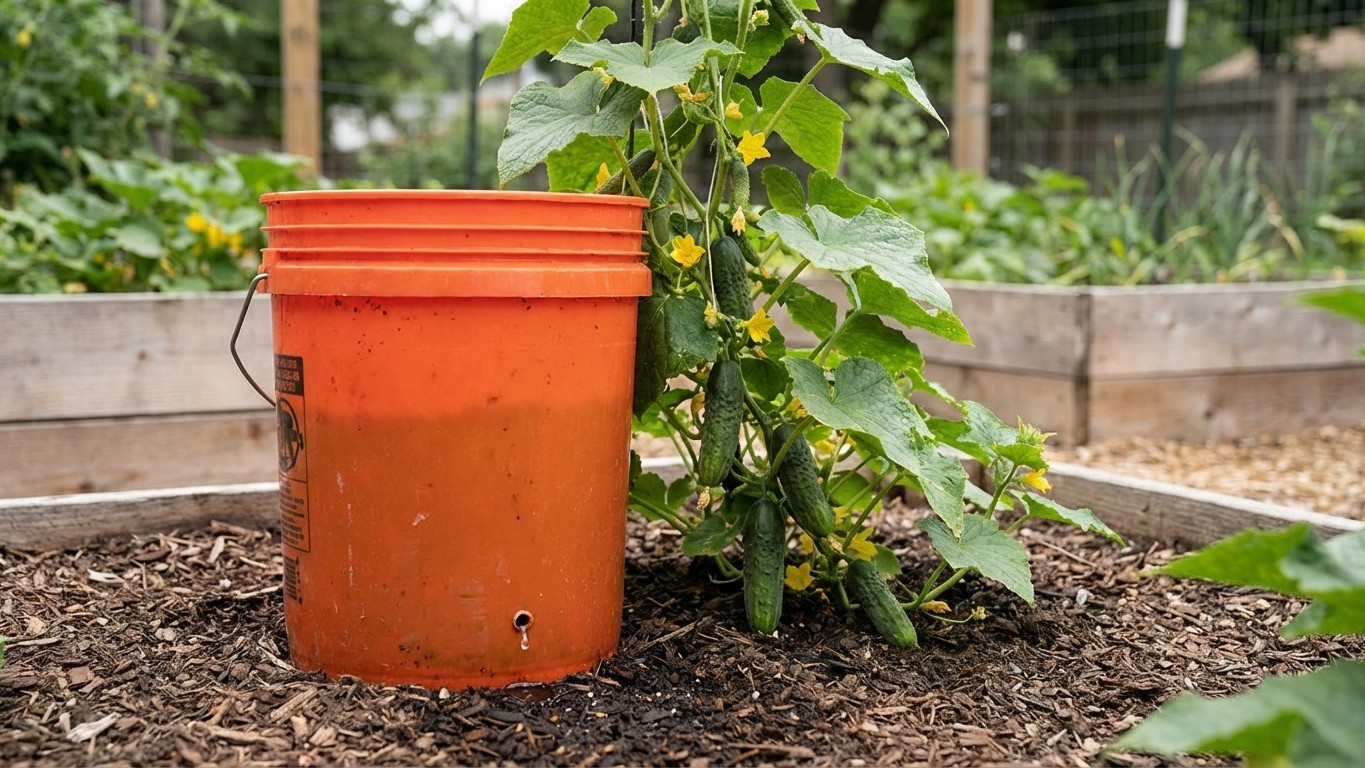
A single bucket with a small hole drilled near the bottom. That’s the whole secret. No expensive irrigation kit, no timer, no smartphone-connected valve. Just gravity, water, and a cucumber plant that finally gets to drink on its own schedule. The results can be genuinely striking, and the science behind them is solid enough to make you rethink how you’ve been watering your garden all along.
Key takeaways
- One gardener discovered a trick so simple it seems impossible—yet it doubled their cucumber yield compared to their neighbour
- Bitter, misshaped cucumbers aren’t a variety problem; they’re a stress signal that reveals what most gardeners are doing wrong
- The method traces back 4,000 years to ancient olla irrigation, but this modern plastic bucket version works just as well
Why Cucumbers Are So Demanding About Water
Cucumbers are about 95% water, which already tells you something important. A plant that is essentially a water balloon wearing green skin needs moisture that is both abundant and steady. The problem is, most backyard gardeners water in bursts, a thorough soak on Tuesday, a forgotten day on Thursday, another flood on Saturday when guilt kicks in. This stop-and-go rhythm is one of the worst things you can do to a cucumber plant.
Bitter cucumbers often result from stress, think inconsistent watering, extreme heat, or poor soil conditions. These factors trigger the plant to produce compounds called cucurbitacins, which cause that unpleasant taste. So the watery, slightly bitter cucumbers from last summer? That probably wasn’t a variety problem. It was a watering problem. A common trigger is inconsistent water supply, such as drought followed by sudden, heavy watering. This erratic moisture disrupts growth and signals the need for self-protection. The plant, stressed, goes into defensive mode — and bitter fruit is the result.
Cucumbers can suffer from drought especially when there is a lack of water or soil moisture for extended periods, since the plants have a shallow root system. Such drought stress can lead to a quality reduction of the cucumber fruits that become bitter, more pointy at the edges, and misshaped. Shape, taste, and yield, all three suffer simultaneously when moisture is uneven. This is the problem a bucket with a hole solves beautifully.
The Bucket Method: Ancient Logic in a Modern Garden
The principle is embarrassingly simple. The goal is clear: make it work without a pump and without any high-tech equipment. So you take a plastic bucket, drill a hole in it, and use nothing but gravity to create an irrigation system. Water seeps out slowly, continuously, and goes straight to where the roots are. No splashing on leaves, no runoff, no evaporation from the soil surface.
To create a drip irrigation bucket, you simply need a standard five-gallon bucket and a drill. Start with a 1/32 inch drill bit and place one or two holes in the center of the bucket. If you don’t have a drill, you can also use a hammer and a nail. The bucket can be elevated slightly on a brick or stone to slow or speed the drip rate, the higher the elevation, the faster gravity pulls the water through. You can adjust the water flow by elevating your bucket for faster drips or lowering it for slower drips. A standard five-gallon bucket provides enough water to keep a plant hydrated for four to five days.
This method is a cousin to the ancient technique of olla irrigation (pronounced “oy-ya”), which has been around for thousands of years. Evidence shows that ollas have been used to water crops for over 4,000 years. They likely originated in China and northern Africa and then spread to the New World and other regions. The bucket version trades porous clay for punctured plastic, but the core idea is identical: let water reach the roots slowly, continuously, and on the plant’s own terms. Ollas can save between 50 and 70 percent more water than traditional irrigation methods by preventing water loss due to evaporation and percolation.
Drip irrigation is 90% efficient, compared to sprinklers which run at 65-75% efficiency. Your neighbor who stands with a hose for 10 minutes every other day is wasting a significant portion of that water to evaporation, runoff, and surface flooding that never reaches the roots.
What Actually Happens to the Plant
Olla irrigation works through soil moisture tension, also called suction tension. The tension increases as the soil dries out, dry soil has a greater capacity to absorb water. When the suction tension in the soil is greater than that of the container, it pulls water from it. Once the soil is moist, the suction tension is no longer greater, and no more water is pulled. The bucket acts the same way: the drip rate naturally slows when the soil around the roots is already saturated, and speeds up slightly as it dries. The plant regulates its own supply.
Olla users report that their vegetable gardens produce more lush plants with higher productivity. Plants watered in this way do not undergo stress cycles due to water and can live and produce longer. For cucumbers specifically, eliminating those stress cycles is the entire game. Cucumbers require a dosed amount of water, avoiding excess water that is sometimes harmful to the crop. Drip irrigation is an excellent technique that increases crop yield and leads to water saving.
Research backs this up with real numbers. The maximum number of fruits per plant, 58.2, along with total fruit yield per plant of 6.17 kg was obtained from the highest irrigation level maintaining full water requirements. Plants that are consistently watered simply produce more fruit. The observed increase in photosynthetic parameters, chlorophyll contents, and plant growth accounted for the significant increase in the number of marketable fruits in cucumber grown in higher water regimens. More photosynthesis, more chlorophyll, more fruit. The chain of cause-and-effect is direct.
There’s another bonus that goes unnoticed. Drip-style watering avoids wetting the crop foliage, reducing crop disease pressure. Overhead watering, from a hose, a sprinkler, or even a watering can held too high — splashes water onto the leaves. Cucumbers are susceptible to mildew, and the early morning sun is an excellent remedy for drying off dew from plants, but minimizing mildew is far easier when the leaves stay dry in the first place.
Setting It Up and Getting It Right
Position the bucket as close to the base of the plant as possible, with the drip hole angled toward the root zone. It delivers water long and slow and deep, directly to the plant, while training roots to reach deep rather than surface and shallow. Deep roots are more resilient roots, they can access moisture further down in the soil during dry spells, which is exactly when surface-watered plants start to suffer.
Mulching around your cucumbers amplifies the effect dramatically. Mulching your cucumbers helps hold moisture and suppress weeds. Apply a 2-3 inch layer of straw or wood chips around the base of each plant, keeping it slightly away from the stem to prevent rot. The combination of slow drip from above and mulch sealing moisture in from below creates a near-ideal root environment.
One practical note: cover the top of the bucket with mesh or a cloth. Cover the bucket with cotton cloth or mesh screen and secure it with cord. This will keep the bucket free from detritus that can clog the system. Mosquitoes also breed in standing water, so a covered bucket keeps your garden from becoming a nuisance.
For a larger garden, the bucket can feed multiple plants through a simple network of tubing. You can connect multiple hoses to the same bucket in varying lengths to reach different spots in your garden. Or, as some permaculture gardeners have done, daisy-chain several buckets together fed by a rainwater collection barrel, a completely off-grid system that costs almost nothing to run.
The deeper shift here is not just about cucumbers. It’s about moving from reactive watering, going out with a hose when a plant looks thirsty, to proactive, continuous hydration. Cucumbers alert you to stress with visible wilting, but by then, bitter compounds are already accumulating inside the fruit. As water oozes through the slow release system, it allows for a slow, even liquid release via soil moisture tension. Once the soil is thoroughly saturated, this same process prevents excess liquid from oversaturating the ground. Eventually, the adjacent plant roots will grow around the water source and pull water as they need it. The plant stops waiting on you, and starts managing itself.
Sources : sciencedirect.com | sciencedirect.com