
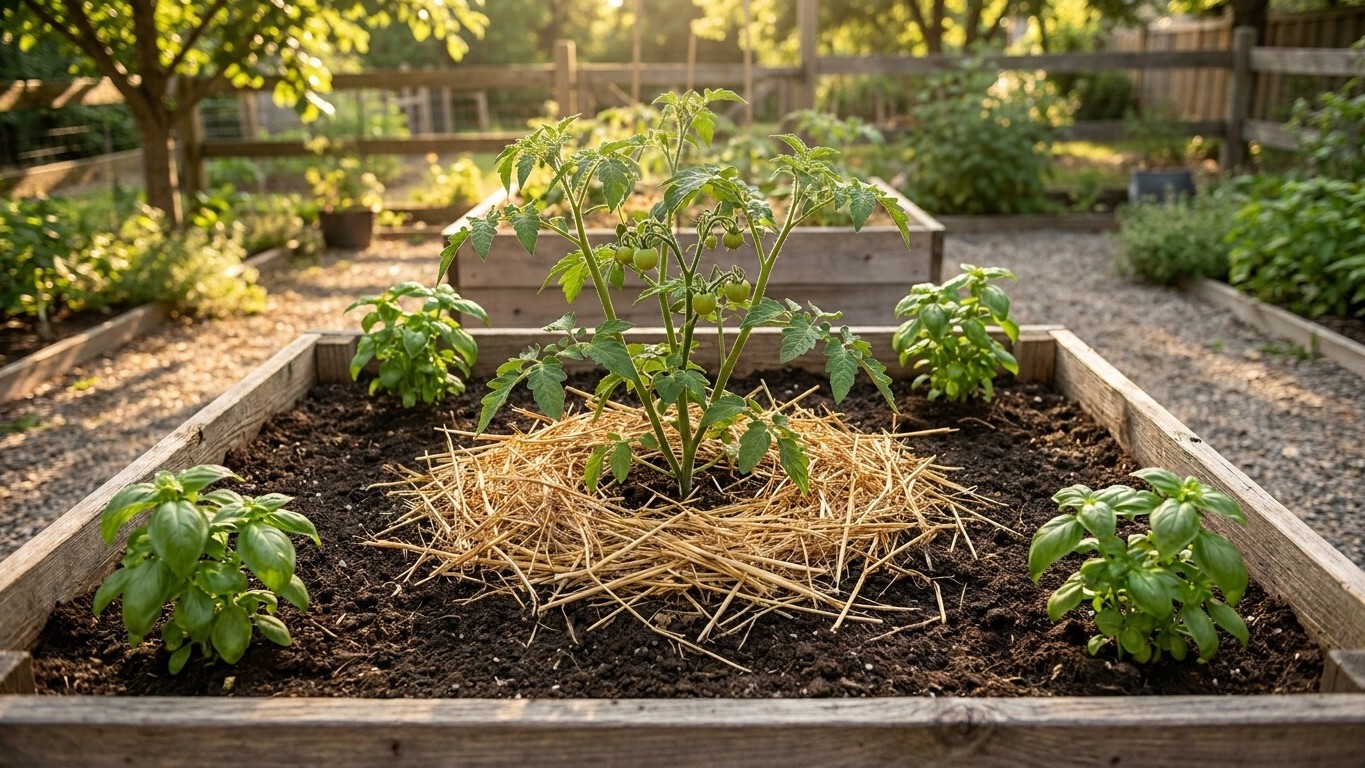
Basil and tomatoes are supposed to be the perfect garden couple. Every companion planting guide says so. Every YouTube video, every seed packet insert, every well-meaning gardening blog repeats the same advice: plant them together and watch both thrive. The problem is that nobody ever explained how to do it without accidentally creating a disease highway between your two favorite summer crops.
That lesson came from an allotment neighbor, a retired schoolteacher who has been growing vegetables on the same plot since 1987. She walked over one morning, looked at my raised bed, and said, very calmly: “Never let the leaves touch the stems.” I had basil seedlings nestled right up against my tomato plants. They were practically hugging. She wasn’t impressed.
Key takeaways
- The pairing works, but only if the plants never physically touch
- A damp leaf-to-stem bridge lets fungal diseases spread at lightning speed
- One simple spacing rule has prevented crop loss for over 30 years
The problem isn’t the pairing, it’s the proximity
Companion planting works on the principle that certain plants benefit each other through scent, root chemistry, or by attracting beneficial insects. Basil genuinely does repel aphids and whiteflies, and its volatile oils may confuse pests that would otherwise zero in on tomato foliage. Studies conducted by agricultural extension programs in the U.S. have shown measurable reductions in thrips populations when basil is grown nearby. The science holds up.
But there’s a critical distinction between nearby and touching. When basil leaves make direct contact with tomato stems, they create a damp, shaded microclimate right at soil level, exactly the conditions that fungal pathogens love. Botrytis (gray mold) and Fusarium wilt can travel along that leaf-to-stem bridge with surprising speed, especially in humid summers. My neighbor had learned this the hard way decades ago, losing an entire row of Brandywines in a single wet August.
The recommendation she follows, and that many experienced growers quietly practice without advertising it, is to maintain at least 10 to 12 inches of clear air space between the basil plant’s outermost leaves and the tomato’s main stem. Close enough to do the pest-repelling job. Far enough that no leaf acts as a physical conduit for moisture or disease.
How basil was actually stressing my tomatoes
Beyond disease transfer, the issue in my bed was competition, specifically for airflow. Tomatoes need good air circulation around their lower stems to stay healthy. Crowding them with dense, leafy basil plants restricts that circulation, keeping the base of the plant perpetually moist. That’s how blight gets a foothold before you’ve even noticed anything is wrong.
There’s also a light competition factor that rarely gets discussed. Young tomato plants, especially in the first six weeks after transplanting, direct energy toward root development. Basil planted too close can shade the soil around the tomato base, slowing soil warming in spring. Tomato roots genuinely perform better in warmer soil, a 2°F difference in soil temperature at root level can affect uptake of phosphorus and potassium, nutrients the plant needs to build its structure before it starts fruiting.
My neighbor’s rule of thumb: plant basil on the south-facing side of tomatoes (in the northern hemisphere), never directly at the base, and always trim basil leaves that creep inward toward the tomato stem over the course of the season. She does this with small scissors every two weeks. Takes four minutes per bed. Sounds fussy until you realize she has never lost a tomato plant to blight in over thirty years.
Rethinking how you actually arrange companion plants
The companion planting charts you find online treat plant relationships as binary: compatible or not. That framing misses the point. Plants interact through proximity, timing, and physical contact, all three variables matter. Getting two of them right while ignoring the third is how you end up with a textbook-correct pairing that still fails in practice.
A more useful mental model is to think of companion plants as neighbors in an apartment building, not roommates. They share the same space and benefit from each other’s presence, but they each need their own zone. Basil at the edge of the bed, tomatoes in the center, with a clear visual gap between them that you actively maintain throughout the season. When basil starts bolting and getting tall in midsummer, its upper leaves can reach toward tomato foliage, that’s the moment to either cut it back hard or move it outward.
Other companions worth reconfiguring with the same logic: marigolds planted too close to pepper plants can create the same moisture-trapping problem at the stem base. Parsley, another popular tomato companion, should be kept at least 8 inches out. Even beneficial plants can become a liability when the physical arrangement is wrong.
What to do if you’ve already planted them too close
Replanting mid-season isn’t always realistic. The practical fix is surgical pruning. Remove any basil leaves that are within 10 inches of your tomato stems. If the basil has grown into a bushy mass right at the base, cut it back by a third, focusing on the branches closest to the tomato. Then add a thin layer of dry mulch, straw works well, around the tomato stem to absorb moisture and create a physical barrier between the soil surface and the plant’s lower leaves.
Check the tomato’s lower stem for any discoloration, soft spots, or powdery residue over the following week. Catching early-stage Botrytis or Fusarium at the stem means you can remove affected material before it travels upward. Most gardeners who lose plants to these diseases don’t realize the entry point was at soil level, weeks before visible symptoms appeared on the foliage.
One final detail worth knowing: basil actually grows more vigorously when planted slightly away from tomatoes and given more sun exposure. The conventional wisdom sells the pairing as purely tomato-centric, but the basil benefits too. Fewer pest visits, better airflow, stronger stems. A properly spaced companion planting isn’t a compromise, it works better for both plants than the crowded version almost everyone starts with.