
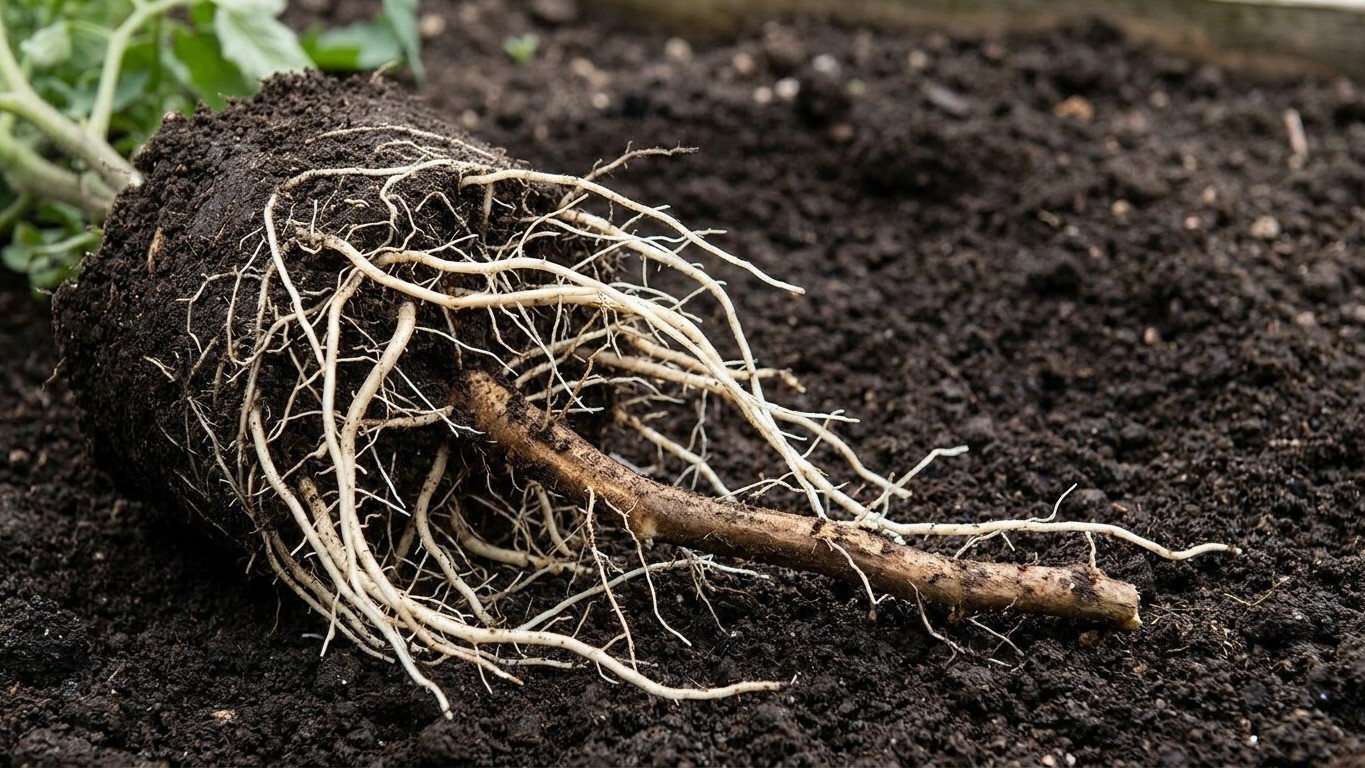
Twelve years of doing it the way everyone does it, and then one afternoon in late spring, the comparison was undeniable. Pulled out two tomato plants that had been grown side by side, one planted upright the traditional way, one laid flat in a shallow trench. The root systems were not even close. The horizontal plant had root growth spreading in every direction along a several-inch stretch of buried stem, dense and branching. The upright plant had a compact ball, tightly centered beneath the crown. Same variety, same bed, same watering schedule. One just understood how tomatoes actually work underground.
Key takeaways
- A side-by-side comparison of one upright and one horizontal tomato plant revealed shockingly different underground root structures
- Tomatoes possess a hidden biological superpower that most gardeners have never leveraged in 12+ years of gardening
- The root system difference compounds over time—by mid-July, the gap in fruit production becomes impossible to ignore
The biology most gardeners never think about
Tomatoes have what are called adventitious roots, roots that form from non-root tissue, which means they have the ability to grow more roots along their stems at any point where the stem is buried. This is not a quirk. It’s a core feature of the plant, and it changes everything about how you should approach transplanting.
The trenching method takes full advantage of this ability. When part of the stem is buried, it stimulates new root growth wherever the stem is in contact with moisture and soil. Look closely at any tomato stem and you’ll notice tiny bumps running along it. These are the beginnings of adventitious roots, root initials, or tomato stem primordia, and given enough moisture and the right conditions, they can emerge and develop into actual roots. They are, essentially, roots waiting for permission.
Most other vegetables punish you for burying their stems. Peppers, cabbages, cucumbers, cover their stems and you risk rot. Unlike peppers and cabbages, tomatoes are vining plants with the ability to easily sprout roots along their stems. Deep planting is recommended precisely because it creates a stronger root system. The tomato isn’t like the rest of the garden. It practically invites you to bury it.
What the root ball actually tells you
Burying Tomatoes on Their side can lead to two, if not three times, the amount of root mass below the soil, it all depends on how much of the seedling stem you bury. That’s not a marginal improvement. That’s the difference between a plant that survives summer and one that produces through it.
A more extensive root system developing along the buried stem leads to improved water and nutrient absorption, and that enhanced root development also increases the plant’s stability and resilience against drought and high winds. If you garden in the South or the Midwest, where summer storms can flatten a bed overnight, that anchoring matters enormously. The method also improves drought resistance and nutrient absorption, and is particularly beneficial in preventing conditions like blossom end rot by ensuring a robust uptake of calcium. Blossom end rot, the black-bottomed plague of every August garden, is a calcium delivery problem, and more roots mean better delivery.
Planting sideways in a shallow trough also keeps the plant in the upper layer of soil, where the richest nutrients are found, and the warmer soil helps accelerate plant growth. A vertical planting that buries the stem deep pushes roots into cooler, more compacted layers. Tomatoes are heat-loving plants, and planting at deeper depths where the soil is cooler can actually slow their growth, making sideways planting a more optimal choice. The trench keeps the action where the warmth is.
How to actually do it, and what to watch for
The mechanics are straightforward. Dig a trench about 4 to 6 inches deep, with one end slightly deeper for placement of the root ball. The trench length should be about two-thirds the height of the plant. Before you place the plant, prune the leaves and any suckers from the bottom two-thirds of the tomato seedling. This matters: those buried leaves won’t turn into roots, and leaving them can invite disease at the soil line.
Within the next sunny day or two, the plant will start to reposition itself upright and continue to grow vertically like normal. This is the part that surprises first-timers. The shoot doesn’t stay flat. Phototropism kicks in within 48 hours, and the tip bends toward the light. One tip worth knowing: lay the plant on its side 2 to 3 days before transplanting. The upper part of the main stem will start to curve upward, which helps avoid bending or damaging the stem when you place it in the trench.
One honest caveat: if you plant tomatoes sideways, you’ll get adventitious root growth, but most of that new root growth stays only a few inches below the soil surface. This means the plant may dry out faster and need more frequent watering than a deeply-buried upright plant, which takes a bit more practiced care. The tradeoff is real, shallower roots need more attention in a dry spell. Consistent mulching helps significantly.
There’s also a variety question worth considering. Bushy, determinate tomatoes are better planted upright in a trench and buried up to the top few sets of leaves. If planted on their side, they may fall over later in the year as fruits develop, so planting upright but deep helps establish a strong, balanced root system that supports the mature plant. The sideways method shines brightest with indeterminate, vining varieties, heirlooms especially, which naturally travel along the ground and form roots along the stem to help increase water and nutrient absorption.
One more thing the root ball reveals
Tomato taproots can grow up to 1 inch per day during active development, which means every week you give a plant with a larger root mass is a week of dramatically accelerated expansion. The gap between an upright-planted and a trench-planted tomato doesn’t stay the same size. It compounds. By mid-July, the difference in fruit set between two otherwise identical plants can be striking, and tracing it back to a planting decision made in May is the kind of thing that changes how you garden permanently.
Sources : canningcrafts.com | gardeningknowhow.com