
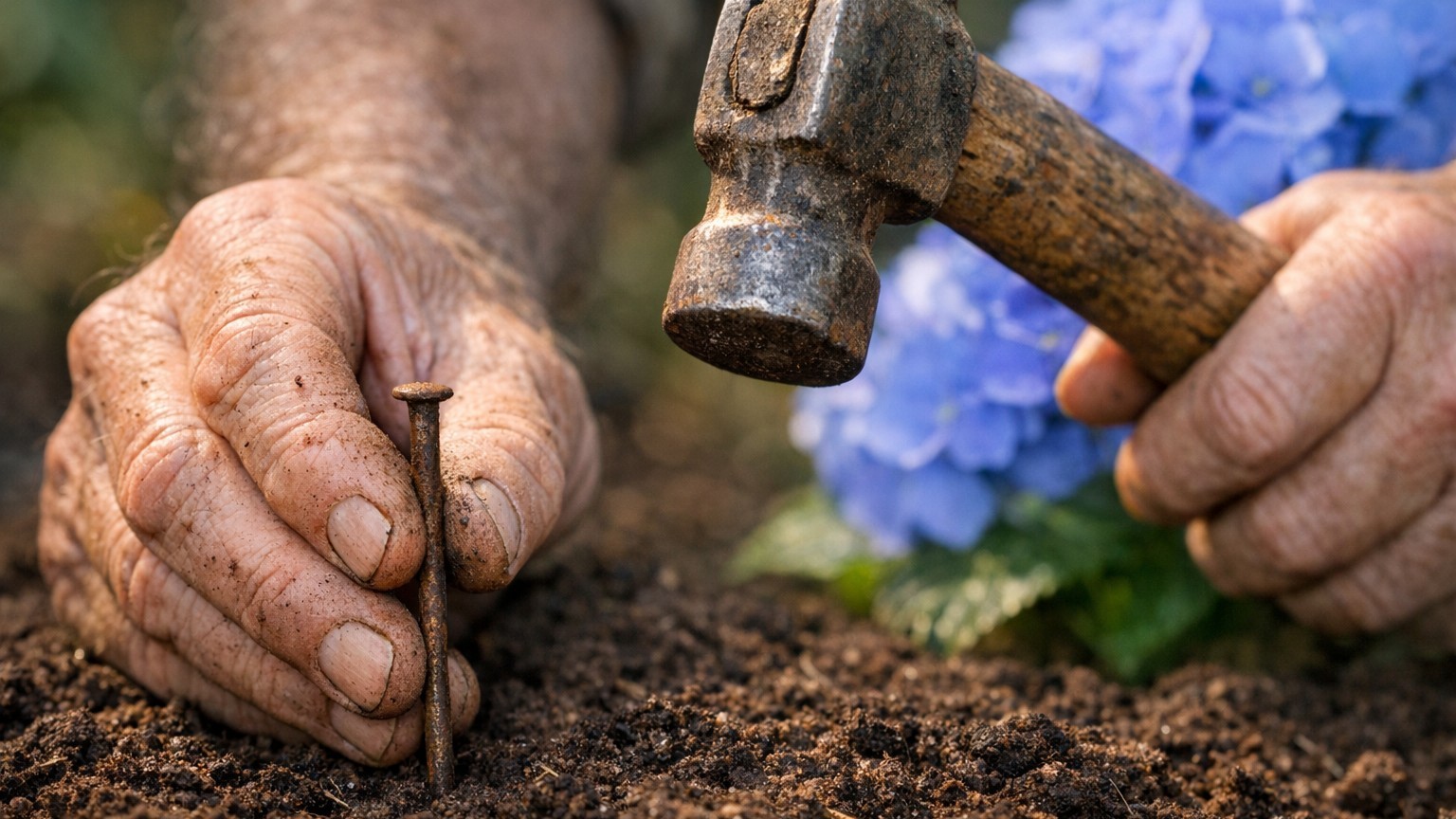
Every spring, the same ritual: kneeling in the dirt, hammer in hand, driving rusty nails into the soil around the hydrangeas. My grandfather did it without fanfare, without explanation. I watched from the porch and thought he was eccentric. For years I wrote it off as the kind of old-person garden superstition that belonged in the same drawer as planting by the moon and talking to tomatoes. Then I started digging into the actual science behind it. The picture that emerged is far more nuanced than a simple myth vs. fact verdict, and honestly, it changed how I think about inherited knowledge.
Key takeaways
- Your grandfather may have been onto something—but probably not for the reasons he thought
- Rusty nails don’t actually work the way gardeners believed, yet the logic behind them is surprisingly sound
- Modern soil science finally explains why hydrangea colors change and what actually works to control them
Why Hydrangeas React to What’s in Your Soil
Big-leaf hydrangeas have flower color that depends directly on soil pH: acidic soils produce blue blooms, and alkaline soils produce pink. That alone is a remarkable botanical quirk, the same plant, the same shrub you bought at the nursery, can dress itself in two completely different colors depending on what’s happening underground. The mechanism behind it is even more interesting than the color show itself.
As horticultural expert Michael Dirr explains, the color is not determined by pH alone, but by the amount of aluminum a plant can access in the soil, which is itself determined by pH and phosphorus levels. In acidic soil, aluminum becomes readily available for the plant to absorb, leading to blue flowers. When the soil is more alkaline, aluminum stays locked in the soil, and the result is pink hydrangea blooms. The nail, in your grandfather’s logic, was supposed to deliver iron, which would acidify the soil, which would free up the aluminum. A three-step chain of kitchen reasoning. Directionally correct. Chemically flawed.
The Problem with Rusty Nails (And Why the Logic Isn’t Crazy)
The “rust” that accumulates on old nails is iron oxide, an insoluble form of iron that will not make any difference in soil pH. This is where the folk remedy breaks down. Rusty nails add more iron, but if the pH is wrong, the plant still can’t absorb it. Rust is iron oxide, a form of iron that’s insoluble in water, and plants simply can’t take it up through their roots. So the nail sits there in the dirt, doing very little — certainly not acidifying anything at a meaningful rate.
But here’s where it gets interesting. The rusty nail legend isn’t built on nothing. Iron really is what these plants are missing, and the intuition to reach for a source of iron to counter an iron deficiency is directionally correct, hence why gardeners of earlier generations turned to the nails. For earlier generations, the rusty nail was not superstition; it was a cheap, homemade way to “feed” the soil. They had limited access to commercial fertilizers and soil tests, so they used what they had on hand: ashes, manure, bones, and metal scraps. Judged against that backdrop, a rusty nail is actually a pretty logical guess.
The real problem, as modern soil science clarifies, is the delivery method. Rust is the wrong form of iron, released too slowly, in a way that soil pH will largely neutralize before roots ever see it. So if your grandfather’s hydrangeas were spectacular blues, the nails probably weren’t the hero, the existing soil chemistry in his yard likely deserves most of the credit.
What Actually Controls the Color
Plants such as hydrangeas absorb more nutrients from the soil when it is in an acidic pH range of 5.2 to 5.5. Getting the soil there, and keeping it there, requires more than scattered metal. Applying aluminum sulfate or elemental sulfur is the reliable way to push for blue blooms. Aluminum sulfate hits faster, dropping pH while delivering aluminum directly to roots.
Soil amendments take effect on the developing buds, not flowers that have already formed and bloomed, so the process requires planning well in advance of flowering, and it may take a couple of years to see the full effect. Patience, essentially, is the actual secret ingredient — not nails. This is why it is much easier to turn a pink flower blue than it is to turn a blue flower pink. Once aluminum is present in acidic soil, it does its work efficiently. Pushing it back out is a different battle entirely.
One detail worth knowing: flower color can only be changed on specific species of hydrangea, mainly those related to H. macrophylla or H. serrata. Oakleaf hydrangeas keep their white blooms regardless of soil pH. Smooth varieties like ‘Annabelle’ stay white as well. Panicle hydrangeas open white and shift to pink or red naturally over the season, but that’s down to age, not soil chemistry. So before you amend anything, identifying your variety is step one.
What Happens When Hydrangeas Don’t Get Enough Iron
When the soil pH is too high, meaning the soil is too alkaline, hydrangeas may not be able to absorb enough iron, which can cause their leaves to turn yellow. This condition is known as iron chlorosis. Iron is an essential micronutrient that plays a critical role in the production of chlorophyll, necessary for photosynthesis. When a plant can’t absorb enough iron, it can’t produce enough chlorophyll, and the leaves begin to yellow. This is the scenario my grandfather was likely reading, yellowing leaves, a plant in distress, a need for intervention.
It usually starts subtly, with a slight paling of the newest leaves, but it can quickly turn grim, with veins remaining dark green while the rest of the leaf turns a ghostly yellow. This is interveinal chlorosis, essentially your plant’s way of calling for help. The trouble is that the problem is not always that the soil lacks iron completely; often, the iron is present but “locked” in a form roots cannot absorb, especially in chalky or very alkaline ground. Adding more iron in the form of an insoluble nail doesn’t solve a lock-and-key problem. Testing soil pH and applying chelated iron when pH is too high (above 6.5) is the targeted fix.
There is also a practical safety concern that tends to get glossed over in nostalgic retellings of grandfather’s garden wisdom. Beyond being ineffective, rusty nails can cause real problems, they don’t break down in a useful way, they can damage roots, and they pose an obvious safety risk. Modern nails may contain coatings or chemicals not intended for garden soil, especially near edible plants like tomatoes, herbs, or peppers. So the affection for the old trick is understandable, but replicating it wholesale is another matter.
What strikes me most, looking back, is that my grandfather was doing something modern gardeners rarely do: watching closely. The habit of burying a rusty nail reflects a certain mindset, pay attention, notice patterns, and make use of what is already lying around. He noticed something was wrong with his hydrangeas. He intervened with what he had. Over time, gardeners observed patterns and passed down tips that seemed to work. Many of these remedies carried a mix of practical value and folklore. The nail may not have been the active ingredient — but the act of watching, diagnosing, and responding? That part was entirely right. And remarkably, there is one scenario where the old tale has a sliver of truth: according to the chemistry of ferric iron, iron oxide hydrolysis can contribute hydrogen ions to the solution, lowering the pH, meaning rust could, in theory, create marginally more acidic soil conditions. Just very, very slowly. And not nearly enough to matter in a single season.
Sources : gardeningknowhow.com | epicgardening.com