
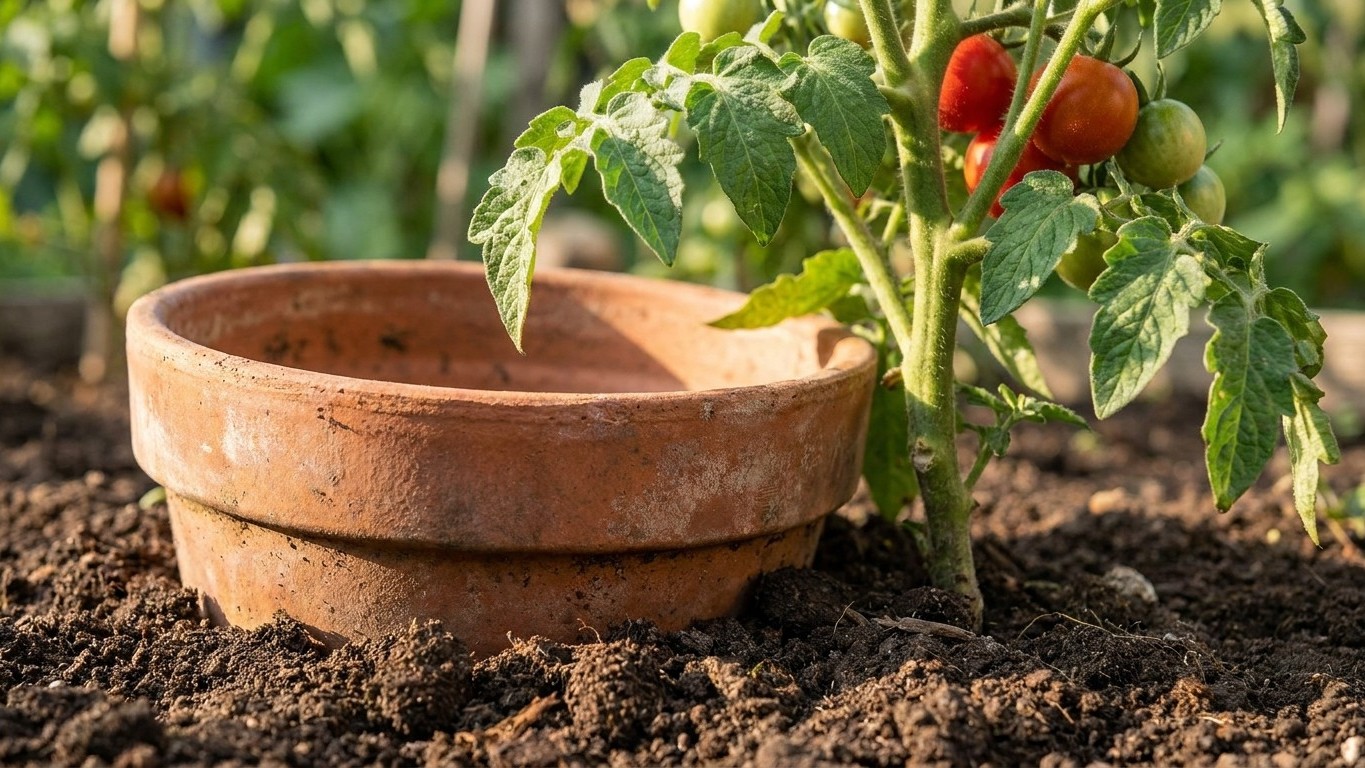
A clay pot, some soil, and a summer full of tomatoes that refused to die. That’s the whole story, and yet it rewrites how most American gardeners think about watering. The technique is called olla irrigation (pronounced oh-yah), and it’s been quietly outperforming sprinklers, soaker hoses, and even modern drip systems for thousands of years.
Key takeaways
- A 4,000-year-old watering method uses physics, not guesswork, to give plants exactly what they need
- Studies show 97% water savings and 44% higher tomato yields—but there’s a hidden reason most gardeners don’t know about it
- The setup takes minutes, costs almost nothing, and works better the hotter and drier conditions get
An Idea 4,000 Years in the Making
Ollas are clay pots that were first used for irrigation over 4,000 years ago in North Africa and China. The concept is almost insultingly simple: olla irrigation uses a buried, unglazed clay pot filled with water to provide controlled irrigation to plants as the water seeps out through the clay wall at a rate that is influenced by the plant’s water use. The pot reads the garden’s thirst. No timer, no battery, no app required.
What makes this work isn’t magic, it’s physics. The science lies in a natural process called soil moisture tension. The porous clay acts as a membrane between the water inside the olla and the soil outside. When the soil is dry, it “pulls” moisture through the pot’s walls. As the soil becomes moist, the pull decreases, and the water release slows or stops. Your tomato plant essentially controls its own water supply. No human judgment involved.
And the numbers are hard to argue with. A study in Kenya found the olla system was much more efficient than furrow irrigation, saving 97.1% of applied water for maize and 97.8% for tomatoes, with a yield increase of 32.2% for maize and 43.7% for tomatoes. That last figure deserves a pause. Nearly half again more tomatoes, with a fraction of the water.
Why Your Tomatoes Are Suffering Without One
Most gardeners water from above. On a blistering July afternoon in Phoenix or Atlanta, a significant portion of that water never reaches the roots, it evaporates before it even soaks in. The autoregulation of olla irrigation leads to very high efficiency, considerably better than most drip irrigation systems, and up to 10 times more efficient than conventional surface irrigation. Ten times. That’s not a marginal gain; that’s a different category.
The consequences of uneven watering show up on the fruit itself. One major benefit ollas bring to tomatoes is the elimination of blossom end rot. This frustrating issue is often blamed on calcium deficiency, but it’s usually caused by inconsistent watering. Ollas maintain even moisture levels, allowing plants to take up nutrients steadily. That dark, leathery patch at the bottom of your tomatoes? Almost certainly a watering problem in disguise. The consistent water also prevents cracks developing in tomatoes or melons, which form if plants receive abundant and then scarce water.
There’s a bonus nobody talks about enough: weeds. Because ollas water underground, the soil surface stays relatively dry. Weed seeds need surface moisture to germinate. By keeping the top layer dry, ollas naturally suppress weed growth, saving hours of pulling and hoeing. Fewer weeds, healthier tomatoes, dramatically less water. The trifecta of a summer garden victory.
How to Actually Do It (Without Overthinking)
The barrier to entry is lower than you think. You can purchase ollas from many different distributors, or install DIY ollas made from a basic terra-cotta pot with the drainage hole filled in. Fill with water, cover with a terra cotta saucer, and bury it in the garden. You can even connect two pots together to create a taller vessel. A couple of unglazed pots from your local garden center, a cork or a dab of food-safe sealant for the drainage hole, and you’re done.
Placement matters more than pot size. For vegetables and flowers, place ollas 6 to 12 inches from the stem. The depth depends on the plant’s roots, start with 12 to 18 inches. For tomatoes specifically, one olla per plant works well. Once buried, dig a hole deep enough to bury the olla, leaving one to two inches of the neck above the soil surface — this prevents dirt and mulch from getting inside.
Sizing follows a straightforward logic: a 1-quart olla provides irrigation to plants in a 1-foot diameter; a 3-quart-sized olla provides water to plants in a 1.5-foot radius; a large olla that holds about 7 quarts of water provides for plants in a 2-foot radius. For the average backyard tomato bed, a medium pot handles things just fine. Cover the olla opening with a lid, rock, or plate to minimize evaporation and prevent mosquito breeding.
The frequency of refilling ollas depends on weather conditions and plant water needs. Generally, check them weekly and refill when they are low on water. During a heat wave, you may need to top them off every two or three days. In milder stretches, once a week is plenty. Ollas are best suited for coarse-textured and/or sandy soil. Soil with a high clay content does not dissipate water well. If your beds are heavy clay, mixing in some compost or coarse sand before installing will make a real difference.
What Grows Better and What Doesn’t
Olla irrigation is most efficient for crops with fibrous root systems like squash, melons, watermelons, tomatoes, and chiles. It is also possible to use ollas with crops with relatively shallow root systems like lettuce and herbs. The deeper and more sprawling the root network, the more benefit the plant draws from a buried water source. Plants develop deep, extensive root systems as they grow toward the consistent moisture source, making them more drought-tolerant and stable, a self-reinforcing cycle of resilience that conventional overhead watering simply cannot create.
A few crops don’t pair as well. Ollas are less efficient for densely planted annual crops like grains or for shallow-rooted plants like spinach, which may not reach the moisture deep underground. Root crops like carrots can sometimes grow oddly shaped if planted too close to an olla. Worth keeping in mind before you convert the entire vegetable garden at once.
One practical note for winter: if you live in an area with hard freezes, dig up your olla each winter to prevent cracking underground. The buried clay pots may also clog up over time, especially if left dry for a long period. If this happens, they need to be removed from the soil and scrubbed, or soaked, to clean out the pores. A quick end-of-season rinse keeps them working like new for years.
What’s perhaps most striking about ollas is that they perform better precisely when conditions get worse. The stable soil moisture maintained by olla irrigation enables crops to be grown in saline soil or with saline water where conventional irrigation would not work, with high tomato yields obtained even using significantly saline irrigation water. In a world where summer heat records keep falling and drought restrictions are tightening across the Southwest and beyond, a 4,000-year-old clay pot may be one of the most forward-thinking tools in your garden shed.
Sources : ncbi.nlm.nih.gov | ncbi.nlm.nih.gov