
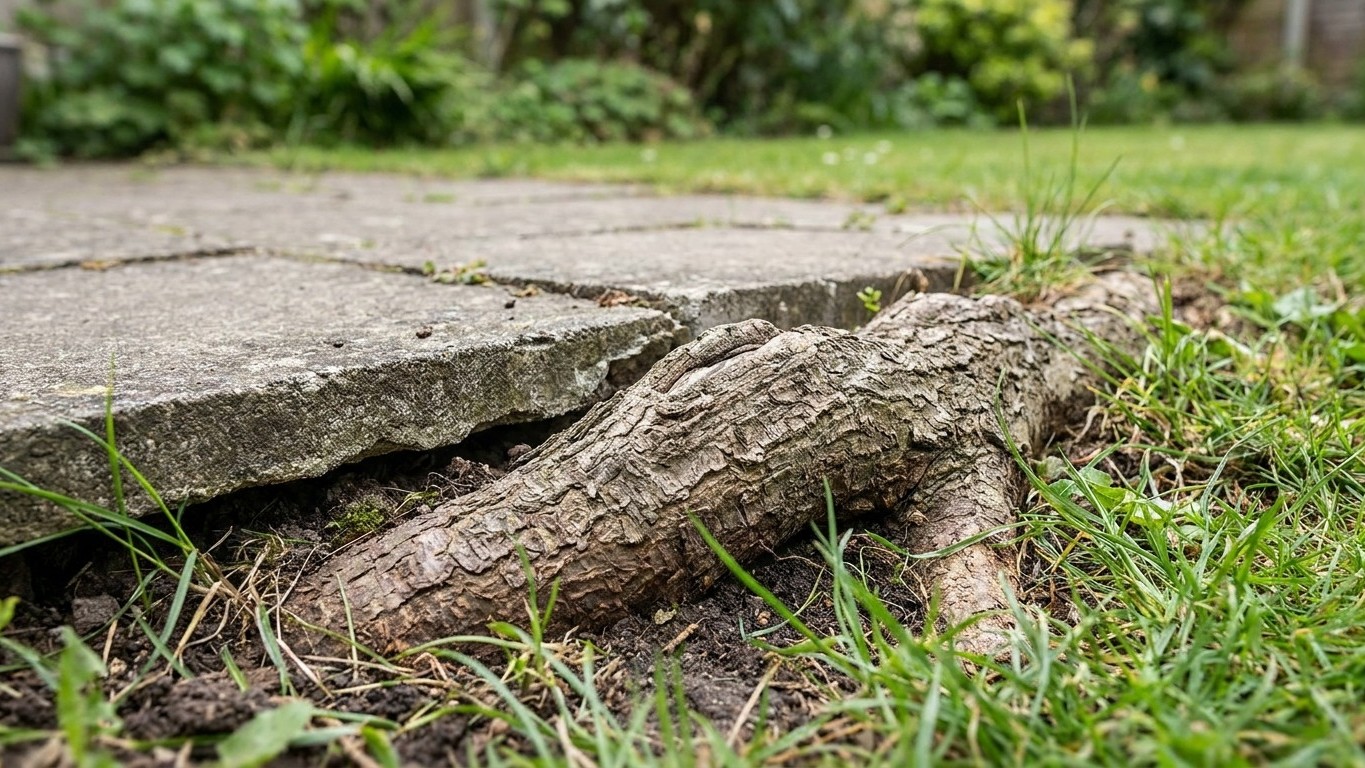
Two years after planting a fig tree three meters from his foundation wall, a homeowner lifted a paving slab and found a root thicker than his wrist running straight underneath it. No drama, no cracking, just a silent, patient invasion that had been underway since day one. That story, shared across gardening forums in 2024, resonated with thousands of readers who had made the same assumption: that a fig tree, being “just a fruit tree,” posed no serious structural threat. That assumption is wrong, and the root system of Ficus carica is the reason why.
Key takeaways
- Fig roots spread 2-3 times wider than the tree’s canopy—a 3-meter-wide tree can have roots reaching 6-7 meters out
- Concrete and paving slabs aren’t obstacles; roots exploit micro-fractures and use them as pathways toward moisture
- The standard ‘3-meter planting rule’ is dangerously inadequate for figs—experts now recommend 8-10 meters minimum
Fig Tree Roots: Not What Most People Expect
The common fig is native to the dry, rocky landscapes of the Middle East and Central Asia. In those conditions, survival depends on finding water wherever it hides, under stones, between cracks, deep into fractured soil. Centuries of adaptation have produced a root system that is aggressive by design, capable of spreading laterally two to three times the width of the tree’s canopy. For a mature fig in a temperate backyard, that can easily translate to roots extending eight to twelve meters in every direction.
What makes this particularly deceptive is the pace. In the first growing season, the tree looks modest. Slow, even. But underground, the roots are already mapping out the terrain, following moisture gradients with extraordinary precision. Clay soil slows them slightly; sandy or compacted soil sends them sideways faster. Concrete, contrary to what many homeowners believe, is not a barrier, it’s a destination. Roots exploit micro-fractures in foundations, slabs, and pipe joints, widening gaps over time through the mechanical pressure of their growth.
A 2019 study from the University of the Sunshine Coast, examining the root spread of common urban fruit trees, found that fig varieties consistently ranked among the highest for lateral root extension and infrastructure risk, comparable in damage potential to willows and poplars, which most gardeners already know to keep away from buildings.
The Three-Meter Rule That Isn’t Really a Rule
Most casual planting guides suggest keeping fruit trees three to five meters from structures. For apples, pears, or plums, trees with relatively contained root systems, that guidance is reasonable. For figs, it’s dangerously insufficient. Horticultural bodies in the UK and Australia generally recommend a minimum of eight meters between a fig tree and any hard surface or underground pipe, with some specialists pushing that number to ten meters for older, clay-heavy soils where root damage tends to compound over time.
The three-meter figure seems to come from a misunderstanding of canopy spread versus root spread. People look at the tree’s branches and assume the roots stay roughly within that footprint. In most species, roots extend well beyond the drip line. In figs, the gap between canopy edge and root tip can be enormous, a tree with a three-meter canopy spread can have roots reaching six or seven meters out within just a few years of establishment.
Paving is often the first casualty, precisely because the roots travel at shallow depths in search of surface moisture. Slabs shift. Jointing sand disappears. Edges lift. These are early warning signs, and they usually appear before any visible damage reaches the foundation wall itself. The homeowner who lifted that slab in year two was actually lucky, he caught the root system before it reached the drainage channel running two meters further along.
What to Do If You’ve Already Planted Too Close
Removing the tree is the most straightforward solution, and the sooner it happens, the less remediation you’ll need afterward. A fig removed in year two or three leaves roots that will die back relatively quickly; a fig removed after decade-long establishment leaves a much more extensive dead root network that can still cause soil subsidence as the organic matter decomposes.
Root barriers are the next option, physical membranes installed in a trench between the tree and the structure, typically reaching 60 to 90 centimeters deep. They work by redirecting root growth downward rather than blocking it entirely, and they’re most effective when installed early. Retrofitting a barrier around an established fig is possible but expensive and only partially reliable, since roots may already have bypassed the potential barrier zone.
Container growing offers a genuine alternative for fig lovers who don’t have the space. Figs actually thrive in large containers, where restricted root space can even encourage fruiting. Terracotta pots of 50 liters or more, placed on a hard surface away from any pipe runs, give you the fruit without the liability. Some growers in urban gardens have kept container figs productive for over a decade with regular repotting and careful watering.
There is also a technique known as “root pruning”, periodically cutting the lateral roots with a flat spade at a set perimeter around the tree. Practiced consistently every two to three years, it can limit spread without killing the tree. Orchardists in southern France have used versions of this method for generations, particularly in villages where old fig trees grow close to stone walls and traditional structures. The trees survive; the walls survive. But the technique requires commitment and timing, and skipping a cycle can undo years of management.
One detail that rarely appears in mainstream planting guides: fig roots are also drawn to leaking water infrastructure with particular intensity. A slow drip from a clay pipe joint or a hairline crack in a plastic fitting creates exactly the kind of moisture signal that a fig root will follow over many meters. Homes with aging drainage systems face a compounded risk that standard planting distances don’t fully account for, which is why some structural engineers now include tree proximity checks as a standard part of drain survey assessments before a property purchase.