
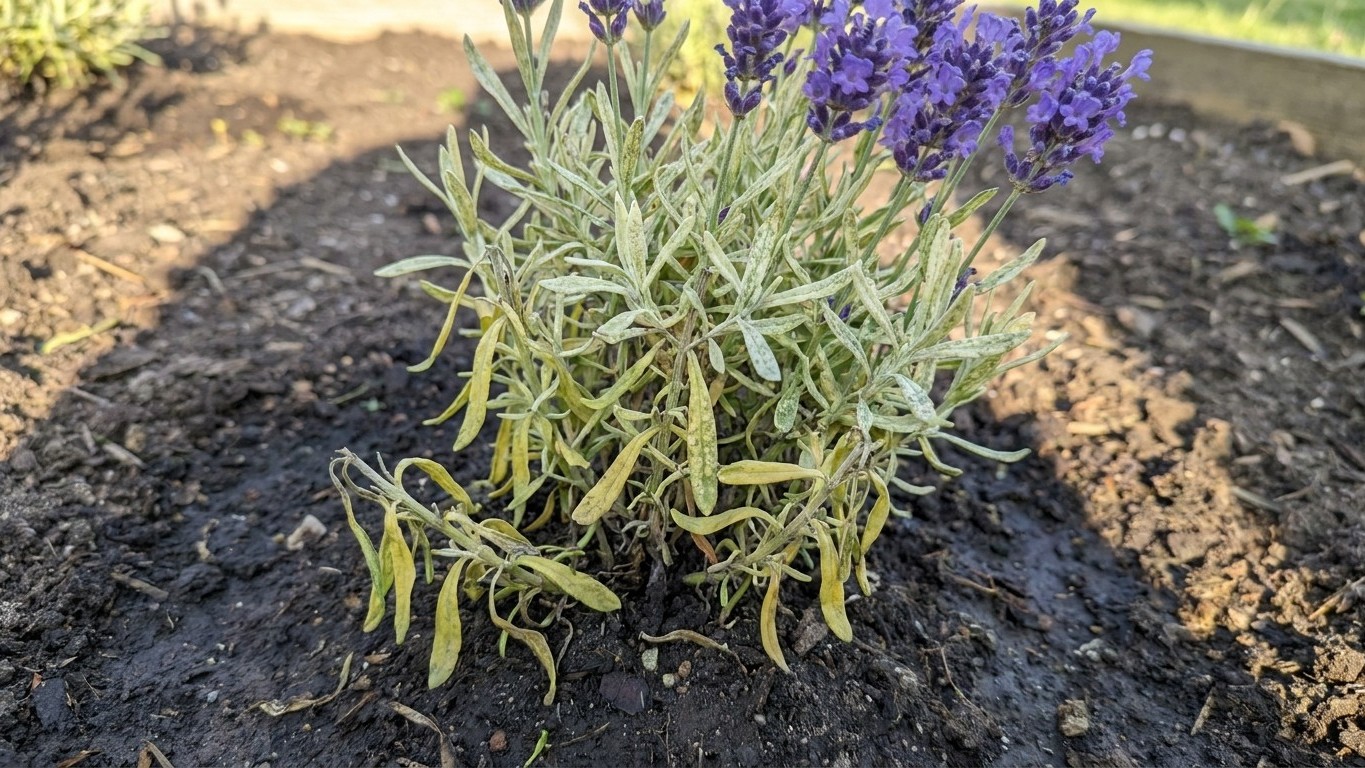
Late July, and your lavender bed looks like it caught a fever: silvery leaves fading to a sickly yellow, right when the plant should be at its purple, fragrant peak. Most gardeners blame the heat wave and move on. That’s the mistake. Yellowing in high summer usually points to something happening underground, in the roots, long before the leaves ever show a symptom.
Key takeaways
- Your lavender isn’t thirsty in July heat—it’s being killed by the kindness of extra watering
- Root rot can establish in as little as 2–3 weeks, but the yellowing you see is already late-stage damage
- One diagnostic test with your hands tells you everything: check if roots are firm and white, or dark and mushy
The Real Culprit Isn’t the Sun
Heat stress does exist, and it does turn leaves pale during a scorching afternoon. But extreme temperatures, both hot and cold, can stress lavender, and during a heatwave, leaves may yellow as a sign of overexertion. That kind of yellowing tends to be uniform, temporary, and it recovers once the weather cools. The pattern to actually worry about is different: yellowing that starts low on the plant and creeps upward, leaves that feel limp rather than crispy, and stems that stay yellow even after a cool morning.
Yellowing leaves may look pale, limp, or even slightly translucent, usually starting at the lower part of the plant before spreading upward. That progression matters. It’s the signature of water damage happening at root level, not sun damage happening at leaf level. And late July is exactly when it shows up, because it’s the season when well-meaning gardeners water more often “just to help the plant through the heat”, which is precisely the opposite of what lavender needs.
Root Rot: The Silent Killer Behind the Yellow
Lavender evolved in the rocky, sun-baked soils of the Mediterranean. It grows in fast-draining, alkaline soils and rarely sees waterlogged conditions in its native range. Transplant that same plant into a clay-heavy backyard bed or a container without proper drainage holes, and you’ve created a completely different environment, one the plant has no evolutionary tools to handle.
When grown in heavy clay, overwatered containers, or low-lying beds, the roots cannot access oxygen and begin to break down, and waterlogged soil starves roots of oxygen, causing the plant to absorb water but fail to transport nutrients. That’s the mechanism behind the yellow leaves: the plant isn’t thirsty, it’s drowning, and its roots have lost the ability to move water and nutrients up to the foliage even though the soil is soaked.
The pathogens responsible have names that sound almost clinical: Root rot is caused primarily by Phytophthora and Pythium species, water mould pathogens that thrive in saturated soil. These aren’t rare, exotic diseases. They’re common soil organisms that stay dormant in dry conditions and explode into activity the moment conditions turn wet, whether from a heavy rain spell, a sprinkler system running too often, or soil that simply doesn’t drain.
What’s striking is how fast this can develop. Root rot can establish within 2–3 weeks of sustained waterlogging. That’s barely more time than it takes to go on vacation and come back to a bed that looks entirely different. And by the time the yellowing is visible on top, the damage below is often already well underway.
How to Check What’s Really Going On
The good news: diagnosing the problem takes about two minutes and no special tools. Gently pull the plant, or at least a section of its root ball, and look. Pull the plant gently; healthy lavender roots are white to pale tan, firm, and fibrous. If instead you find dark, mushy roots with a foul odor, that confirms root rot rather than simple heat stress or a nutrient gap.
If the roots still look healthy, the yellowing may instead trace back to something simpler: compacted soil blocking nutrient uptake, or a mild deficiency. Nutrient deficiencies, most often nitrogen, magnesium, or iron, can cause leaves to turn yellow while the veins remain green. That pattern, yellow flesh with green veins, is a useful way to rule out root rot before assuming the worst.
What to Do Once You Catch It
If root rot is confirmed, speed Matters More Than perfection. Stop watering immediately and do not water again until the soil is completely dry to a depth of 2 inches. For container plants, check that nothing is blocking the drainage holes at the bottom of the pot. For plants in the ground, the fix is more physical: dig in coarse horticultural grit, at least a bucketful per plant, and raise the planting level by 4 to 6 inches to improve drainage.
One instinct to resist: reaching for fertilizer. It feels like the responsible thing to do for a struggling plant, but it backfires here. Do not add fertiliser to a yellowing lavender, since nitrogen encourages lush leafy growth at the expense of roots, worsening the problem. The plant doesn’t need feeding. It needs air around its roots and dry soil, full stop.
Timing also determines whether the plant can be saved. This is early-stage root rot, still recoverable if caught quickly when the damage hasn’t reached the crown yet. But root rot is the most serious lavender problem and is almost always fatal if it reaches the main stem crown. That’s the real reason to take late-July yellowing seriously instead of shrugging it off as a heat wave side effect: a plant that could bounce back with a week of dry soil in early August might be unsavable by Labor Day if the rot has already reached its base. A five-minute root check now can be the difference between a lavender bed that blooms again next June and one you’ll be replacing from scratch.
Sources : greg.app | agribotix.com