
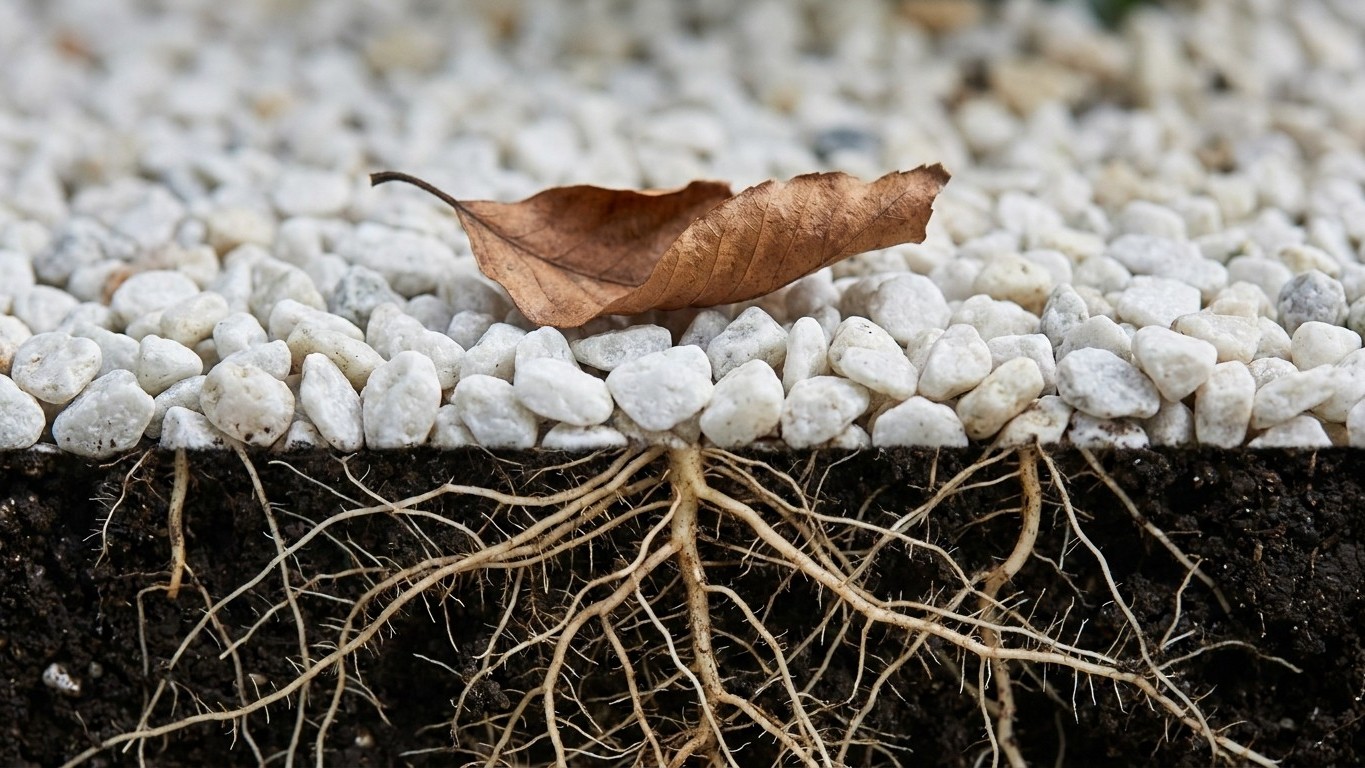
Ten days after dousing the gravel with white vinegar, the weeds came back. Not all of them, but enough to make the exercise feel pointless. The leaves had browned and curled within hours, sure. But underneath the stones, something had survived the whole ordeal and was already pushing green shoots back toward the light.
That something is the root system. The active ingredient in vinegar, acetic acid, works as a rapid-acting, non-selective contact killer that penetrates the cells of leaves and stems. When applied to plant foliage, the acid ruptures cell membranes, causing a rapid loss of moisture and a “burn-down” effect where the plant wilts within hours. Visually, it looks like a total win. A weed that was thriving in the morning is a crispy brown husk by afternoon. The problem is what that speed conceals.
Key takeaways
- Vinegar burns weeds from above but never reaches the roots storing energy underground
- What looks like total victory in hours becomes regrowth in days when root systems tap into reserves
- The ‘natural’ weed killer you thought was safer can actually be more toxic than the synthetic alternatives
Why the burn never reaches the roots
This mechanism is not systemic, meaning the acetic acid never travels through the plant’s vascular system down to the root. Vinegar kills on contact and nothing more. It has no ambition beyond the leaf it touches. That’s precisely why gravel paths and driveways, riddled with cracks where taproots run deep and undisturbed, are the worst possible battlefield for this method. The rapid action of acetic acid is generally insufficient for perennial weeds such as dandelions or bindweed, which possess deep taproots or extensive underground rhizomes that store significant energy reserves, and even after the vinegar destroys all visible foliage, the root system remains largely unaffected, using its stored energy to regrow new shoots.
A gardening researcher who ran his own field test described it bluntly after spraying grocery-store vinegar on crabgrass and spurge growing through driveway cracks: “it was more effective than I expected.” But that success story comes with an asterisk. The scientific evidence shows vinegar does not kill larger weeds with established roots, though it can have an effect on seedlings. Young, tender growth with shallow, fibrous roots dies for good. A mature dandelion with a taproot diving eight inches into the subsoil under your gravel barely notices the inconvenience.
What’s actually surviving under the stones
Three things persist beneath that layer of gravel, and none of them show up until the vinegar has evaporated. First, the taproots and rhizomes themselves, untouched by a treatment that never made it past the leaf surface. Second, the seed bank sitting dormant in the soil, waiting for the next rain to trigger germination, since vinegar leaves weeds free to regrow from remaining roots or seeds if they’re not properly removed. Third, and less visibly, the soil chemistry itself starts working against you. Vinegar concentrates sprayed onto soil work by lowering the pH to a level where plants can’t survive, an acidifying effect that lasts from several months to a year depending on soil type and weather.
That acidified window matters, because once the soil pH drops, taproots eventually starve, but before dying they often produce one last flush of growth from nutrients stored in the roots. That’s exactly the ten-day surprise: a dying root system throwing Everything it has left into one final push of visible growth, right when you thought the job was done. For genuinely woody perennial weeds, that dying process can take up to six months, which explains why an annual spring pour never actually resolves anything long-term.
The concentration trap and a smarter approach
Household vinegar, the stuff sitting in your pantry at roughly 5 percent acetic acid, is genuinely weak medicine for gravel weeds. Household vinegar at 5% acetic acid is a contact burndown agent that damages above-ground tissue on young, tender weeds but does not translocate to roots. Horticultural strength, sold at 20 to 30 percent, hits much harder, with an 85-100% kill rate reported in some trials. But that jump in potency comes at a real cost to the person holding the sprayer. UC IPM notes that 20% acetic acid is corrosive, capable of causing chemical burns to skin, permanent eye damage, and respiratory irritation, making it more dangerous to handle than many synthetic herbicides. That’s worth sitting with for a moment: the “natural” alternative can be riskier to your own body than the chemical you were trying to avoid. In fact, one comparison of toxicity data found the oral LD50 in rats for glyphosate is 4320 mg/kg, which is less toxic than vinegar at 3310 mg/kg.
The good news for anyone worried about long-term soil damage is that the punishment doesn’t last. Acetic acid breaks down quickly in the environment, is both volatile and readily biodegradable, with a half-life of around 1 to 10 days depending on the weather, since soil microbes quickly metabolize it into carbon dioxide and water. Rain speeds that recovery along. So the gravel bed isn’t permanently poisoned. It’s just temporarily reset, which is exactly why the same weeds, or their neighbors from the seed bank, show up again next spring on schedule.
For gravel specifically, the fix that actually holds isn’t a stronger spray, it’s addressing what’s underneath the stones in the first place. The most effective long-term strategy combines 3 to 4 inches of wood chip or straw mulch with hand-pulling, and for persistent perennial weeds, sheet mulching with cardboard and wood chips smothers them over one to two seasons. Landscape fabric under fresh gravel, refreshed every few years as it degrades, does more to block that seed bank than any acid ever will. Vinegar can still earn its place in the shed, as a quick knockdown for the seedlings that pop up between applications, but treating it as a one-and-done spring ritual for gravel weeds is asking a leaf-level tool to solve a root-level problem.
Sources : ruralsprout.com | gardenerbible.com