
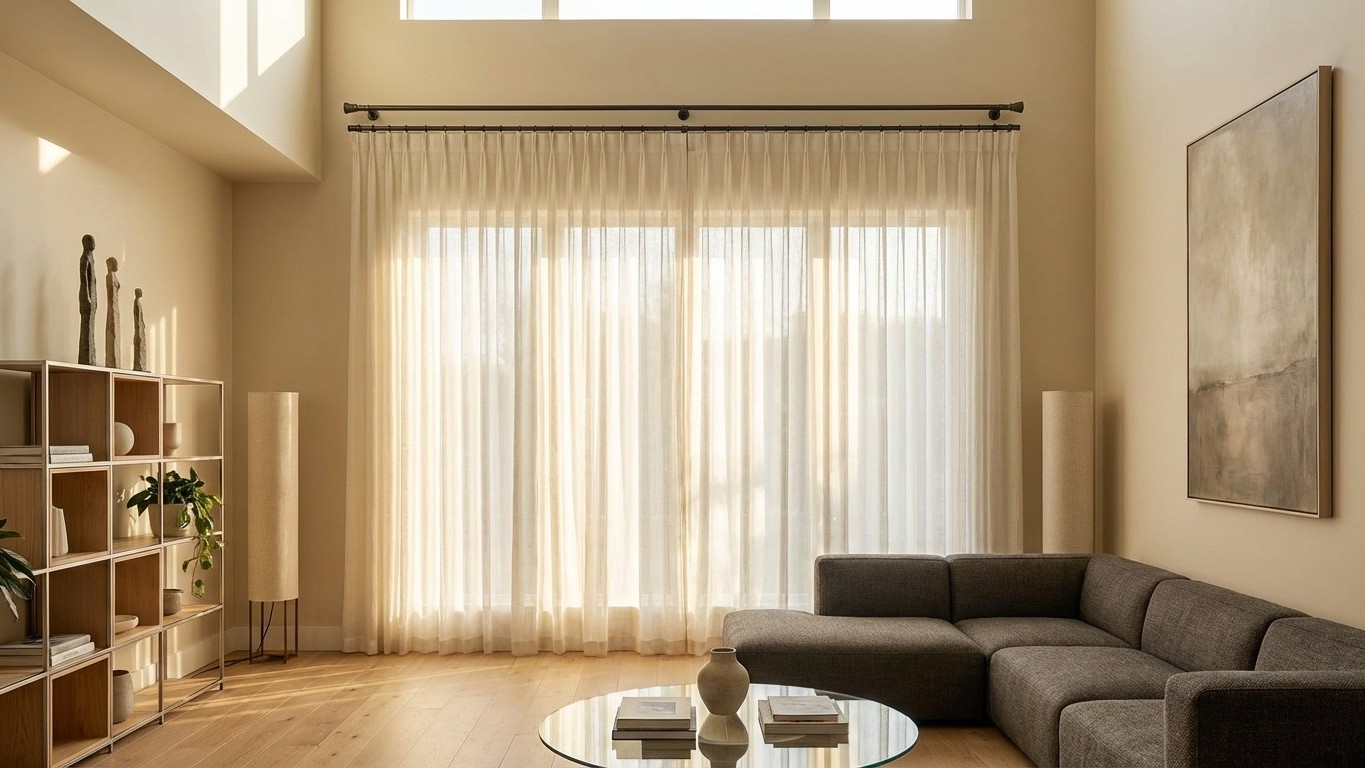
Staring at my living room one evening, I found myself blaming the ceiling for its lack of presence. It pressed down, or so it seemed, muting the space with an invisible weight. False culprit, it turns out. The real culprit? The curtain rod, positioned like a brow too low on a worried face, casting a shadow over every attempt to let light and airiness into the room.
“Hang your curtain rod higher. Higher than you think,” the designer advised. Not just a random tip, but a keystone of space perception. Suddenly, years of subtle discomfort snapped into focus. And the best part? No need for renovations, scaffolding, or architectural wizardry, only a tape measure, willpower, and a modest step stool.
Key takeaways
- Why your ceiling might not actually be the problem you think it is.
- The Surprising ruler-and-rod formula that unlocks vertical space.
- How a small shift in curtain placement can change the whole room’s mood.
The Optical Illusion Above Your Head
Human eyes are hungry for verticality. Walk into a grand hall, notice your attention climb to the rafters. Yet in most homes, curtain rods often squat a few inches, sometimes barely the length of a stapler, above the window frame. The result is a chopped horizon. Every window visually shrinks, and with it, the room loses its breath. Architects call this “visual compression”, a crime committed thousands of times a day in apartments and houses across the country.
Raise the curtain rod closer to the ceiling, six inches, even a foot or more if there’s room, and something magic happens. The room grows. Walls stretch, windows soar, and, almost imperceptibly, the very air feels lighter. It’s the home-decor equivalent of a great posture correction: same bones, new presence.
How High Is High Enough?
Here’s the basic rule: mount curtain rods about halfway between the top of the window and the ceiling, or at least four to six inches above the window trim. Got less than a foot between ceiling and frame? Go as high as you can Without crowding the cornice. For rooms with generous ceilings, extending almost to the very top (an inch or two below the crown molding) dial up the feeling of grandeur.
Of course, exceptions exist. In prewar apartments with extravagant moldings, the rod should never slice through a detail. Instead, tuck it right below the thickest molding or, in rare cases, just above it for a layered look. Modern minimalists often favor rods nearly flush with the ceiling, an invisible line that lets the drapery fall like fabric waterfalls.
Yes, Length Matters
Height alone isn’t the only factor. The width of the rod also plays a secret supporting role. If your rod barely edges past the window, drapes stack up and block precious light. The fix? Extend the rod at least six to twelve inches beyond each side of the frame. Now, when the curtains pull back, glass is fully exposed, sun streams in, and windows look wider, sometimes double their original impression.
Small changes, big payoffs. Imagine a row of dominoes: shift one, the whole scene transforms. This simple rod placement quietly recalibrates space, like tailoring a suit so the shoulder seams finally align.
The Science (and Psychology) of Vertical Space
Ceilings have long played with our emotions. Studies suggest rooms with higher ceilings inspire creative thinking and a sense of freedom, while low ceilings can evoke coziness, but also, for some, a creeping closeness or restlessness. Without moving a single wall, adjusting how our eyes travel upward changes how we feel at home. It’s the architectural equivalent of wearing stripes: vertical for height, horizontal for width.
Interior Designers have known this curtain trick for decades. Even hotel rooms, which often juggle modest floorplans, rely on high-mounted curtains to inject luxury and drama. The best part: you can borrow this trick for the cost of a lunch out. No wonder so many before-and-after Instagram reels feature a masked drill-sergeant of a decorator, rod in hand, banishing low-hung lines to oblivion.
A quick trip through American suburbs doesn’t lie. In newly built houses, developers often opt for extra-tall windows paired with high curtain rods, while older homes (think 1950s ranches or GIs’ postwar bungalows) cling to their modest proportions and outdated mounting habits. Yet, even these can be coaxed into vertical elegance, with nothing but a new mounting bracket.
Real-Life Results: A Curtain Call
I tested the theory in my own home. The experiment? Raising the curtain rods by eight inches in the living and bedroom. Result: a neighbor who’s never noticed my décor before stopped by and asked if I’d “done something major.” Same furniture, walls, Everything, except the shifting of a simple metal pole. The entire room radiated lift and calm, as if it had drawn a deep breath.
This isn’t just for living rooms. Bedrooms benefit too, a taller drape adds hotel-like luxury. Even home offices feel sharper, the vertical lines echoing productivity and focus. Not surprisingly, designers often encourage clients renting apartments to make This Simple Change first—curtains are easy to move and reverse, still delivering the illusion of custom architecture.
A quick caveat: longer curtains will be required. Measure from the new, elevated rod position to just above the floor, not to the bottom of the window. The most luxurious look? Curtains that kiss the floor, or even puddle slightly (half an inch to an inch). Hemming iron-on tape and a basic set of drapery hooks make the job quick, and unburdened by sewing skills.
Sometimes, it really is one rule away from transformation. The world’s most elegant homes didn’t get there with unlimited budgets, but with a handful of architectural sleights-of-hand that open up possibility and light. You don’t need to move; you need to look up.
Now, walking into my once-oppressed rooms, the ceilings have grown, the windows have stretched, and the entire place feels like it just lifted itself onto its toes. It’s easy to wonder: If such a small tweak can change how we experience home, what other overlooked “rules” are quietly shaping our days?