
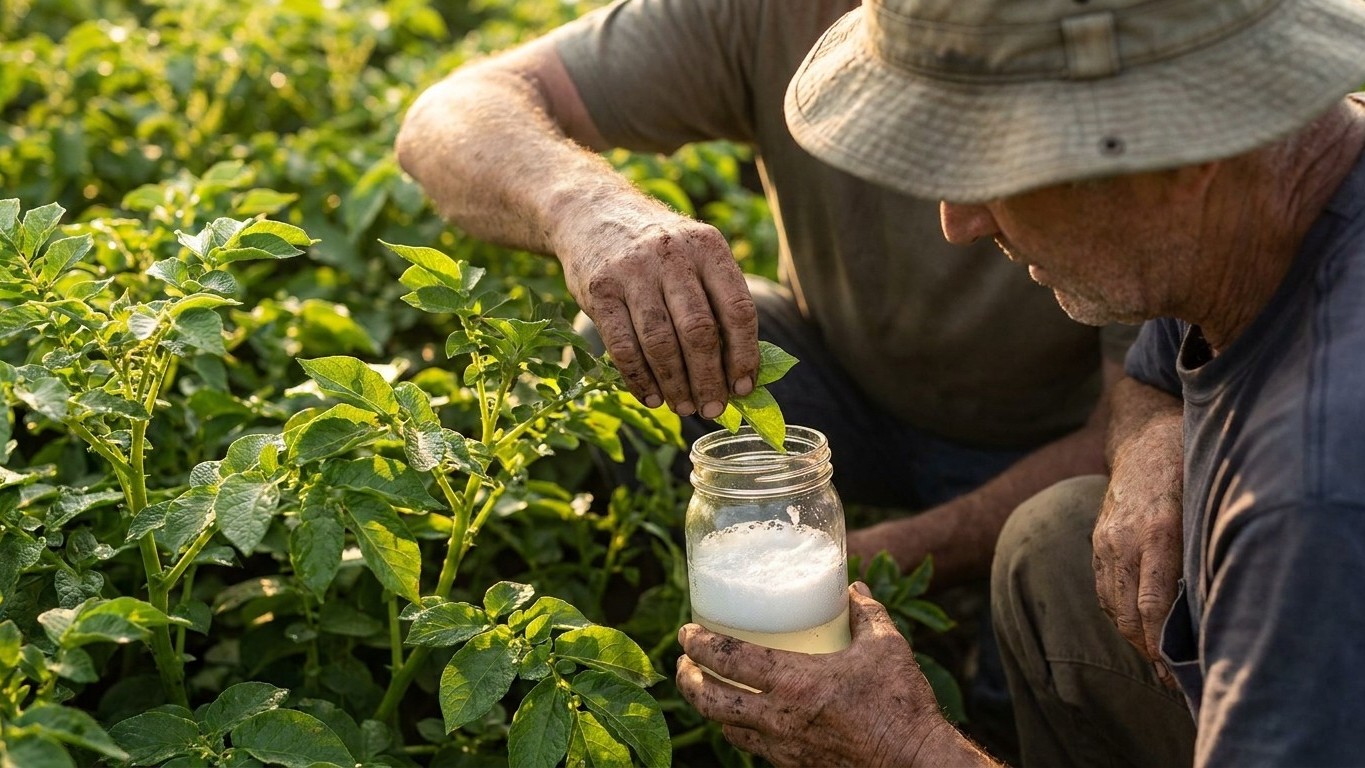
My grandfather never explained himself. Every July morning, bucket in one hand, he’d walk the same fifteen rows of potatoes, bend down every few feet, and drop something small into the water. I assumed it was superstition, maybe a habit left over from harder decades. It wasn’t. He was hunting Colorado potato beetles, and that bucket was the only reason his plants made it to harvest while a neighbor’s collapsed into skeletons of stems by August.
The insect responsible for that kind of destruction has a name that sounds almost too on-the-nose: the Colorado potato beetle, Leptinotarsa decemlineata. A leaf beetle native to the Southwestern U.S. and Mexico, it was first described in 1824 by Thomas Say near the Colorado Rockies and has since spread across North America, Europe, and Asia, becoming one of the most destructive defoliators of potato crops. What makes it dangerous isn’t brute strength. It’s persistence, and an almost comic ability to outsmart whatever humans throw at it.
Key takeaways
- One overlooked detail about July changes everything: it’s when the second wave of beetles emerges AND when potato plants can least afford to lose leaves
- A single female beetle can lay 300-800 eggs per season—do the math on what happens if you miss one week in mid-July
- The method your grandfather used is backed by modern research, and it costs almost nothing
A Bug That Never Really Loses
What makes the Colorado potato beetle such a formidable pest is its extraordinary ability to adapt to unfavorable conditions, surviving by burrowing underground during heat or cold, feeding on other nightshade plants when potatoes aren’t available, and developing resistance to insecticides, having evolved resistance to over 50 different products, often within just a few years of their introduction. That last part explains why so many gardeners spray, see the beetles vanish for two weeks, and then watch them return as if nothing happened.
The real damage doesn’t come from the adults, oddly enough. Larvae can consume about four times more leaf mass than adults do, so feeding by larvae is far more damaging than feeding by the beetles themselves. A single female can produce an alarming number of future defoliators in one season: a single adult female can lay up to 300-800 eggs in her lifetime, in clusters of 20 to 30 yellow eggs on the underside of potato leaves. Do the math and one overlooked egg mass becomes dozens of hungry larvae within about a week, since larvae emerge about 4-10 days after eggs are laid.
Why July Is the Month That Decides Everything
This is where my grandfather’s timing stops looking like superstition and starts looking like strategy. The pupal stage lasts 5-10 days, and first-generation adults start to emerge in July. Translation: just when a home gardener thinks the worst is behind them, a fresh wave of beetles crawls out of the soil, ready to mate and start the cycle over. One extension source puts it plainly, noting that the second generation of adults will emerge around mid-July.
The stakes are also highest at exactly this point in the growing season. Potato plants can shrug off a Surprising amount of leaf loss early on, but that tolerance evaporates during a narrow window. Leaf feeding has the greatest effect on yields if it occurs during tuber formation and while tubers are bulking, near the period of full bloom, while feeding before or after that time is less damaging to yield. Miss that window and even a modest infestation can shrink a harvest. Catch it, and the plant barely notices. That’s the entire secret behind a man with a bucket walking rows in July instead of June or September: he wasn’t being paranoid, he was hitting the exact moment the crop couldn’t afford to lose leaves.
The Bucket Isn’t Just a Bucket
Soapy water is the unglamorous engine behind this whole method. The larvae and adults can be removed and placed in a container filled with water and a few drops of dish soap, which breaks the water’s surface tension so the insects sink rather than escape. No pesticide, no resistance risk, no cost beyond a squeeze of dish soap.
Timing the walk matters almost as much as doing it. Picking is easiest early in the day when the beetles are cold and slow to move. That’s likely why grandfather was always out there before the coffee had time to cool, not lounging through the afternoon. Once in the rows, the technique is simple but has to be thorough: collect the beetles in a wide-mouth jar, coffee can, or deep baking pan half full of soapy water, place the container below leaves with beetles or larvae and shake the plant so the insects fall in and drown, and squish any larvae and egg masses found directly on the leaves.
Consistency is the part people underestimate. This isn’t a once-a-season chore. Extension guidance recommends scouting fields weekly, or every 3-4 days during periods when rapid population growth is likely, such as when eggs are hatching or numbers approach economic thresholds. A missed week in mid-July, right as that second generation emerges, is exactly when a patch can go from thriving to shredded in a matter of days.
What Else Belongs in the Routine
Hand-picking works best paired with a few habits that cost nothing extra. Checking leaf undersides Matters More Than checking tops, since eggs are deposited on the underside of leaves in masses of 20 to 30 and are covered with a waxy film. For larger infestations or busier weeks, Bacillus thuringiensis var. tenebrionis is a bacterial product that kills young larvae and works best when applied while larvae are still small. And because the beetles overwinter right in the dirt, removing old plants and weeds in and around potato plots before, during, and after the season eliminates food sources for the ones waiting to emerge next spring.
My grandfather never used the phrase “economic threshold” or knew the beetle’s Latin name. He just knew that fifteen minutes with a bucket, done religiously in July, beat any amount of regret in August. Modern research has simply put numbers and names to what he figured out through decades of trial: the plant can take a hit almost any month of the year, except this one.
Sources : gardensthatmatter.com | cals.cornell.edu